1
1
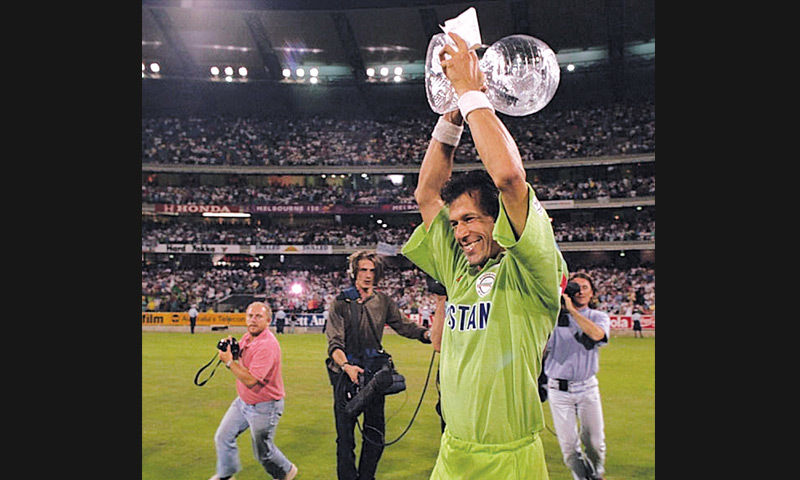

The fifth World Cup, held in Australia and New Zealand, was the edition which radically changed the character of the event. Cricketers dressed up in coloured kits bowled with white balls and played under floodlights. That this had been initiated in Australia some 15 years ago by Kerry Packer and adopted by the Australian Cricket Board (ACB) in 1979 showed just how much the International Cricket Council (ICC) had paddled against the flow to keep such innovations at arm’s length in World Cups.
There were other innovations as well; New Zealand brought in the novel concept of opening the bowling with a spinner and England opened with a pinch hitter in the form of Ian Botham, the mercurial all rounder who always batted in the middle. The organisers also did away with groups and all the teams played each other in a league-based format. Then there was the rain rule that ironically would come to haunt the organisers. Australia was a reluctant host and was in fact pushed into jointly hosting the Cup with New Zealand; the compromise was that the Australians held it after their entire season of international commitments ended. Then it invited more trouble as the Australian Cricket Board(ACB) had taken on a tobacco sponsor, something to which the Australian government objected but eventually acquiesced after they were told that rejecting the sponsor meant there would be no tournament.
Perhaps the biggest news in this World Cup was the return of South Africa to the international competition on the special request of Nelson Mandela, who felt that since the process of reconciliation had begun in apartheid-ridden South Africa, the cricket team would be a great advertisement for a new and tolerant South Africa. The team remained an all White combination of course, but as a token gesture one Omar Henry, a 40-year-old non-White, was selected in the squad.
The Australian Cricket Board, quick to see its marketability, re-tailored the schedule to fit in a ninth team and the South Africans naturally invited curiosity as well as anticipation. The world was introduced to the young Allan Donald and Jonty Rhodes alongside stalwarts like Peter Kirsten and Kepler Wessels who captained the side. Kepler thus became the first player to play for two Test sides in the World Cup. He had represented Australia in the early 1980s before going back to his native South Africa.
Licking their wounds from the previous World Cup Imran Khan’s cornered tigers ambushed the world
Australia were the ostensible favourites, reigning world champions, and playing at home on surfaces which all touring teams found totally alien. Under Allan Border the young ones of ’87 like Dean Jones and David Boon had matured into top class cricketers over five years and they had their pace attack led by the young hero of that triumph in India, Craig McDermott. They were unfortunately to feel the full impact of the host’s curse, losing to co-hosts and weaker team New Zealand in their opening game and then to South Africa and Pakistan. They were dethroned in the worst way possible, not being able to reach the last four despite winning their last match against West Indies, who again failed to reach the semi-finals by losing that last game.
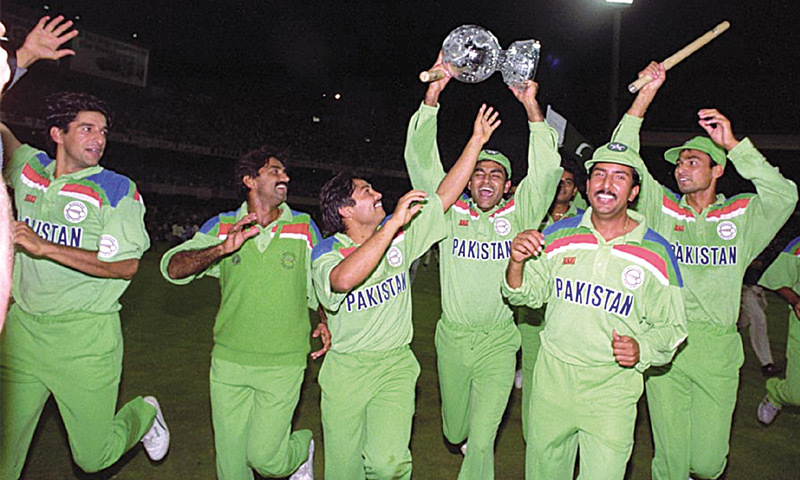 |
| ‘We rule the world!’ |
New Zealand under Martin Crowe nevertheless took full advantage of the home conditions and remained unbeaten until their last two games, which unfortunately mattered most. Both games were against Pakistan and their first defeat in the last league game allowed Pakistan to fancy a last four place when all had seemed lost for them after their first five games into the tournament. Their second was in a semi-final against the same team they had allowed breathing space to.
Sri Lanka and Zimbabwe, despite the former being a Test-playing nation since the past 10 years, were simply rolled over by the other sides and India, despite having been in Australia over the past several weeks, ran out of steam after giving the hosts a scare and losing by a whisker. But they managed to win the final of the Sub Continent by beating Pakistan. They scored only 216 but bowled out Pakistan for 173.
England considered themselves unlucky again, reaching their second successive final, their third overall and then being pipped at the post. As one writer wrote: “Will they always remain the bridesmaid and never the bride?” Ironically, they may not have faced Pakistan in the final had their league match against them not been rained off. Pakistan had collapsed to 74 all out in their league game against the English and England were 24-1 after 8 overs when the rains came. That allowed Pakistan to salvage a point in the abandoned game.
But what has never been considered is that had rain not fallen when Pakistan were well placed at 74-2 needing less than 5 an over to overcome South Africa’s 211, Pakistan would have finished with an additional point even if they had lost to England. After play restarted following rain the target had been reduced by 18 runs but 14 overs had been deducted! Pakistan remained short of the adjusted target by only 20 runs with two wickets left.
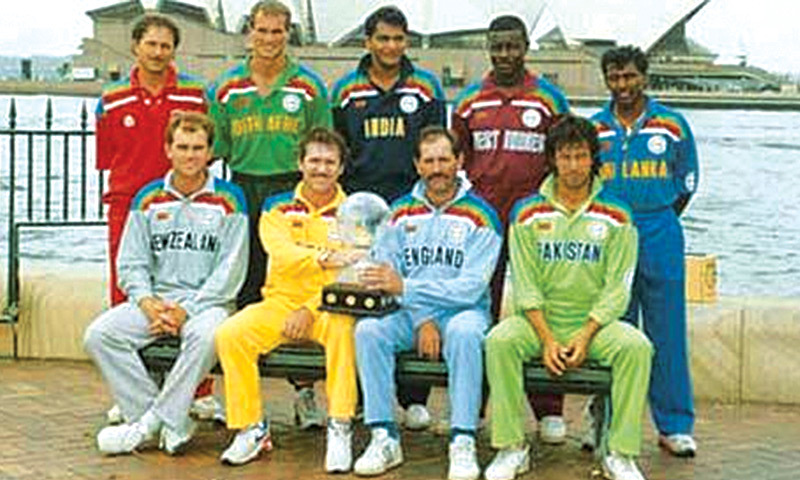 |
| The nine team captains |
Indeed the convoluted rain rule ruined many a game, not least of it the semi-final between England and South Africa. Chasing England’s 252 South Africa needed 22 off 13 balls with two well set batsmen and four wickets in hand. But after a brief downpour of 12 minutes the reports came in that two overs had been docked but only 1 run reduced from the target. That meant 21 off 1 ball! The body language of even the England players was embarrassing at this victory.
But to come back to Pakistan, they deserved to win. Their turning point had been the game against Australia, where Imran coined his famous ‘cornered tigers’ mantra and told his young lot that they would be winning everything from here on in. Imran walked in to toss wearing a white T-shirt with a roaring tiger printed on it. They scored 220-8 with Aamer Sohail fetching 76 at the top and then a blitz of superb swing and spin bowling by Wasim Akram (2-28), Aaqib Javed (3-21) and Mushtaq Ahmed (3-41) cut down the hosts from 116-2 to 130-6 and then to 172 all out.
Their most remarkable Pakistani wins were of course reserved for the two knockout games where a young lad by the name of Inzamam ul Haq introduced himself to his countrymen at a time when Pakistan seemed to have lost the semi-final. New Zealand had racked up 262-7 and Pakistan started slowly, with Imran Khan stepping up to No.3 to take control of the mid pitch strategy after a slow but sedate start by Aamer Sohail and Ramiz Raja. When he left for a 93-ball 44 Pakistan needed more than 8 an over. Enter Inzamam, with the walk of a man who seemed bored with life. But by the time he left for a speedy 60 off 37 balls, Pakistan needed another 35 off the last five and crossed over with an over to spare.
How they won the final is indelibly etched in the minds of those who saw it. Pakistan batted first this time but the layout of the innings mirrored how their innings progressed in the semi-final: a slow start, then Imran coming in at No.3 and featuring in a long drawn out partnership with Miandad with it all finishing with another express batsmanship from Inzamam. It will also be remembered for those two mind-boggling deliveries from Wasim Akram, both bowled from round the wicket. The first angled in toward leg stump and straightened up after pitching on middle to clip Allan Lamb’s off stump; the second hurtling in from well outside off to whistle past Chris Lewis as he clamped down desperately and unsuccessfully on what must have seemed a blur to him.
When Imran finally lifted the World Cup it still didn’t sink in. Pakistan had gone into the World Cup without Waqar Younis and almost without Miandad who flew in at the last minute after half recovering from a stomach infection. That he still suffered from it when he scored a fifty each in the semi-final and final and yet finished the second highest scorer in the tournament was a tribute to his tenacity. But it also symbolised what the entire Pakistan team stood for: a will to win against all odds inspired by a great leader who believed in victory even when all had seemed lost.
ICC World Cup — 1992
Teams: 9
Games: 39 in 33 days
Hosts: Australia and New Zealand
Venues: 18
Format: A league stage in which every team played every other. Top four qualified for the semi-finals, followed by a final
Winners: Pakistan; Runners-up England
Man of the Series: Martin Crowe (New Zealand)
Attendance for final: 87,182
Match summaries
1st match — New Zealand v Australia at Eden Park, Auckland on Feb 22 — New Zealand won by 37 runs
2nd match — England v India at W.A.C.A. Ground, Perth on Feb 22 — England won by 9 runs
3rd match — Sri Lanka v Zimbabwe at Pukekura Park, New Plymouth on Feb 23 — Sri Lanka won by 3 wickets (with 4 balls remaining)
4th match — Pakistan v West Indies at Melbourne Cricket Ground, Melbourne on Feb 23 — West Indies won by 10 wickets (with 3.1 overs remaining)
5th match — New Zealand v Sri Lanka at Seddon Park, Hamilton on Feb 25 — New Zealand won by 6 wickets (with 1.4 overs remaining)
6th match — Australia v South Africa at Sydney Cricket Ground, Sydney on Feb 26 — South Africa won by 9 wickets (with 2.1 overs remaining)
7th match — Pakistan v Zimbabwe at Bellerive Oval, Hobart on Feb 27 — Pakistan won by 53 runs
8th match — England v West Indies at Melbourne Cricket Ground, Melbourne on Feb 27 — England won by 6 wickets (with 10.1 overs remaining)
9th match — India v Sri Lanka at Harrup Park, Mackay on Feb 28 — No result
10th match — New Zealand v South Africa at Eden Park, Auckland on Feb 29 — New Zealand won by 7 wickets (with 15.3 overs remaining)
11th match — West Indies v Zimbabwe at Brisbane Cricket Ground, Brisbane on Feb 29 — West Indies won by 75 runs
12th match — Australia v India at Brisbane Cricket Ground, Brisbane on March 1 — Australia won by 1 run (revised target)
13th match — England v Pakistan at Adelaide Oval, Adelaide on March 1 — No result
14th match — South Africa v Sri Lanka at Basin Reserve, Wellington on March 2 — Sri Lanka won by 3 wickets (with 1 ball remaining)
15th match — New Zealand v Zimbabwe at McLean Park, Napier on March 3 — New Zealand won by 48 runs (revised target)
16th match — India v Pakistan at Sydney Cricket Ground, Sydney on March 4 — India won by 43 runs
17th match — South Africa v West Indies at AMI Stadium, Christchurch on March 5 — South Africa won by 64 runs
18th match — Australia v England at Sydney Cricket Ground, Sydney on March 5 — England won by 8 wickets (with 9.1 overs remaining)
19th match — India v Zimbabwe at Seddon Park, Hamilton on March 7 — India won by 55 runs (revised target)
20th match — Australia v Sri Lanka at Adelaide Oval, Adelaide on March 7 — Australia won by 7 wickets (with 6 overs remaining)
21st match — New Zealand v West Indies at Eden Park, Auckland on March 8 — New Zealand won by 5 wickets (with 1.3 overs remaining)
22nd match — Pakistan v South Africa at Brisbane Cricket Ground, Brisbane on March 8 — South Africa won by 20 runs (revised target)
23rd match — England v Sri Lanka at Eastern Oval, Ballarat on March 9 — England won by 106 runs
24th match — India v West Indies at Basin Reserve, Wellington on March 10 — West Indies won by 5 wickets (with 5.4 overs remaining) (revised target)
25th match — South Africa v Zimbabwe at Manuka Oval, Canberra on March 10 — South Africa won by 7 wickets (with 4.5 overs remaining)
26th match — Australia v Pakistan at W.A.C.A. Ground, Perth on March 11 — Pakistan won by 48 runs
27th match — New Zealand v India at University Oval, Dunedin on March 12 — New Zealand won by 4 wickets (with 1.5 overs remaining)
28th match — England v South Africa at Melbourne Cricket Ground, Melbourne on March 12 — England won by 3 wickets (with 1 ball remaining) (revised target)
29th match — Sri Lanka v West Indies at Berri Oval, Berri on March 13 — West Indies won by 91 runs
30th match — Australia v Zimbabwe at Bellerive Oval, Hobart on March 14 — Australia won by 128 runs
31st match — New Zealand v England at Basin Reserve, Wellington on March 15 — New Zealand won by 7 wickets (with 9.1 overs remaining)
32nd match — India v South Africa at Adelaide Oval, Adelaide on March 15 — South Africa won by 6 wickets (with 5 balls remaining)
33rd match — Pakistan v Sri Lanka at W.A.C.A. Ground, Perth on March 15 — Pakistan won by 4 wickets (with 5 balls remaining)
34th match — New Zealand v Pakistan at AMI Stadium, Christchurch on March 18 — Pakistan won by 7 wickets (with 5.2 overs remaining)
35th match — England v Zimbabwe at Melbourne Cricket Ground, Melbourne on March 18 — Zimbabwe won by 9 runs
36th match — Australia v West Indies at Melbourne Cricket Ground, Melbourne on March 18 — Australia won by 57 runs
1st semi-final — New Zealand v Pakistan at Eden Park, Auckland on March 21 — Pakistan won by 4 wickets (with 1 over remaining)
2nd semi-final — England v South Africa at Sydney Cricket Ground, Sydney on March 22 — England won by 19 runs (revised target)
The final — England vs Pakistan at Melbourne Cricket Ground, Melbourne on March 25 — Pakistan won by 22 runs
Published in Dawn, Sunday Magazine, January 4th, 2015