0
0
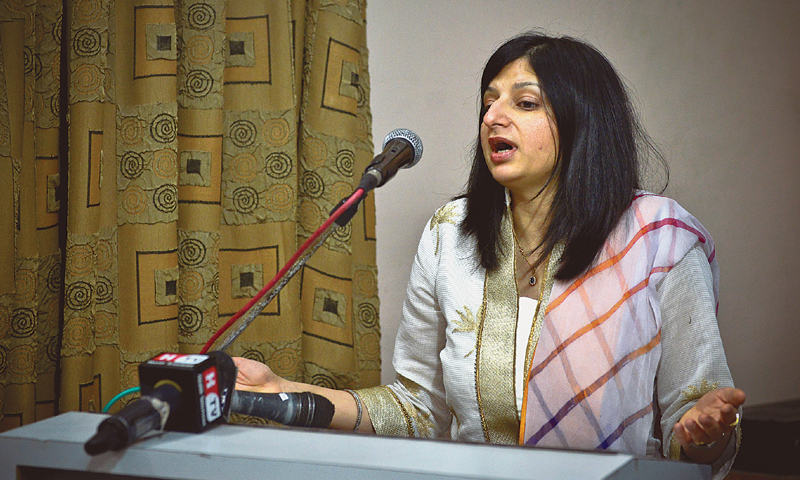

KARACHI: The brand managers of advertising companies are now determining the programming content of television. The media has now become a tool for espousing a particular agenda. Given that private TV networks are increasing in number, there is still dearth of information on the burgeoning television industry.
These views were articulated by speakers at the book launch of The Game Changer — A Brief History of Television in Pakistan, authored by Tanya Anand, at the Karachi Press Club on Wednesday.
With rallies and protests denouncing the horrific Peshawar attack on Tuesday taking place outside the KPC, and several other events cancelled for the day, the event organisers were, however, intent on conducting the launch. Nevertheless, speaker after speaker condemned the terrorist attack.
Highlighting the lack of information pertaining to the local TV industry, Babar Ayaz, journalist and author of What’s wrong with Pakistan?, said he had come across only three books on television and The Game Changer was the fourth one. He added that the author being the progeny of Satish Anand, well-known film and television producer, had access to media owners and thus provided valuable insight in her book.
“Tanya has also mentioned the heavy reliance of advertisers on TV ratings system, which is faulty since people meters installed in 600 households cannot be a good sample size. Consequently, the information gleaned from these meters are heavily relied upon by brand managers who determine the programming content.
Thus, one gets to view dramas that have standard characters, the good suffering woman, the evil, bold woman and so on and so forth.
Similarly, the comedy programmes have little wit and in current affairs shows only those guests are invited who can speak in fiery manner leading to higher TRPs.”
Discussing further the link between TRPs and lowbrow television content, he said that the stakeholders must keep in mind what the author has mentioned in her book. “The British government had once commissioned a white paper on the BBC and came to the conclusion that competition can be achieved without detriment to the quality of programming. However, here competition is catering to the lowest denominator.”
Speaking about the TV revolution, Mr Ayaz said the advent of foreign satellite channels being available through dish, it was the Kargil war in 1999 that compelled General Pervez Musharraf to open up the space of TV broadcast to the private sector in 2000.
“Musharraf felt that PTV had failed to carry out effective propaganda over the Kargil conflict and the private sector would perhaps be more influential.” This, according to Mr Ayaz, was akin to doing the right thing for the wrong reason.
Sultana Siddiqui, the president of Hum TV Network, spoke about her days at PTV where she was renowned for her musical shows and hard-hitting dramas.
“When I joined it was the era of the likes of Aslam Azhar, who were liberal, intellectual and culturally rooted. This gave us the space, but it is a confined one. During Zia’s regime, the space further shrank so much so that we felt suffocated. Unreasonable restrictions were placed.”
She further discussed the opening up of TV space under Musharraf’s era and its pitfalls. “Then came another dictator, Musharraf, who unshackled the space which was great for us. But this was like a genie out of a bottle that was left loose without the stakeholders drawing the line.
"Whatever one may feel about PTV and how it was stuck in a time warp, it did impart to us ethics that has all but been forgotten. It has now become a rat race and the media is for personal use and espousing an agenda.”
There were three primary motivations to write the book, said the author, who is working as a media consultant in London. “I wanted to pay homage to an industry that started off with few resources and professionals. In just under a decade [2001-2009] we went from one channel to 80, which is amazing that we achieved something with such scarce resources.
"The media owners started channels with their hard-earned money in a environment where most offer similar content and heavy reliance on advertising revenue which is limited. These people have survived in these challenging circumstances. Private TV channels have given us a global identity.”
Her other two motivations were the information gap and curiosity to understand the burgeoning TV industry. “Having been asked to speak at colleges and universities on media I was struck by the fact that mass communication students and teachers did not have basic information about the TV industry.
"Then, I had this burning curiosity about this sudden TV explosion. There was so much content to watch now and the advertisers also had a wider choice of distributing their ads.
"During the writing of the book I discovered that every channel owner had to overcome several obstacles. It wasn’t easy for them.
"We must look into our past to aspire for the future. We must aspire to be a global TV player. We have such a long way to go, but we must take it to the next level.”
Published in Dawn December 18th , 2014