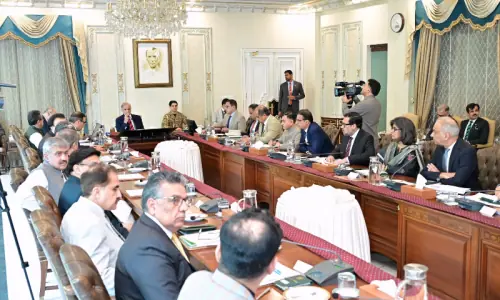
OVER 30 Japanese entrepreneurs held discussions with officials of the Board of Investment earlier this month on investment opportunities at the Bin Qasim Industrial Park in Karachi, which was recently awarded the status of a special economic zone.
The BoI was represented by its Secretary, Imran Afzal Cheema, and Director General (Policy) Dr Raania Ahsan. The Japan International Cooperation Agency (Jica) was represented by its chief representative to Pakistan Mitsuyoshi Kawasaki, and special advisor to BoI Massao Nagasi. Meanwhile, the Sindh BoI was represented by its director Azeem Uqaili, and the National Industrial Parks by its CEO Mohsin Syed and senior marketing official Farhan Baig.
The Japanese entrepreneurs and representatives included those from Yamaha, Toyota, Marubeni Corporation, Otsuka Pharmaceutical, Japan External Trade Organisation and Bank of Toyo, among others.
Countries like China, Turkey and Japan have indicated interest in the special economic zones (SEZs). Meanwhile, Pakistan’s honorary investment counselors in foreign missions have been asked to inform foreign investors about the new SEZ’s facilities and incentives as provided under the law.
The special economic zones are now positioned to meet the global challenge of competitiveness in attracting foreign direct investment
The SEZs are now positioned to meet the global challenge of competitiveness in attracting foreign direct investment (FDI). The law allows the creation of an industrial cluster and offers liberal incentives and infrastructure and investor facilitation services to enhance productivity and reduce the cost of doing business.
The potential investors were informed in the dialogue initiated by Jica that all sectors were open to investment in the SEZ (except for some specified industries), with foreign equity of up to 100pc and no minimum limit on foreign investment, remittance of capital, profits and dividends.
Other incentives included zero-rated import of raw material for export manufacturing and for import of machinery and equipment, as well as a 10-year corporate income tax holiday for investors and for developers of the zone and duty-free import of capital goods for developers and zone enterprises.
The facilities include the provision of gas, electricity and other utilities and captive power generation for developers of the zones.
Yamaha was the first foreign firm that decided to set up a $150m motorcycle manufacturing plant on a 50-acre plot at the Bin Qasim Industrial Park (BQIP). The park is being developed on an area of 930 acres by the National Industrial Parks Development and Management Company, a subsidiary of the Pakistan Industrial Development Corporation.
The Yamaha plant is expected to create 45,000 jobs. The project would lead to a transfer of technology in the manufacturing of motorcycles, and the company would set up training centres for developing vendors’ skills and capacity. It plans to produce motorcycles of above 100cc, which are in global demand.
Published in Dawn, Economic & Business, Sep 15th, 2014