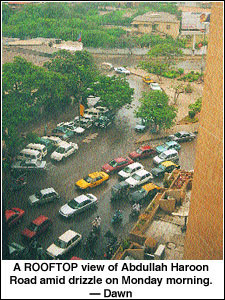
 KARACHI, July 21: City will have no rain during the next two days, as the system working over the last few days has some to an end.
The city, however, would have cloudy weather with chances of drizzle over the period, the met office said.
The temperature in Karachi dropped to 28 degrees from 33.5 degrees centigrade on Monday, as a result of light rain in some areas of the city. Humidity was 69 percent.
On Tuesday, the temperature is expected to remain between 32 and 34 degrees centigrade.
Hyderabad and Mirpurkhas divisions will have hot and dry weather with occasional gusty winds on Tuesday while Sukkur and Larkana divisions will experience hot and dry weather.
Light rain is expected at a few places along with Sindh- Mekran coastal areas during the next 36 hours, whereas thunderstorm and rain is likely to occur at one or two places in Quetta, Kalat, Zhob and Sibi divisions of Balochistan.—APP
Our Staff Reporter adds: The rain received by the city in the current month has been the heaviest in the past seven years. The chief meteorologist at the Pakistan Meteorological
Department, Arif Mehmood, told Dawn that the met office observatory at the airport had recorded a rainfall of 100.9 millimetres from July 1, 2003. He added that the observatory at PAF Masroor Base in Mauripur had recorded a rainfall of 122.5 millimetres in the month of July so far.
Giving a breakdown of rainfall recorded at the airport observatory during the past seven years, Mr Mehmood said that in July 1996 the observatory had received 12.8 millimetres of rain; in July 1997, 18.6 millimetres; in July 1998, 10 millimetres; in July 1999, 0.2 millimetres; in July 2000, nil; in July 2001, 73.6 millimetres; and in July 2002, 0.3 millimetres.
He added that for the past 30 years the airport observatory and the Mauripur observatory had received an average rainfall of 85.5 millimetres and 92 millimetres, respectively, in the month of July.
The chief meteorologist explained that rain during monsoon did not exactly follow a set pattern. He recalled that in July 1994 and July 1995 the airport observatory had recorded a rainfall of 256.3 millimetres and 157.9 millimetres respectively.
He said Karachi’s record of rains showed that the city had received maximum amount of rain in July 1967 which had totalled 429.3 millimetres. “At least three factors are responsible for the change in the weather pattern of Karachi. First, the increase in the population. Second, the spread of the areas under population. Third, pollution emanating from the industrial localities of the city. In Feb 1979, for instance, the city had received 96 millimetres of rain.”