0
0

When delegates turned up for a big healthcare conference at New York’s plush Waldorf Astoria hotel in February, they were met by placard-wielding activists.
That in itself was not unusual. Big pharma has long been the subject of angry campaigns over issues such as animal testing and access to Aids drugs in Africa.
Yet the focus of these protesters was something different: the high cost of a new hepatitis medicine in the US.
This small-scale insurrection on a Manhattan sidewalk has since turned into something approaching a national rebellion against Gilead Sciences and its drug known as Sovaldi, which costs $84,000 for a 12-week course of treatment. Scrutiny increased further last week when the California-based biotech company announced that sales of the medicine had reached $5.7bn after six months on the market, making it the most successful drug launch on record.
But while investors were celebrating - Gilead’s share price is up 50 per cent in the past year - many in the industry were nervously monitoring the growing political debate over drug pricing that Sovaldi has triggered.
The high cost of a new hepatitis treatment is prompting the debate that most alarms the industry: whether to curb the US free market in drugs
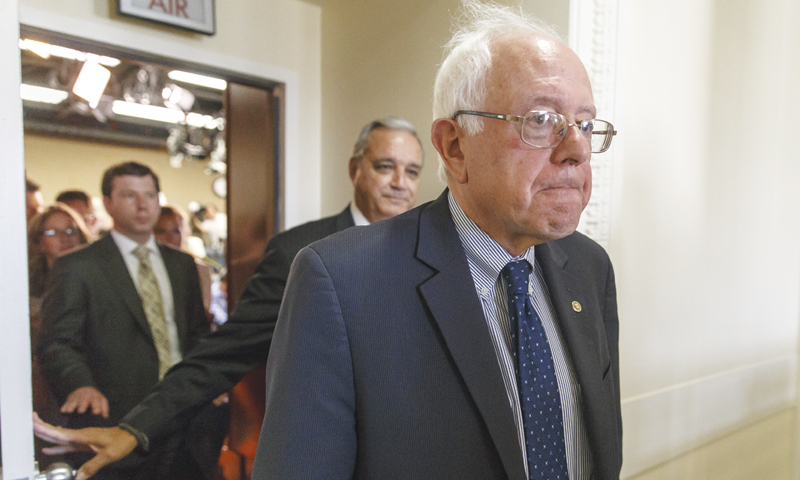
Last month two senior members of the US Senate finance committee wrote to John Martin, Gilead’s chief executive, asking him to justify Sovaldi’s price and expressing “serious concerns about the extent to which the market for this drug is operating efficiently and rationally”.
Such an intervention is unusual in the US, which, alone among big developed economies, has no government powers to regulate pharmaceutical pricing. The letter from Ron Wyden, Democratic chairman of the Senate finance committee, and Charles Grassley, a Republican, has raised questions over whether this laisser-faire approach could be destined to change.
After a slowdown since the financial crisis, US healthcare costs have started to rise again. At about 17pc of GDP, they are the highest in the developed world. Pharmaceuticals account for only one in every $10 spent on health but they are among the most visible to patients because of the steep co-payments demanded by insurers.
President Barack Obama’s healthcare reforms have increased incentives for healthcare providers to control costs as insurance coverage is widened. But Sovaldi has shown that, when a new medicine arrives with high demand and no competition, there is little to stop drugmakers charging what they wish.
“Other countries have come up with frameworks to make drugs affordable for people whereas in the US it has always been a case of what the market will bear,” says Steve Miller, chief medical officer of Express Scripts, one of America’s biggest prescription management companies. “We think the market is no longer bearing up.”
For the pharmaceuticals industry, there is nothing that causes greater anxiety than the idea that its cherished pricing freedom in the US could be imperiled. Annual US per-capita spending on pharmaceuticals is $1,010, more than double the $498 average among members of the OECD.
This high US spending underpins the economics of the global pharmaceuticals industry. More than half of all sales from new drugs launched between 2009 and 2013 were made in the US, compared with 23pc in Europe.
Seldom has the international disparity in drug pricing been starker than in the case of Sovaldi, a drug hailed as the biggest breakthrough in hepatitis C treatment since the virus was discovered in 1989. In more than nine out of 10 cases, the treatment will lead to complete cure within 12 weeks.
Gilead agreed to sell the drug in Egypt, the country with the world’s highest prevalence of hepatitis C, at a 99pc discount to the US price.
However, while few would begrudge efforts to make the medicine more affordable in the developing world, many Americans have been asking why, if Gilead can afford to price Sovaldi at $11-a-pill in Egypt, does it charge $1,000 in the US.
“The answer is because it can,” says Dr Miller, one of Gilead’s fiercest critics. “Sovaldi has shone a light on the fact America is subsidising healthcare innovation for the rest of the world.”
US drug prices are high because, unlike in most other countries, the government does not use its purchasing power to contain them. There is nothing like the UK’s National Institute for Health and Care Excellence (Nice), for example, which acts as a gatekeeper for new medicines.
Before a treatment is recommended for use in Britain’s National Health Service, its manufacturer must convince Nice that the product represents value for money.
The result is that fewer new drugs are adopted in the UK, and at a lower price than in the US. Gilead, for example, has priced Sovaldi at a 30pc discount to its US price in Britain. Yet even that has not been enough to convince Nice of its clinical value. The agency told Gilead in June to come back with more data to support its case for the drug. France, too, is playing hardball.
To many in the US, the notion of government rationing drugs and regulating prices is wholly un-American. Republicans have long characterised Nice as a “death panel” that epitomises all that is wrong about European socialised healthcare. A study sponsored by the Pharmaceutical Research and Manufacturers of America, the industry lobby group, last month showed that almost 80pc of cancer drugs reviewed by Nice in the past seven years have had some type of restriction placed on access. This, said the lobby group, could explain why the average five-year survival rate for US breast cancer patients is higher, at 90pc, than the UK’s 78pc.
Yet the fact that the US industry issues warnings against ‘centralised, one-size-fits-all value assessments’ across the Atlantic exposes its concern that such concepts could be gaining ground in the US. There are increasing signs that politicians and health officials are taking a harder look at how to rein in rising costs.
“We can’t ignore the elephant in the room,” says Karen Ignagni, president of America’s Health Insurance Plans, which represents health insurers. “The Sovaldi case brings all these issues together in a very stark way: How much is too much? Can this price be sustained? What happens if it blows up your budget? This is a debate we’re just on the cusp of having in our society.”
Sovaldi is not the most expensive drug on the market. What sets it apart is the size of the patient population it aims to treat. There are an estimated 3.2m people in the US infected with hepatitis C, four times more than the number with HIV.
So far 70,000 patients have been prescribed Sovaldi but its impact is being felt throughout the healthcare system. WellPoint, one of the biggest US health insurers, for example, spent $50m on hepatitis C treatment in the first quarter - as much as the whole of last year. State governments warn that their social healthcare budgets risk being crippled.
While Sovaldi may be an exceptional case, there is a growing number of expensive speciality medicines emerging from laboratories that collectively promise to put further stress on budgets.. In order to recoup high development costs from relatively small patient groups, prices tend to be very high. Take, for example, a cystic-fibrosis drug, called Kalydeco, made by Vertex Pharmaceuticals, which costs $300,000 a year.
Increased spending on speciality medicines explains why the average price of branded medicines in the US has almost doubled since 2008, according to Express Scripts. The overall drugs bill has been growing more slowly because of the falling price of generic medicines, which represent 86pc of all US prescriptions. However, while speciality medicines account for less than 1pc of total prescriptions, they drain more than a quarter of pharmacy spending.
Gilead and other drugmakers argue that their prices are justified both by the need to provide a return on investment in research and development and by their long-term value to patients. John Castellani, president of the PhRMA, says that, by curing hepatitis C, Sovaldi has the potential to save the US healthcare system $9bn a year in the long run by reducing hospitalisations from the liver disease that often results from the virus.
However, industry leaders accept that they have a role to play in bringing healthcare costs under control. It has become almost obligatory for pharma executives to espouse a shift towards more ‘value-based’ pricing models that reward drugmakers based on measurable health outcomes. This is code for acknowledging that the era of overpriced ‘me too’ drugs is drawing to a close, while making clear the industry expects to be rewarded for true innovation.
Published in Dawn, Aug 4th, 2014