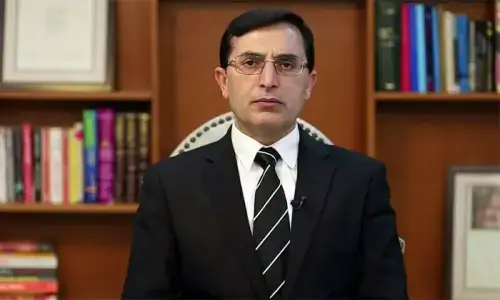
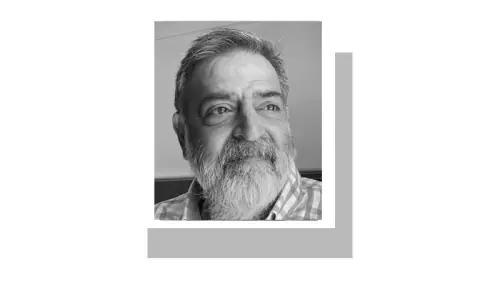
ISLAMABAD: The Asian Study Group hosted a book reading of A White Trail: A journey into the Heart of Pakistan’s Religious Minorities, by Haroon Khalid on Monday.
The author read excerpts from his book, answered questions and shared various experiences he had while gathering stories.
A White Trail is an ethnographic study of the minority communities in an increasingly intolerant country. It is unusual in that it delves into the lives of the communities using the occasions of their religious festivals to explore their psyches and larger socio-political issues.
Nilofer Qazi, the moderator, began the evening with a question on what brought Khalid to the idea of exploring the minorities.
He said: “Shortly after the Gojra incident I approached newspapers with the idea of writing a series of articles on the minorities but because of the political climate there was no interest. I then met Sharmeen Obaid Chinoy who was working with Citizens Archive of Pakistan (CAP) who funded this research.”
He added that the book in restricted geographically to Punjab both because that was the priority of the funding organisation and because it was convenient and affordable since he was Lahore based.
As the book is based on oral testimonies of oft-times persecuted people, there were some difficulties in accessing the stories where some people refused to give interviews while still others repeated a mantra but did not share the truth.
There were also instances where repeat sessions were required as the individuals were not particularly articulate and it was difficult to find the story.
The author said certainly there is a political perspective that the book originates from although that is neither the focus nor the agenda of the research. Since he has a background in anthropology his interest was in the socio-cultural aspects.
A White Trail is in many ways a pilgrimage through the shrines, temples and festivals of non-Muslim Punjab.
Ayesha Siddiqa questioned if the author had observed how the minorities internalise their identities. In some cases they had dual names while others claimed to belong to another more acceptable minority religion.
In a region which had a very strong caste system historically, it appears that the caste distinctions were now subsumed in the religious identity. Nevertheless there was, Khalid said, a difference in how minorities of higher classes were treated and the level of persecution experienced by the lower classes.
Haroon Riaz, a blogger, said at one stage various minority communities wanted the Blasphemy Law extended to provide protection to all religions and asked whether with the increasing intolerance this attitude was still present.
Khalid responded saying that the law did technically have provisions for the protection of various religions and in 1997 Christians in Shanti Nagar lodged a complaint against a police officer for defiling a Bible during a raid. A former bishop of Lahore believes the law should be abolished.
The author observed that there was an increasing acceptance of the blasphemy law amongst Muslims and the debate was dying down on the subject. He also felt that after the murders of Salman Taseer and Shahbaz Bhatti, dialogue was limited and the space was constrained.
An audience member asked why the minorities continued to stay in a hostile environment to which the author said in some cases it was lack of options and in others there was an affinity with this land.
As the book traces non-Muslims through their festivals, we also find shared saints and shrines.
There is a sense of ownership of historical figures, myths and spaces because of their significant ties to the land.
As the author read from the chapter, Lohri at Nankana Sahib, K.M. Chima said: “As the oldest person here, I remember Lohri in pre-partition time. Hindu, Muslim and Sikh girls would go house to house singing songs to collect money for the festival and the songs would be about Dullah Bhatti, a Muslim agitator for peasant rights. This was a Punjabi festival and eclectic in nature.”
As Shazreh Hussain said, “Haroon Khalid’s book is truly a journey into the heart of women and men of different faiths. It captures not only fear and oppression but also colours of their celebration, their festivals and their persistent hope.”