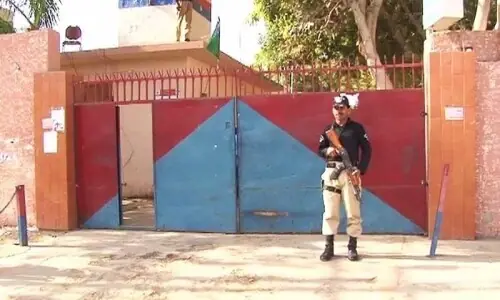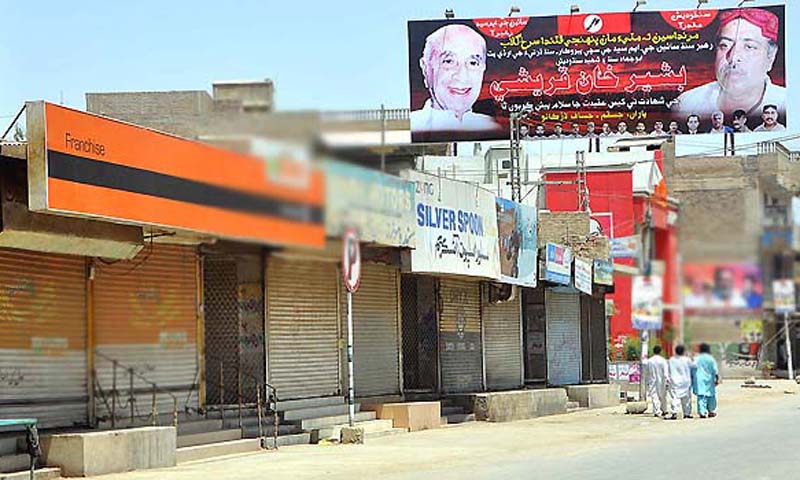
Sakrand appears to be little more than a small roadside cafe, a decrepit road leading towards Nawabshah and two colleges. Outside the Government Degree College for Boys, the road is eerily silent one minute and full of honking rickshaws and cars the next.
Patiently waiting for a Jeay Sindh Muttahida Mahaz activist to show up, we failed to notice that a group of four young men across the road were watching us with equal patience.
Several calls and a meek response later, the activist showed up knocking on the car window. It turned out to be one of the same group waiting at the roadside cafe. But he wanted to meet at another restaurant now.
Fifteen minutes after taking our seats inside the red-curtained restaurant Manzil and sharing an awkward silence with the owner, we were face to face with ‘Imran Laghari’, who casually remarked that that was not his real name.
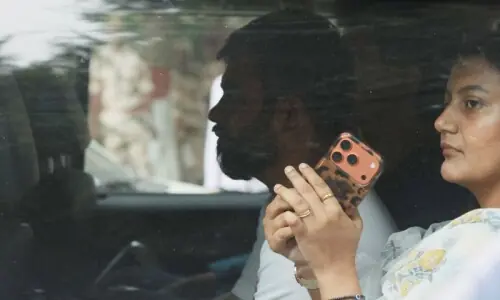
Dressed in a white shalwar kameez with a brown jacket and a muffler, Laghari was accompanied by two men, one of them nervously locking and unlocking his mobile phone. The other, a young man of 21, kept glancing out of the tinted windows.
“This is what the state of Pakistan does to you. It bans you for being liberal. We can’t even use our real names anymore. Main apna ghar wala naam aap ko nahi bata sakta [I can’t tell you what I am called at home],” he remarked as one of the two men accompanying him nodded earnestly.
From that moment onwards, Laghari spoke nostalgically, with a few moments of anger and frustration creeping in his tone. His conversation ranged from the Indus Valley civilisation and Sindh’s uniqueness to his ‘saccha saeein’ G.M. Syed, founder of the nationalist movement in Sindh. Except for the JSMM, most nationalist outfits drawing inspiration from G.M. Syed’s ideology have adjusted their views to work within the country’s political system.
His tone resembled a rant against the state as he talked of ‘Greater Punjab hegemony’ which he said was the reason behind the creation of the JSMM on Nov 26, 2000.
Laghari’s voice rose a notch higher: “We are geographically being colonised by the Punjab. There can’t be one culture in the entire country, we have sacrificed 150 of our workers, and we’ll continue to do so.”
At that moment, two women sitting some distance away tilted their heads to see what the ruckus was all about. Noticing the curiosity being aroused, Laghari started speaking in a slightly softer tone. “We have to rely on face-to-face communication, but it’s alright, if that’s what it takes to gather our people, we will.”
That is exactly what they managed to do last year in Hyderabad on July 6. According to reports, the JSMM congregation — their first public gathering after being banned in April 2013 for carrying out militant acts inside the province, including several railway track explosions — was attended by 95,000 attendants from across Sindh.
With their main headquarters in Qambar-Shahdadkot and Tando Mohammad Khan, Sakrand is gradually becoming one of the smaller tehsils where the proscribed group enjoys a lot of support and sympathy. Refusing to meet in Karachi where he said he’d be “recognised easily”, Laghari claimed that the organisation’s outreach was more than it appeared.
But would armed resistance help them in the long run? Or would the movement fizzle out like so many other movements? A firm “no” was Laghari’s reply. “We have the support of labourers and students. And we are political activists by the way. We just believe in voicing our opinions which doesn’t go down well with others, that’s all.”
Though not so sure about their present, the activists seemed pretty certain about their future. The other man sitting next to Laghari finally introduced himself as ‘Yunus Mehmood’, adding, after a pause, that that was not his real name either. Speaking about their future strategy, he said that they were expanding their network across Sindh. “So the next time around, the state will have to search every home and village in the province,” he added.
At that point, the men stood up and made a hasty exit after mumbling about going for another meeting. As they stepped out, a waiter who had been listening to the conversation laughed, “Our ajrak and topi have been hijacked addi.” The owner, meanwhile, asked him to mind his own business.