Lapses in public policy
ISLAMABAD has a great deal to learn from some of the recent advances in economic thought. Economics as a discipline has advanced in recent years to encompass a number of factors in growth models that were previously considered to be exogenous, meaning that they could not be influenced by public policy.
According to conventional wisdom, growth resulted only with the accumulation of capital and the application of labour to the process of production. There is now enough accumulated evidence, collected by those who have made it their profession to identify the determinants of growth, to conclude that it takes more than capital accumulation to develop economies.
For growth to take place, it is also important to improve the quality of the work force, and that takes investment in education, skill development and heathcare.
Attention also needs to be given to improving the economy’s technological base and this entails investment not only in education and skill development but also in research and application of research to production processes in all sectors of the economy.
Attention also has to be given to the development of institutions and to developing social capital. In all these areas, the state has an important role to play. The state needs to play this role by formulating intelligent public policies directed at accelerating the pace of growth and ensuring that the rewards of growth are available to all segments of society. Annual federal and provincial budgets are part of the public policy agenda of governments.
Today, I will continue with the subject of annual budgets, public policy and the economic and social challenges faced by Pakistan. In the previous articles, I have suggested that the importance usually attached to the preparation of annual budgets by the federal government and those in the provinces is justified if they institute major changes in public policy.
Preparation of the budget for 2007-08 presented Islamabad’s policymakers with an opportunity to take careful stock of the economic situation with a view to identifying both strengths and weaknesses, and then using fiscal policy to address the weaknesses.
This opportunity -- to change the course on which they had set the economy and deal with some of the structural weaknesses – was lost by the policymakers. Instead, they chose to congratulate themselves on their ability to oversee the continuation of high growth rates in the economy for the fifth straight year.
In the various seminars that were held across the country, senior policymakers spent time counting the benefits the economy had delivered to the people. They could have spent the same time in engaging themselves with the people to find out what worried them about the economy. In this way they would have had a better idea of the fixes that the economy needed.
But Islamabad wished to celebrate. While there is much to be happy about, this celebration will only last if the high rates of growth of recent years are sustained into the future in a way that benefits are made available to broader segments of the population.
When I studied economics at Oxford and Harvard and spent time reflecting on what had come to be called the discipline of development economics, there was consensus that public policy could do little to improve income distribution. In fact, many economists believed that in development’s early phase, inequality worsened.
This line of thinking originated with Simon Kuznets, an American economist who used econometrics to relate changes in income distribution in a large number of countries with rates of GDP growth. He found that high growth countries initially saw the worsening of income distribution.
This was not a bad thing since in the economies that were led by the private sector, increased earnings went into the pockets of individuals and companies that had a higher propensity to save compared to the general public.
These savings would be used for investment; with greater capital accumulation, there would be greater employment in more productive sectors of the economy; and, with the workers employed in the activities that could afford to pay higher wages compared to those that used traditional means of production, incomes would eventually trickle down to the poorer parts of the society.
It was this thinking that informed the authors of Pakistan’s highly successful Second Five Year Plan (1965-70) and those who analysed its achievements once the plan had run its course. It was thus that Mahbub ul Haq justified the emphasis on growth as the first step towards poverty alleviation and improving income distribution.
It was the same logic that prompted Gustav Papanek, the Harvard economist, who was for several years an advisor to the Planning Commission, to applaud the achievements of the plan in a widely read book published in 1967. He used the phrase “social utility of greed” to justify the Ayub government’s development model.
There were two serious problems with the approach. By saying that the fruits of growth would eventually trickle down to the poor, the span of time implied by “eventually” was not identified.
For how long would the poor have to wait before they could see the rewards of growth coming their way? The second problem was another finding by economic empiricists – the people who analysed large amounts of data to identify trends and then use the noted trends to build economic theories.
Those working on income distribution trends in different groups of countries reached the conclusion that after the Kuznets effect had brought about a change in income distribution and the economy had reached a higher stage of development, income inequality became “static” and did not change over time. Efforts made through the use of public policy to bring about an improvement in the distribution of income resulted in waste rather than in improving the situation of the well-to-do.
This conclusion is now being looked at once again as more data has accumulated in both developed and developing countries. As Lawrence Summers, secretary of treasury in the administration of President Bill Clinton, put it in a recent article, “Today, we have another generation’s worth of data including the information technology-driven re-acceleration of productivity growth in the 1990s. This experience forces a reassessment of the earlier economic orthodoxy. It can no longer be plausibly asserted that average wage growth tracks productivity growth.”
Using budget data, Summers and his colleagues concluded that there was a significant worsening of income distribution in the United States in the 1990s. “Since 1979, changes in income distribution had raised the pre-tax incomes of the top one per cent of the population by $664 billion or $600,000 per family — an increase of 43 per cent.”
Experts believe that fiscal policy has contributed to the widening of income disparities in the United States. Under President George W. Bush, tax rates were lowered with most of the advantage going to the rich. Also, the states, squeezed by the federal government, have resorted to such devices as increases in sales tax in order to meet their revenue requirements.
Sales tax is a regressive tax since it collects revenues from consumption which has a higher proportion in the budgets of the less well-to-do segments of society. Corporate salaries have increased, particularly at the higher end of the scale.
The ratio between top salaries and federally mandated minimum wages has touched new records. I mention all this for the US as there are interesting parallels between what is happening in that country and in Pakistan.
Pakistan’s fiscal policy does not favour the poor. It is true that the poor and the lower middle classes don’t pay taxes directly into the government’s coffers but it is also true that the recent emphasis on sales tax has shifted the tax burden on consumption and thus on the less well-to-do.
Pakistan is one of the few relatively large economies in the world where capital gains are not taxed. In recent years, capital gains in real estate and the stock market have created a great deal of wealth for the well to do. The absence of capital gains has encouraged speculation in these activities.
Listed companies, public sector corporations and some parts of the public sector have permitted top salaries to rise with the result that the ratio between the top salaried class and those that earn only the federally mandated minimum wage has increased enormously.
The ratio between top corporate salaries and the minimum wage now exceeds 100. By encouraging domestic as well as foreign investment in real estate — particularly in high-rise buildings — the government has created opportunities that provide significant returns on investment but not much continuous employment to the poor. In other words, the economic model being pursued by the government and the fiscal policy Islamabad is currently following is contributing to the widening of income inequality.
Can the government correct its course? Can it adopt policies to accelerate the rate of economic growth while ensuring that it does not contribute to the widening of income and wealth gaps.
The list of the policies that could be adopted is long and what I will propose here is only for illustrative purposes. Rapid growth is a necessary but not a sufficient condition for poverty alleviation and improvement in income inequality.
Growth needs investment; sustainable growth requires investment to be financed from domestic savings. To help people save, we need institutions that would induce people to set aside some of their current incomes for future consumption. The best institutional device for this is the instrument of pension funds in the private sector.
Some work has been started by the Punjab government in this direction but the federal authorities need to develop a regulatory framework that would encourage the development of these saving instruments.
It is correct for the government to encourage the development of the construction industry and some further steps were taken in this budget in that direction. It is also appropriate to facilitate the working of capital markets.
However, both activities attract speculation and that is harmful for economic growth and income distribution. A capital gains tax would be helpful in this respect. The government could also use tax policy to encourage the development of research in the private sector. No effort was made in this direction. The budget took some steps to provide help to the poor, burdened as they are by an unrelenting increase in the prices of goods and commodities on which they spend the bulk of their meagre earnings. They will be able to access food below market prices from fair price shops.
But such interventions are notorious for leaking benefits to the not so poor. The government could have launched a large public works programme in both rural and urban areas for increasing employment for the poor unemployed while, at the same time, creating much needed infrastructure.
The world has many examples of such programmes from which the government could have borrowed. Budgets can help move economies towards desirable goals provided they are formulated within the context of well defined long-term strategies. These have not been formulated with any seriousness up until now. That is why I believe that another good opportunity has been lost.
Mixing religion with politics
NEW prime ministers don’t get long to get their point across. Within 24 hours of his arrival at No 10, Gordon Brown was fighting for front pages with Madeleine McCann and the Spice Girls’ reunion.
So he kept it simple: his government was going to be about two things – competence and serious moral purpose. It’s the latter which this son of the manse repeatedly emphasises as he refers back to the devout family background which provided his “moral compass”.
He is the third consecutive Labour leader to put religion at the heart of his politics, and it’s not just a matter of leaders. Yet again, there are enough believers in Brown’s cabinet for a decent prayer group.
It’s a curious phenomenon that at a time when Christianity continues its steady decline in Britain, religion has re-emerged as a central inspiration of political rhetoric — not as the flash-in-the-pan aberration of one individual but now well established as a convention of the centre ground, acknowledged by the Cameroons as much as by Labour. This strange afterlife of religious belief must be pretty galling to secularists and humanists.
It’s even more evident on the other side of the Atlantic, where almost all serious contenders for political office have to go through a process of personal confession of faith which must prompt the likes of Richard Dawkins to choke over their breakfast. Hillary Clinton happily does God, as did her husband, as does Barack Obama, who recently was moved to confess: “I learned that my sins could be redeemed. I learned that those things I was too weak to accomplish myself, He would accomplish with me if I placed my trust in Him.”
Obama and Brown express themselves very differently in response to their respective political cultures, but the important point is that they are both doing much the same thing - resorting to a biblical tradition of language, character and morality. It is as if with the collapse of what John Gray in his new book calls the “political religions” - most significantly, communism - there is no effective alternative ethical language other than that of the Bible.
The 20th-century traditions of humanism, secularism and even atheism have signally failed to develop a popular language of morality in which to describe moral character and the disciplines of responsibility, self-restraint and duty which are essential to democracy and social wellbeing. If you want to convince a sceptical, inattentive electorate of your moral purpose, you have to use the shorthand of faith.
It’s back to the old staples - the millennia-old stories of repentance, redemption, Samaritans, eyes of needles, camels and shepherds of a Middle Eastern society.
Being British we prefer these referenced rather than a sermon — a distinction Brown observes meticulously, anxious not to offend anti-religious sensibilities. But on the occasions when he lets loose, in church gatherings about global poverty for instance, he is his father’s son, the preacher.
The differences from Blair’s faith are striking. It’s very hard to imagine Brown praying with anyone, let alone George Bush, nor is he likely to make references to God’s judgment on his Iraq policy, and least likely of all is his being tempted down the path to Rome. Blair found God in emotionally charged prayer meetings in Oxford hosted by a gregarious Australian vicar.
In contrast, Brown saw faith sustaining communities through hardship in his father’s ministry - he describes it as “social Christianity”. He was not interested in theology and personal salvation in the hereafter, the hellfire and damnation side of Presbyterianism, but in how religion inspires bonds that help individuals and communities through hard times, how it provides solidarity and ensures resilience - and that still fascinates him.
No one knows if Brown is really a hand-on-heart believer. His commitment is intellectual and practical. What intrigues him is how religion is useful. Its values have historically facilitated the development of capitalism – the Protestant ethic – and democracy, and like his fellow Scot Adam Smith, he believes morality is vital to the effective functioning of both.
That makes him an unusual figure in British intellectual circles, and it’s to the US that he’s turned for inspiration. What he’s found there in a string of writers, which includes Robert Bellah (a favourite of fellow traveller Chief Rabbi Jonathan Sacks) and Robert Putnam, as well as more rightwing thinkers such as James Q Wilson and Gertrude Himmelfarb, is the anxiety about a moral and social breakdown.
The problem, said Bellah in Habits of the Heart, is an individualism “which denies the basic reality of our interdependence” and identifies with the “typical virtues of adolescence” such as independence but also the “less savoury adulation of success, and contempt for weakness”.
The consequence is a “radical disengagement” from society. The challenge is to “renew the cultural capacity for community and solidarity”, wrote Bellah more than 20 years ago, and he suggested both “biblical traditions and civic republicanism” could help. It’s advice Brown appears to have been following since, not least in his development of the concept of Britishness.
One volume that should get on his summer reading list is Benjamin Barber’s Consumed, which warns that whereas once capitalism was allied with virtues that contributed to democracy and citizenship, now it is allied with vices that undermine them. The infantilisation of impatient, insecure, greedy consumers militates against the development of responsibility and adult maturity. Will democracy survive, asks Barber, and answers the question with a rather unconfident “qualified yes”.
If this sounds gloomy, it is. Brown’s faith bears the hallmarks of his origins. He may have done away with hellfire but he’s replaced it with a dour if noble vision of endless duty, effort and obligation — his school motto of “I will try my utmost” — without even the promise of celestial reward. Self-restraint and self-discipline are principles written into the Brown DNA but to a consumer-obsessed, debt-ridden electorate, they are as foreign as Mars.
As politics increasingly moves into a territory of personal behaviour — how do you persuade people to forgo consumer goodies to save for pension provision and to eat healthily to avoid obesity, the respect agenda, parenting (it’s significant that many of these issues have landed in the lap of his closest associate, Ed Balls) — Brown is increasingly going to find that his Kirkcaldy religious DNA comes into conflict with his faith in the free markets and their promotion of a voracious consumer culture.
Put crudely, how can the state hope to inculcate an ethic of responsibility into its citizens regarding eating and spending in a culture that urges fast food and is saturated with cheap credit? It’s a bit like putting a bottle of whisky in front of an alcoholic and asking them to kick the habit.
Much of Brown’s political career has been clarifying the relationship between the market and the state.
What lies ahead is an even more demanding task: how to resolve the conflict between personal freedom, the market and the morality he believes must underpin both of them.
Feeding the hungry and clothing the naked is the easier part, but his manse morality is going to take him into much more difficult waters.
––The Guardian, London
Misperceptions about Urdu
IN A recent issue of Dawn, there was a letter titled ‘Language: creating a new reality’ by K. Perwaiz regarding some of my alleged statements about Urdu and Hindi. There were misunderstandings in this letter which need to be corrected and this is the main subject of this column.
The writer of the letter quoted some of my earlier writings in the press and took offence at statements I made at the Aga Khan University last month about Urdu. According to the writer, I made two statements: first, that the Urdu press and school textbooks were neither pro-peace nor sensitive to women’s rights etc; and, second, that Urdu was the same as Hindi and that it came from Hindi. K. Perwaiz then concluded that I had ‘belittled’ Urdu and that nobody liked their language to be belittled.
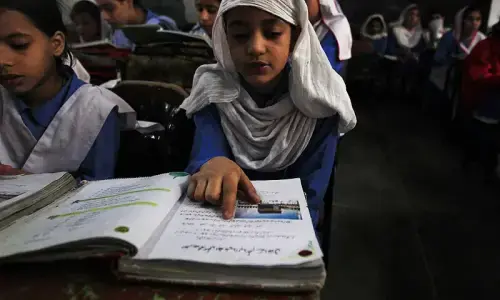
Now let us take these statements in their proper context. First, the charge of having ‘belittled’ Urdu. Anyone who has read my academic work e.g. Language and Politics in Pakistan and Language, Ideology and Power, should know that I have always supported Urdu against the elitist use of English. I have been arguing since 1994 that we should make our young people proud of their languages and their roots. This means giving respect and value to their mother tongues — Punjabi, Sindhi, Pashto, Balochi, etc — as well as Urdu as the language of wider communication (LWC).
I have gone to the extent of suggesting that elitist English-medium schools should be phased out by converting all schools to the same medium of instruction which should be the mother tongue in primary schooling and then Urdu (as the LWC). English should be taught as a second language using modern, interactive methods (films, songs, plays, conversation) throughout the school and college years. Higher education and research should, however, be in English.
This view goes against the view of the privileged classes and I expected criticism from members of those classes. However, unexpectedly, I was accused of belittling Urdu when, in fact, I have shown respect for all languages including the mother-tongue of the people and even English, which, after all, is a global language and as such it would be foolish not to teach it.
So, though I want English to be taught, I only want it to be spread more equitably among the school-going population in the interest of justice and equity. I do not want some people to purchase skills in English from the market at exorbitant rates while others are not even able to dream of doing so and are cheated of their hard-earned income by schools which claim to be English-medium when they are not.
The very presence of English among the privileged classes has caused an apartheid in our educational system which is causing resentment. A lot of the lawlessness we witness is because the gap between the haves and the have-nots is increasing. Even militancy using the idiom of Islam or ethnic identity is fuelled by deprivation, inequality and the unjust distribution of goods and services.
It is to correct this imbalance that state schools should be improved and a parallel, privileged, for-profit system of education be phased out. If my suggestions are accepted it will increase the role of Urdu in education not decrease it. This being so, I fail to understand how I have ‘belittled’ Urdu.
As for the charge that I said that the Urdu press and school textbooks express views which are not conducive to promoting peaceful, tolerant and democratic values, yes, I did say that. Indeed, Khalid Ahmed of The Friday Times, has pointed out that if my ideas are implemented, intolerant and pro-war views will become ascendant. He used my own data from my book Denizens of Alien Worlds to prove that madressah students are most intolerant, the English-medium ones most tolerant while those from Urdu-medium schools are somewhere in between.
He had a point, of course. I, therefore, suggested that if we increase the role of Urdu in our education system, we must purge our textbooks of the legacy of the Ziaul Haq years and also of earlier pro-war and anti-India policies. This is something which a number of intellectuals have been saying and which the ministry of education supports in principle as far as school textbooks are concerned.
If we want to live peacefully in a domestic context as well as with our neighbours, we should promote values of peace and tolerance in our media and textbooks. Hence, to say that textbooks in Urdu should be made more pro-peace, more sensitive to women’s rights and more tolerant of minorities is not an insult to the language. It is an attempt to make it more conducive to a happy coexistence.
Of course, there are left-leaning writers in Urdu, but we are talking of textbooks not of literature. Textbooks were deliberately crammed with intolerant and pro-war material, and this is what needs to be removed from them.
Now for my statement that Urdu comes from Hindi and that they are both really the same language. These are complicated issues of linguistic history and it is not possible to go into the details. However, let me make a few things clear. The ancestor of Urdu and Hindi was called by several names — Hindi, Hindvi, Gujri, Dakni, Indostan, Moors, Rekhta, Hindustani — until 1780 when the name ‘Urdu’ was used for this language for the first time.
Most earlier sources, generally Persian, use words such as ‘the Sheikh said in the Hindi language’. Amir Khusro, although he used different names for languages of different areas, reserved the term ‘Hindi’ for a language which appears much like the ancestor of both modern Urdu and Hindi.
Even after this date, Hindi, Hindustani and Rekhta were used, but gradually Urdu came to be reserved exclusively for that variant of the language which was written in the Perso-Arabic script and used Persian diction. The parent of modern Hindi and modern Urdu, whatever name we use for it, started bifurcating in the 18th century.
Muslim intellectuals purged it of certain words (‘sagar’, ‘nain’, ‘preet’ etc) to make it an identity symbol of the Muslim gentry. Somewhat later, identity-conscious Hindus did the same for modern Hindi. They wrote it in the Devanagari script and put Sanskritic words in it. Thus, the literary or official varieties of one common language are two languages now: Urdu and Hindi.
However, the language of the streets, of popular films, songs and drama dips towards the Urdu end of the continuum. These are historical realities to be presented for the purposes of scholarly accuracy.
Now I come to the use of Hindi in India. I never sang praises of it because the variant used officially, that is Sanskritised Hindi, is an artificial language which people do not understand or use in real-life situations. Moreover, attempts to impose it all over India were resented by the speakers of Dravidian languages, which, in fact, led to the subdivision of India into linguistic provinces. This was given as the excuse for the retention of English as the official language.
I did praise the practice of the makers of Hindi movies and TV soap operas which chose to use a comprehensible language which people in India and Pakistan — at least those who know Hindi or Urdu — can understand. While official Hindi is used for symbolic and identity-related reasons, just as Urdu laden with Persian and Arabic words is in Pakistan, the unofficial language of the streets are very close to each other.
There is so much confusion about language issues that I intended to write about these matters anyway. I thank Mr Perwaiz whose letter inspired me to write this earlier than I had envisaged.
| © DAWN Group of Newspapers, 2007 |