0
0

The right to public protest
THE establishment’s favourite method of dealing with any street agitation against its policies or actions is to deny the people their rights to assembly and protest, and to subject them to violence if they persist in exercising their basic freedoms. This has again been amply demonstrated during the current movement against the outrageous attack on the rights and dignity of the country’s Chief Justice.
When the lawyers started taking to the streets the Punjab police were unleashed to give a display of wanton savagery for which they have been known since the colonial period – not only in the subcontinent but also across large areas in Asia and Africa. Heads and limbs were broken and teargas was used in a spirit of abandon rarely witnessed even in our part of the troubled world. Journalists who were guilty only of performing their professional duties were similarly targeted.
The government’s attempts to terrorise the media (and indirectly the lawyers and the people in general) into submission reached their peak with the raid on the Islamabad office of a TV organisation by a police contingent in full uniform and equipped with officially supplied weapons. The realisation that the incident had been seen by TV watchers across the globe prompted an unusual show of remorse and rehabilitation of the anchor who had been ordered off the channel a day earlier. No such consideration was shown to the other victims of police brutality that are not needed by the regime for its image-building.
Scared into some semblance of sanity by adverse reaction to its resort to excessive force against lawyers, the administration modified its tactics. Instead of preventing lawyers from assembling and parading the thoroughfares, it embarked on plans to divide them and separate them from elements outside the legal fraternity, especially political parties. There have been reports from a few district towns, and even provincial capitals, of some lawyers’ bid to dissociate themselves from the mainstream.
An attempt to engineer an exchange of brickbats between lawyers and political workers in Islamabad was followed by an incredible clash between black-jackets and media professionals in Karachi.
Meanwhile, the establishment’s propaganda batteries are being relentlessly used to demonise the protesters. The stock argument is that they are politicising a legal/constitutional issue that can only be agitated in a court or a tribunal enjoying the appearance of a court. The untenability of this specious plea can easily be proved.
Instances when regimes of various kinds have sought to justify political excesses under legal subterfuge are legion. The colonial rulers strove for decades to use their legal apparatus to prove that they punished the seekers of freedom for breaking the law and not for their views, and the people had no business to protest against the killing or detention of their popular leaders. General Ziaul Haq did not succeed in convincing anybody that his decision to liquidate Bhutto was not so much a political choice as a legal obligation. Washington has not been able to persuade the world that the atrocities being committed at Guantanamo Bay cannot be ‘politicised’.
Anybody who says in Pakistan, of all the countries in the world, that constitutional issues cannot be treated as political matters betrays not only a corrupted mind but also ignorance of history. The Quaid-i-Azam consistently maintained that the demand for Pakistan grew out of failure to evolve a constitutional formula for India that satisfied the Muslims. In his address of August 11, 1947 too he described the partition as the only way to solve the subcontinent’s constitutional problem. In other words, the Pakistan movement could be described as “politicisation” of a constitutional issue.
Besides, the Quaid did not rule out street action to realise constitutional objectives. It is possible to argue that his break with Gandhi on the latter’s decision to confront the alien rulers was a matter of disagreement on tactics and the prohibitive cost and not one of principle. When by 1946 he was confident of Muslim League’s strength he did not hesitate to call for direct action.
That extra-constitutional regimes often try to protect themselves by denouncing politics as a law and order matter and as something unnecessary, wasteful and even treacherous is known. The truth, however, is that each and every public grievance, be it the lack of drinking water or unemployment or high power tariff or involuntary disappearance or the use of a long knife against the head of the judiciary, is political in nature and no law or pretext can deny the people their right to secure their due through any means available to them.
More often than not the choice of agitation in the street is forced upon the people by their rulers who block all other routes to protest for a democratic change.
It is clearly time the first principle of modern, civilised governance was accepted by Pakistan’s oligarchs -- that the people have an inalienable right to challenge the edicts of their surrogates in authority and to punish the incorrigible by removing them. As a corollary to this principle, public protest, within the four walls of a bungalow or in the open, simply amounts to the exercise of a basic human right to participate in the country’s governance, directly when indirect means do not bear fruit.
Public protest against government policies or actions usually either shrouds a demand to undo something that is perceived to be contrary to people’s interest or a plea for some action the people consider necessary to secure relief in a hardship situation or to meet a pressing need. Two factors commend mass agitation through public rallies, processions and hartal to our people. First, it has been an essential part of the people’s political culture since the time they started challenging the colonial power in the subcontinent. It is a tradition they have every reason to be proud of.
Secondly, a public demonstration in the open gives the cause provoking it a face and a personality that other forms of expressing citizens’ demands, such as petitions, memoranda, demands through media or courts, cannot grant it. A public rally not only reveals the identity of the protesters but also the number affected in the given territorial context and the intensity of their feelings. Authorities that claim to govern by popular consensus should welcome public agitations as they offer them possibilities of correcting their policies.
It is true that sometimes mob power can be mobilised in support of demands society cannot afford to concede. However, just as ordinary people cannot distinguish good candidates for elective offices from bad coins unless a tradition of free and fair polls has been set over a long period, the masses cannot learn to reject unhealthy calls without enjoying the freedom to congregate in support of issues of public interest, and that too over a long period.
Much confusion has been caused by the policy of tolerating only processions and rallies staged to hail the rulers of the day and condemning most, if not all, other assemblies as subversive of good order.
The theory of blocking public rallies was developed in the colonial period on the premise that putting pressure on the government established by law was an offence. The post-independence authorities have used this theory far beyond its legitimate application. Coup-makers have sought to crush public protest as an activity designed to undermine authority established by law although they have had less claim to this status than even the colonial masters.
For many years now all public protests have been prohibited. At one stage the Supreme Court made a modest move to examine this bar to the people’s fundamental rights but the matter was not pursued to any conclusion.
The most commonly used tactic to ban public rallies is the abuse of Sec. 144 of the Cr.P.C. According to the text drafted by the British authors of the Code of Criminal Procedure, the district authorities could ban the assembly of more than four persons (how five made an unlawful assembly was never known). But this power was to be used only when a situation demanded and an order under 144 could not be valid for more than 14 days. It was left to our present-day rulers to keep large populations, especially in big cities, permanently under 144 although this is not only unlawful but also violative of the people’s fundamental right to peaceful assembly.
The second common tactic to prevent the people from registering their protest against a regime is that of detaining leaders and activists concerned on the eve of protest. Since no law holds criticism of any government to be a crime, all dissent is defined as anti-state activity and preventive detention is justified. It can be said without any fear of contradiction that most of such arrests, if not all, constitute criminal abuse of authority. Some time ago the Lahore High Court had to rule that raising anti-government slogans did not warrant the arrest of political activists under the Anti-terrorism Act.
The third method to interfere with the people’s right to assemble and protest is the use of plainclothed musclemen from security forces to beat up and terrorise the protesters. In this form of cussedness Pakistan’s so-called law-enforcers have surpassed their colonial role models. No head is safe from their unruly hands, not even that of the country’s Chief Justice. They are free to use their dirty hands to probe women protesters’ bodies and rough them up as they wish. No woman is safe – neither the head of the Human Rights Commission of Pakistan nor the president of a widely respected association of Pakistani doctors in the US.
The neoliberal apologists of market economy have started criticising mass action, especially hartals, on the ground that poor vendors are adversely affected. They should welcome Pakistan business people’s opposition to rallies in shopping avenues. Time was when traders had a stake in liberty and democracy. It may not be impossible for them to realise that when demonstrators who belong mostly to disadvantaged sections of society call for democracy and justice, they fight for a change that would bring themselves smaller rewards than traders. Subject to undertakings against destruction of property, no part of any city should be a ‘no go area’ for public processions / rallies.
Whatever the result of their present agitation, the people expect of the country’s jurists and lawyers a determined effort to rid them of the myth that opposition to government is always an attack on the state and also to get Sec. 144 repealed or at least radically revised and to end the use of plain-clothed goons to attack any citizen’s inviolable person and dignity. This should also be high on the people’s demands on political parties. They must learn to respect the citizen whose vote alone will help them win the right to be lawful and legitimate rulers of this magnificent land of ours.
Struggle between state & society
WAS the struggle for independence from colonialism meant to change the character of governance or merely the race or religion of the rulers? State and society have been at loggerheads with each other in most Muslim majority countries (including Pakistan) that emerged as sovereign states after long periods under colonialism.
The tug of war between them is a recurring tragedy that wastes the potential of countries and holds them down despite the vast human and physical resources at their disposal.
This dichotomy is acute in cases where the state got independence from colonial rule while the social and political institutions of society were too weak to assert their rights and act as watchdogs to ensure that the state worked to serve the interests of society.The two World Wars of the 20th century had wreaked devastation on the European colonial powers. These wars, also dubbed ‘civil wars of Europe’, had killed millions of young and skilled people and crippled their economies. The human and financial cost of direct control over far-flung colonies was no more feasible since their left-over resources were badly needed for reconstruction of their own countries.
The unflattering fact is that the independence of states came to some countries less because of the strength of their social and political institutions and more because of weakness of the colonial powers devastated by these wars.
Decolonisation was also helped by the leadership provided by the US which was in crucial post-war periods headed by men like Woodrow Wilson, F.D. Roosevelt and Harry Truman who believed in independence and development of the peoples of these colonies and wanted them to become full and respected members of the international community. Imagine the fate of the colonies if instead of these reformers the US was then headed by someone like George W Bush.
The concept of sovereign nation-states, as against empires — whether based on religion or conquest — travelled from Europe largely as part of liberal social and political education by the missionaries. In a way, the missionaries were undoing the work of their empire builders — the commercial and military interests — that had arrived to conquer and exploit the resources of colonies.
But the concept of sovereign nation-states also came with that of sovereign people in these nation-states. Both concepts — sovereignty of the nation-state and that of the people — have a common philosophical foundation. If we deny one, we are ipso facto in denial of the other. The principle of sovereignty of people makes conquests and empires illegal enterprises — whether based on race, religion or language. It requires that people determine who should rule them and how the resources of society should be deployed and for what purposes.
Colonialism was bad not because of the race or religion of its rulers but because it violated this principle of sovereignty of the nation-state. That is why the Catholic and Spanish-speaking people of Latin America fought wars of independence against Catholic Spain. That is also why the Arabs rebelled against fellow Muslim Ottoman Turks.
And that is the reason why our fellow citizens in East Pakistan rebelled against West Pakistan, the glue of a common faith being unable to contain their perceptions of being ruled under a colonial-style dispensation.
As for the ‘development’ argument, let’s not forget that the British also brought new technologies, undertook irrigation networks and other development projects in their colonies.
The continuing problems of governance in Pakistan emanate from this paradox: while the state became sovereign, the people were not. When independence came, only one part of the bargain was implemented. The state enjoyed the privileges of being sovereign and independent, but its people were denied their rights as sovereign citizens because society was too weak to enforce the rights of its members.
This weakness would have been overcome and not become a lingering problem except for the fact that the social and political reforms needed to implement the second part of the bargain of national independence were often blocked by new rulers of state — themselves the beneficiaries of the first part.
Ever since, the struggle between state and society in Pakistan — and indeed in several OIC countries — has continued as the state refuses to submit to members of society under one pretext or another. Let’s not forget that in mediaeval governance, the ruler — whether king, conqueror, caliph or holder of any other title — was not only the head of the executive but also the lawgiver as well as the ultimate judge. Many rulers of these new nation-states, nostalgic about the bad old days, still want to have unity of command over all institutions and are trying to turn the clock back.
It is here that the current battle between state and society in Muslim countries acquires some characteristics of a second struggle for independence; because the mediaeval style is akin to the colonial style of governance. Both held conquests and empires to be legal enterprises and both are in denial of the sovereign right of the people to choose and change the mode of governance.
Although this struggle between state and society is being waged throughout the Muslim world, it is more acute in Pakistan where social and political forces outside the state apparatus — specially the media and the middle class — have grown in strength and are refusing to allow a free hand to the state. Pakistan is different in several ways from some Middle Eastern countries and the Pakistan of the 21st century is also different from what it was in the early days of independence.
Its society has now overcome — against the heavy odds frequently placed in its path — the weaknesses of half a century ago and is insisting that the unfinished business of struggle for national independence be completed. National independence is not complete merely by giving independence to the state while denying the fruits of independence to members of society. Sovereignty of the nation-state is not complete without respecting the sovereignty of the people in that nation-state.
Within this larger struggle between state and society, however, another struggle is also raging in the Muslim world. The leadership of the first struggle for independence of the state was firmly in the hands of ‘friendly’ forces. For internal and external reasons, the national and democratic forces of change have been weakened. Increasingly now, mediaeval values of governance are staking their claim to leadership in this second struggle
Which way the struggle is going is not clear. What is clear, however, is that the state cannot escape the logic of history. It is inevitable that as society matures in its social, professional, economic and political dimensions, the state has to surrender more space to it. If the anachronistic apparatus ruling these states does not accommodate moderate and democratic forces of change, it will have to surrender to a mediaeval society with whom many among them share common values of unacceptable governance.
Today’s Pakistan encapsulates both struggles simultaneously taking place in Islamabad around the Chief Justice and the Hafsa madressah. The difference in the treatment of both struggles by the state apparatus is also becoming clearer by the day.The symptoms may change, the tactics and locale may vary but the real battle being fought in the Muslim world remains one between the state and society and not the various concoctions marketed from time to time to divert attention from the real issue.The state would have to surrender space to one or the other face of society. Each is calling upon the state to deliver the second part of the bargain according to its understanding and complete the unfinished business of national independence.
The writer is a former head of Board of Investment & federal secretary.
Email: smshah@alum.mit.edu
Case for an open hearing
CHIEF Justice Iftikhar Mohammed Chaudhry, when addressing the concluding session of a very successful international conference ‘Justice for All’ in Islamabad just a few months ago, could have hardly imagined that soon afterwards he himself would be desperately seeking justice in a reference case filed against him allegedly for ‘misconduct’.
And strange though it may read, as per Mirza Aslam Beg, the former army chief, “the reference against Chief Justice Iftikhar Mohammed Chaudhry was made because he appeared to have crossed the threshold of tolerance of the government through the speedy dispensation of justice.”
During his appearances before the Supreme Judicial Council, apart from registering his objection to the composition of body and the impropriety of the manner in which he was made non-functional, Justice Iftikhar Chaudhry also demanded an open trial.So far all proceedings in this case have been conducted in camera, perhaps because of the embarrassment an open trial would entail especially because of the high offices the defendant and the referrer hold.
In 1970, in a similar reference against Justice Shaukat Ali, he himself requested his trial to be held in camera to avoid any likely embarrassment to himself. However, in the present case, the defendant Justice Iftikhar Chaudhry himself is insisting on an open trial. To then have in camera proceedings seems obviously in the interest of the government.
However, the question arises as to what other revelations are left to cause further embarrassment to the two parties in this case. Was it not already embarrassing that the disgraceful accusations against the sitting Chief Justice of Pakistan were levelled in an open letter, put on a website and carried by the media without even a preliminary inquiry and verification? Later, the media also carried the charge-sheet against the Chief Justice and the matter became a topic of public debate.
The CJP was summarily, and in the view of some experts unconstitutionally, made non-functional. His movement was restricted and his house and family were kept under constant surveillance. Again, was it not embarrassing for the entire judiciary that the Chief Justice, who is in fact its icon and symbol, was made to go to the president’s camp office at the Army House, Rawalpindi, made to sit there for hours and subjected to all kinds of psychological pressure before talking to Gen Pervez Musharraf? Since Gen Musharraf is both president and chief of army staff, his meeting with the Chief Justice in his military outfit was suggestive and symbolic of the army-judiciary equation or rather the superiority of the former over the latter. This further exacerbated the ire of the legal fraternity.
Worse, the Chief Justice was pulled by his hair on the main street by a policeman in full media glare for the whole world to see. What else could be more embarrassing than this?
Hence any argument for holding the trial in camera on the grounds of avoiding embarrassment is hardly plausible.
On the contrary, as all the charges and the accusations against the Chief Justice were openly made and debated, it seems most logical and fair now that the trial should also be open and not in camera.
The public knows almost everything said against the Chief Justice. Naturally, they would also be very curious to know what the Chief Justice has to say in his own defence and how the lawyers of the two sides argue this case in an open and transparent manner so as to make the just distinguishable from the unjust.
An open trial may also make the members of the Supreme Judicial Council more responsive to the national interest knowing that the entire nation could be watching the proceedings.
The judicial crisis is not new in Pakistan. But this is perhaps the most critical of all so far and has precipitated political protests. The judiciary in the past has been held responsible for the debacle of Pakistan by helping to create some of the country’s worst constitutional crises, particularly when it invoked the notorious doctrine of necessity time and again.
But this time the judiciary is at its most critical juncture and the decision of the Supreme Judicial Council in the case of the Chief Justice may exercise a decisive influence not only on the judiciary but perhaps also on the future course of Pakistan’s history, especially at a time when Pakistan is grappling with uncertainty and impending dangers are lurking all around.
Standoff on Iraq
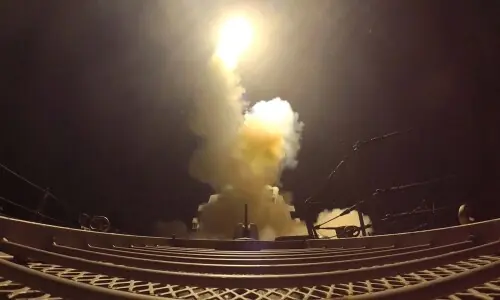
PRESIDENT BUSH and congressional leaders are due to meet this week to discuss possible compromises on strategy and funding for the war in Iraq. Neither side has been sounding conciliatory; that the talks are taking place at all may be due to the chorus of senior statesmen who have been pointing out that a standoff that delays funding for military operations in Iraq and Afghanistan will only hurt the country.
Unfortunately, the wise men themselves don't agree on a way out. Lee Hamilton, the Democratic co-chairman of the Baker-Hamilton commission on Iraq policy, published an article on the opposite page last month that was supportive of a House plan to mandate the withdrawal of most US troops from Iraq by September 2008. His Republican counterpart, James A. Baker III, followed with a piece opposing timetables or deadlines for the removal of troops, which are also written into the Senate version of the war funding bill.
The crucial difference between Mr Bush and the Democratic leadership is quite similar to that between Mr Baker and Mr Hamilton. All share the goal of handing responsibility for Iraq to the Iraqi government and army and withdrawing US combat forces as quickly as possible. The difference is whether the drawdown should happen according to a timetable drawn up in Washington and disconnected from events in Iraq, on the theory that a continuing American military presence won't much change the direction of events; or whether it should be linked to progress on the ground, in the hope that the United States still can influence events and leave behind an Iraqi regime capable of defending and sustaining itself.
One way out of the dispute is what Mr Baker and Mr Hamilton arrived at. Their bipartisan report set a date for the withdrawal of combat forces -- March 2008 -- but only as a goal. The Senate version of the spending bill adopts that approach, but it also mandates the beginning of a pullout four months from now. That would directly interfere with the military strategy being pursued by Iraq commander Gen. David H. Petraeus, who has said that he will not be able to judge whether the attempt to pacify Baghdad is succeeding until the end of the summer.
— The Washington Post
| © DAWN Group of Newspapers, 2007 |