0
0

US strikes in Somalia
IN contravention of international law and in full pursuance of the controversial Bush doctrine of pre-emption, the US has conducted air strikes on several locations in Somalia over the past few days. The Americans say they are targeting Al Qaeda operators in the area, including those they hold responsible for bombing the US embassies in Kenya and Tanzania in 1998. As yet, no definite casualty figure is available, but it is believed that scores of people, including civilians, have died in the US attacks. The latter have been roundly condemned by the European Union while the new UN chief Ban Ki-moon has expressed his concern over the situation, fearing that the air strikes could lead to wider US-militants confrontation in the area.
Ever since last month’s rout of the Islamists in Mogadishu and south Somalia by government forces backed by Ethiopian troops, the African country has sunk deeper into chaos. The border with Kenya has been closed and US warships are patrolling the waters off the Somali coast, the idea being to restrict the movement of the Islamists and to cut off their links with the wider terrorist network. But it is uncertain how exactly the US plans to achieve its goal of curbing the movement of Islamists in Somalia. With thousands of troops tied up in Iraq and Afghanistan, it seems unlikely that it can commit ground forces to bolster air attacks. It may have the backing of Somalia’s transitional government and Ethiopia that is the recipient of US military aid, but judging by the situation in Afghanistan and Iraq, where the insurgencies have gathered momentum despite a strong US military presence, Washington’s aims in the Horn of Africa might backfire. Greater instability could then extend the frontiers of the war on terror and engulf a number of countries already on the brink.
It is unfortunate that throughout the Bush years, the US has shown itself to be averse to political solutions, especially where it has felt its interests are threatened. In situations where its bluff has been called — in the case of the WMDs in Iraq for instance — its response has been to intensify military operations against perceived enemies. This has led to the killing of thousands of innocent civilians besides causing serious damage to infrastructure and economy in the targeted areas. Such tactics have only strengthened the resolve of Islamic militants to strike back. This gung-ho approach has created deep divisions between Muslims and western governments that have, by and large, gone along with American aims. The arena of antagonism that was at one time confined to a few places including Palestine, Chechnya and similar trouble spots, has expanded at a frightening pace. The conflict now includes militant players from a number of countries, including many in the West. As long as the US continues on this dangerously unilateral course, and shuns sane advice such as that contained in the Iraq Study Group report, it cannot expect to make any long-term gains or win “hearts and minds” in the Muslim world. In Somalia, where no justification has been given for the offensive aside from the flimsy pretext of pursuing three Al Qaeda terrorists, resentment against the US will inevitably grow. As long as a political approach is bypassed, new fronts like Somalia will continue to arise to widen the conflict.
Revising history textbooks
FOLLOWING last month’s disclosure that the Pakistan Studies textbooks were being revised to give a more moderate version of the two-nation theory comes the news that middle school history students will be taught about other religions as well as ancient civilisations in an effort to promote tolerance. This is a welcome departure from the current warped versions of history that were woven into the national curriculum by General Ziaul Haq who did so to consolidate his power as promoter and protector of Islam. From a young age, children were being denied an honest and objective view of the subcontinent’s history. There was little or no emphasis on ancient civilisations like Mohenjodaro and Harappa and they were led to believe that the country’s history began with the conquest of Sindh by Mohammad bin Qasim. The manner in which the creation of Bangladesh was taught was also deplorable as was the contempt towards other religions that was injected into young minds. The results of denying other communities their due place in history are evident today in society’s drift towards intolerance. This selective learning has produced narrow-minded adults, unable to question issues of identity prior to the creation of Pakistan simply because they were in the dark about past civilisations and the contributions made by men and women of those eras. Instead, children were taught to worship war heroes, unaware that civilisations could exist in peace and harmony without warfare or that Islam was spread peacefully by the Sufis known for their tolerance and humanism. All this will now hopefully change and produce a future generation that will take pride in its rich and varied heritage.
It is reassuring that the government wants to undo the wrongs of past regimes but it must do so in a well thought-out manner. It cannot hope to produce an enlightened generation overnight, especially not by overloading young minds with more information than they cannot easily absorb or understand. What the government must not do, however, is to give in to the religious lobbies which are likely to resent the changes in the curriculum. Any yielding to their pressure will result in another dark chapter in the country’s history.
How not to police Lahore
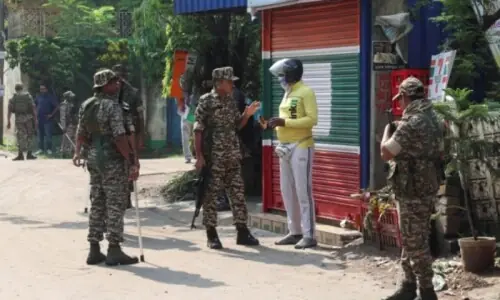
POLICE pickets are back, reportedly with a vengeance, on the streets of Lahore as the city police fail to arrest the rising crime wave. The new Punjab inspector-general’s order to reverse the decision of his predecessor, who had removed the pickets terming them a nuisance for citizens, has left the people baffled. Policemen posted at the pickets often end up fleecing the motorists while criminals continue to rob the citizens with impunity. If the latest measure is in response to the mysterious episode involving a DIG who was allegedly mugged at gunpoint and wounded by a gunshot the other day, it is all the more bizarre: why punish law-abiding citizens for the police’s failure to track down the culprits who assaulted one of their officials? The pickets set up along the city’s thoroughfares on Tuesday night did not stop the robbers from striking at least 20 times the same day, or indeed from snatching at gunpoint cell phones, cash and jewellery from many a road-user.
There are widespread complaints against the newly recruited Muhafiz force which patrols Lahore’s roads on motorbikes in groups of two. Not too long ago a couple of these policemen were reportedly accused of having staged robberies and even of attempting rape. You cannot instill a sense of responsible policing in new recruits when they are routinely used by officials and politicians to harass their opponents. The absence or ineffectiveness of the existing public safety commissions, as envisaged in the police reform plan, has left the citizens at the mercy of robbers and a police force that they have come to fear equally. Police pickets and street patrols by trigger-happy, young recruits have failed to yield the desired results. These cosmetic measures should be stopped forthwith and more serious efforts made to restore a sense of security among the citizens.
The enduring energy crisis
OFFICIAL inaction in the area of adequately increasing the energy output or its ready availability to meet the needs of the people for the last seven years has made them face the prospect of increasing loadshedding with all its crippling impact and the Water and Power Development Authority (Wapda) fears a shortfall of Rs84 billion to meet the challenge. The government will again come to its help and enable it receive the financial assistance in the form of a large budgetary support, commercial bank loans and sanctions for higher electricity rates apart from permission to import furnace oil. All that will add to the financial liabilities of the Authority, earlier dubbed as white elephant.
The cheapest source of power is the hydel power from large dams, but the government has waited for seven long years to decide on the five dams led by the Kalabagh dam, Daimer, Basha dam, Akori dam etc. It could have taken a decision on the other four dams and got down to work earlier if a political consensus on the Kalabagh was not coming forth.
But it waited for too long and ultimately President Musharraf had to exercise this option in favour of the Kalabagh dam and move ahead cautiously.
They are to be completed by 2016 — nine years from now when more hydel power may become available.
The Wapda has a loss rate of 23/24 per cent of its output even after strenuous efforts to reduce its heavy loss rate.
And each percentage of the power lost means a loss of Rs2.5 billion. Even when the power is paid for in full, the Wapda is a loser.
Its production costs per unit is Rs4.75 and its sale price is Rs4.10 — a loss of 65 paisa per unit.
Wapda has to receive Rs50 billion from Fata and the the NWFP including Peshawar. And it has to pay Rs100 billion to the independent power producers for the power it buys and for that it doesn’t use.
It often buys power at a higher rate than it sells to the consumers along with the cheap hydel power it gets from the large barrages.
This happens as the power tariff has not been increased since November 2003 which it has to do now.
The World Bank and the International Monetary Fund (IMF) have been urging the Wapda and the government to carry out the power sector reforms suggested by them and accepted by Wapda.
It has to unbundle its 12 distribution companies and let them charge their own power rates.
The donors argue that if the power sector reforms are not carried out in full they will not extend large loans for the big dams.
The government is slow in implementing the reforms for fear of political fallout of the high power rates. But now it cannot resist or delay any longer but this is the election year in which it is not politically wise to ruffle the millions of voters’ feathers.
Wapda has been helped to an extent by the fall in oil prices. Otherwise it would have needed a total financial support of Rs90 billion.
But even now the cost to the nation for the oil import this year may be $7.5 to 7.8 billion as against $6.5 billion last year and that is the outcome of an 80 per cent rise in the fuel oil consumption.
Wapda's cash shortfall in 2002 was Rs30 billion. Since then there has been a 180 per cent rise in the need for financial support. The government had come up earlier with financial assistance of Rs100 billion. The shortfall in June was Rs56 billion.
The government used to protest that it had to pay an annual subsidy of Rs100 billion to the public sector before the process of privatisation began. Now that the privatisation is half way through there is still a demand for nearly RAS100 billion from Wapda while the privatised Karachi Electric Supply Corporation (KESC) has to look after itself.
While the oil prices have now come down to 55 dollar a barrel, the oil producing countries are disturbed and they want to hold up the price around 60 dollars a barrel if they can.
And they are meeting soon to reduce their oil output and raise their oil prices.
In such circumstances China has called for an Asian buyers’ cartel or association to safeguard their own interests.
This is the right move at this hour.
While the prospects of the oil prices staying high are real, little efforts are being made to reduce the waste and theft of power in Pakistan by the Wapda and the KESC. Wapda, by its own admission, loses a quarter of its power (23-24 per cent).
It produces after it has come down from the 40’s range. It is losing a lot of money on this core at the rate of Rs2.5 billion for a percentage of power lost.
KESC's power loss had shot up to 17 per cent for a while in 2004 before coming down. What is the rate of theft and waste now that it is privatised has not been publicly stated. It is doing its theft catching work quietly.
Some of the power thieves are influential persons or powerful officials. One has to be wary of ruffling their feathers. The others in the Katchi abadis are well organised and militant enough to resist Karachi Electric Supply Corporation (KESC) moves. But these days some of the poor are being charged exorbitant rates arbitrarily.
The massive power theft must be rooted out in a systematic manner. Otherwise the poor and the middle class will continue to pay very high rates for power as well as suffer the privations of frequent loadshedding.
The need of the hour is a relentless drive to cut waste of power and promote energy conservation assiduously. But in reality the waste is on the increase and very conspicuously.
The wedding galas are getting larger and fancier and opting for elaborate illumination. The houses are illuminated more fancily than before and for a larger number of days. Wedding halls with mindless illuminations are increasing in number.
Many of them are lit up even when there are no functions taking place there. Each major wedding is having too many functions as compared to before and are orchestrated by professional event managers. In this context the old question of whether to serve wedding dinners or not has become absurdly out of place.
The KESC staff gets 999 units of power free in a month. It costs the company a lot of money than when a unit used to cost 25 paisa.
In such an environment the need for energy conservation is hardly mentioned.
It has become an obsolete slogan with the president and the prime minister attending many wedding functions, no host feels he has to exercise any restraint in spending.
On the other side, the government has come up with a liberal and comprehensive Alternate Energy Policy which if earnestly and fully implemented will reduce the need for oil and gas. But while it wants wind power, solar power, hydel power and power from coal etc, there is no organised drive to make the policy popular and make it a success. The policy with its positive merits and liberal rewards needs active and imaginative salesman ship.
Usman Aminuddin , a former petroleum minister, says Pakistan can get more energy out of the Thar coal reserves than what China can provide out of its energy reserves.
The methane gas from Thar coal can eventually provide all the gas we need, he says. We are supposed to seek the assistance of China in this area, but we have been tangling with the Chinese company trying to get the gas out of Thar as the company wanted 50 per cent of the profit.
But now the dispute appears to have been settled. Let us wait for some real action.
China should be made to feel we are earnest in getting energy out of Thar coal and in expanding the projects to its full steadily. That is all the more imperative whenever energy demand rises by 50 per cent in two years.
Energy shortage is a three-dimensional problem for Pakistan. When oil prices rise, the government has to provide a large subsidy to Wapda out of its tax revenues. And when higher oil imports consume as much as $7.5 billion, it strains our external account excessively.
All that results in high electricity rates which the people and the industry cannot afford. Then, there is the exasperation of continuous and frequent load shedding which sometimes produces violent outbursts.
So the country as a whole should take the energy issue far more seriously rather than leave it to the government to manage it alone.
| © DAWN Group of Newspapers, 2007 |