Israeli-Turkish relations
TURKEY recognized Israel in 1949. It may be recalled that Ismet Inonu was the president of Turkey at this time. He had been Kemal Ataturk’s principal lieutenant, and in that role he had been a participant in Ataturk’s relentless drive to disestablish Islamic institutions and discourage Islamic observances and practices in the process of secularizing Turkey
The Turkish elite at the time did not envisage an active role for themselves in the Middle East. They did not entertain either much respect or affection for the Arabs. That Israel was a Jewish state engaged in conflict with the Arabs did not, in their view, disqualify it for normal inter-state relations with Turkey.
Relations between the two countries remained fairly mundane for several decades, and it was not until the 1990s that they began to be newsworthy. From then on, while they covered several areas of interaction, they were first and foremost strategic in character.
In 1996 the two countries signed an agreement providing for cooperation in a variety of defence-related areas, including exchange of military visits, joint training exercises; sharing of intelligence and military know-how; Turkish participation in the manufacture of aircraft, missiles, and other weapons.
The following year Israel exported weapons valued at 3.4 billion French francs and contracted to modernize 54 Turkish Phantom and 48 F-5 warplanes at a cost of $700 million. The planned modernization was to include structural improvements, installation of radar systems, computerized aeronautical and navigation systems, electronic warfare capability, and armaments to improve the planes’ bombing performance. The contract was to run until 2008.
Israel also offered to modernize Turkey’s Pattons (tanks) of which it had 4,000. Israel would equip them with Markava 120 mm cannon, additional range and penetration power, day and night vision, and 900 hp engines. It also agreed eventually to set up Markava tank production lines in Turkey, showing that mutual trust had been established and Israel was willing to share its military secrets with Turkey. Israel was also said to be ready to sell surface-to-surface missiles.
Starting December 1998, Turkish and Israeli naval craft have periodically carried out joint “search-and-rescue” missions, and their air forces have held joint two-week exercises several times a year with half of the deployments in each country. Israel has sold to Turkey Python 4 air-to-air missiles, and the two have collaborated in manufacturing the Popeye surface-to-air missile. They have discussed Turkish participation in the production of Israel’s Arrow anti-missile missile and a jet-propelled 400 km range cruise missile. The strategic “dialogue” between the two countries has been institutionalized.
It should be noted that in Turkey the impetus for strengthening relations with Israel has come primarily from the generals, and they are the ones who have sustained it even when the ruling politicians were sceptical, as was the case when an Islamic party had taken power in Ankara.
While the potential for non-military bilateral trade between Turkey and Israel is substantial, the actual volume in recent years has been rather modest. In 1996, for instance, Turkish imports from Israel amounted to $196 million and exports to Israel reached $243 million. Turkish exports to Israel included textiles, light industrial goods, electronics, food products, and grain. Israel’s main exports to Turkey consisted of chemicals, plastics, air conditioners, computers, medicines, telecommunications, and irrigation equipment.
Places in Turkey have increasingly become favourite destinations for Israeli tourists. More than 350,000 out of some two million Israelis who go abroad for sightseeing, fun, and recreation have been coming to Turkey since 1995. They spend on average $1,000 per person. Their combined gambling losses in Turkish casinos (which become gains for these establishments) amount approximately to $1.5 billion annually.
Looking to the political side of the Turkish-Israeli connection, we see that both sides have been apprehensive of Iran and Iraq, and from time to time Syria as well. In Israeli perception these countries harbour and aid Palestinian and Islamic militants. Turkey, Iraq, and Iran contain large Kurdish minorities that, for many centuries have been possessed of a lively sense of their distinct national identity and the aspiration for a state of their own. They are thus a separatist force in each of these three countries. Yet, each of them has, from time to time, instigated the Kurds in one of the other two countries to assert their separatism and disrupt order. Syria is known to have housed and trained cadres of Kurdish nationalists (PKK) from Turkey.
At one time the Labour government in Israel sought to make peace with Syria, disregarding Turkish sensibilities, but the Likud has been more attentive to them. Prime Minister Netanyahu suspended contacts with Syria, and made it known that peace with Syria would not be made until it ended its aid to the Kurdish separatists.
In 1996, Prime Minister Shimon Peres used his contacts in the Council of Europe, and those in the Socialist International, to gather support for the project of a customs union between Turkey and the European Union. He also supported Turkey’s drive to prevent the placement of Russian S-300 anti-aircraft missiles in Cyprus. The Jewish lobby in Washington has worked to tone down American congressional criticism of Turkey’s alleged failings in the area of human rights.
The bright image of Turkish-Israeli relations is not without wrinkles. The Arab states are more or less unhappy about the Turkish-Israeli friendship. Some Syrian spokesmen have described its emergence as the greatest “mishap” since the creation of the state of Israel in 1948 and as the most “perilous milestone” since the First World War. Commercial relations between Turkey and the Arab states have been on the decline. In 1982, 44 percent of Turkish exports went to the Arab Middle East and 29 per cent of its imports came from that area. By 1996 these figures had fallen to 11 per cent (Turkish exports) and eight per cent (Turkish imports).
Let us now look at the impact that the relationship with Israel has had on Turkey’s domestic politics. It should first be noted that many millions of Turks have lately begun to resent Israeli repression of the Palestinians. The Israeli connection has thus sharpened the polarization between the “Islamists” and the secularists, and between the former and the military elite who have all along acted as the guardians of the Kemalist legacy.
The Islamic press in Turkey has often linked the moves to close down the seminaries (“madressahs”) with pro-Israel officers. The man who attempted to assassinate President Demirel in May 1996 justified his action as a response to the conclusion of a military agreement with Israel. The Islamists alleged that the Turkish generals had come under the spell of Zvi Elpleg, the Israeli ambassador, who wanted to topple the government of Prime Minister Necmettin Erbakan (who belonged to an Islamic party, “Refah”).
They believed the Jews loved no one except themselves, and anyone wishing to make agreements with them should think twice. Israel, they said, had been fomenting divisions between Turkey and its neighbours. They cautioned that close ties with Israel would also hurt Turkey’s relations with the Balkan states and the Turkic-speaking republics in Central Asia. They denounced Israeli diplomatic establishments for corrupting Turkish morals in that liquor flowed at their parties like water.
These perceptions and attitudes notwithstanding, cooperative relations with Israel continued even when Erbakan was prime minister in 1997. Another Islamic party, called Justice and Development Party (AKP), formed the government in Turkey in January 2003, and relations with Israel came under a bit of strain. In May 2004, Prime Minister Recep Tayyip Erdogan accused Israel of state-sponsored terrorism against the Palestinians, and Abdullah Gul, the Turkish foreign minister, called his ambassador in Tel Aviv home for “consultations,” provoking a Likud member of the Knesset, Ehud Yatom, to say that Turkey should make up its mind whether it stood with or against Al Qaeda terrorists.
Prime Minister Erdogan and his party appear to have decided to strike some kind of a balance between their relations with Israel and those with their Arab neighbours. There are, thus, moves to increase trade with Syria. In view of their desire to join the European Union, Turkish leaders also want to align their policy more with the European, rather than American, thinking, which is critical of Israeli policy towards the Palestinians.
There is thus a slight sliding away from Israel. Recently Israeli companies were excluded from certain types of contracts for military hardware, for instance, helicopters, ostensibly to boost domestic industry. On the other hand, as recently as May 2004 Turkey contracted to sell Israel 50 million cubic metres of water (from a Turkish river) annually for the next 20 years.
What may we now say as to how a Pakistani relationship with Israel will fare? In my reckoning it is not likely to be all that advantageous. Pakistan is not as attractive a partner as Turkey. Its location is of no great consequence to Israel. It may be a gateway to Afghanistan and Central Asia but Israel has little, if any, interest in this region. The roots of the Islamic establishment in Pakistan are deeper and sturdier than they may be in Turkey, with the result that the anti-Israel and anti-Jewish sentiment is Pakistan is likely to be stronger.
Pakistan’s receptivity in Israel, when the newness of relations has worn off, is, therefore, problematic. Any Pakistani effort to influence Israel’s India policy, pleas that it should be treated on par with India, will get nowhere.
Israel may be willing to sell weapons to Pakistan if it has the money to buy them, but I doubt that it will share its military secrets and high technology with Pakistan, as it has done with Turkey.
As I see it, Pakistan’s recognition of Israel, and the establishment of diplomatic relations with it, will be a dramatic departure from a long-standing policy. But otherwise, this is not an issue of any great moment. Pakistan’s relations with Israel, if they do materialize, will probably be of the same order as those with a number of other countries such as Egypt, Indonesia, or the Philippines. They will be “nothing to write home about,” as an American expression has it.
The writer is professor emeritus of political science at the University of Massachusetts, Amherst, US.
E-Mail: anwarsyed@cox.net
Management of a disaster
THE Pakistan army has come to occupy the centre-stage in the country’s politics and administration. The politicians and the civil servants may accept or resent this situation, as they varyingly do, but are compelled to take a role subordinate to the soldiers, or quit if they don’t.
That is in times normal. In the havoc wrought by the earthquake they are hardly seen playing any role at all. The distressed people must be wondering who would have done, whatever little is being done for them, if the soldiers were not there. The people cannot be faulted for carrying this impression. A sad but hard fact to be recognized is that army is the only effective and disciplined institution left in the country today. All others stand diminished or subverted.
This is recognition of a fact — and not a tribute, but an indictment. The army’s repeated interventions in civil affairs on the pretext of rooting out corruption or restoring law arid order and then staying on and on to reform the system (the reform as the commanders view it) have not only shattered the political parties, the civil services and indeed civil society itself but has also made them all irresponsible. No other event or argument can underline this position more forcefully than the harrowing tragedy of the earthquake.
In managing the current crisis, the civil administrator; at all levels and of all vocations have been silent spectators and the ministers and other politicians only haranguing. The district administration, which used to be the pivotal point of action and source of relief in all calamities — natural or man-made — has all but ceased to exist. This action and responsibility both now stand transferred not even to provincial capitals but to Islamabad.
The involvement of the federal government and of the army in an operation of this vast and tragic proportions was indeed necessary and inevitable but the rescue and relief would have been managed quicker and better were it to be assessed and supervised by the district administration. The criticism for delay and neglect then, too, would have been directed at the local officials and not at the president and the army commanders.
The councillors and nazims have a role to play in community and civic affairs but they cannot be a substitute for professional administrators at all times and more particularly in an emergency. In the system introduced by General Musaharraf, the nucleus of administration its a district where all departments were represented has disintegrated.
The real worth of the deputy commissioner or district magistrate lay not in his powers or even competence but in providing a forum for the representatives of all departments — federal, provincial or autonomous — to assemble and coordinate their activities whenever the circumstances so demanded.
Now all of them have to wait for instructions or orders from their superiors in the provincial or federal capitals before they act. Such a phenomenon was observed by Nick Bryant of BBC at a destruction site where the men of an organization were present but waited for instructions from above before extending a helping hand to the people buried in the rubble.
The decentralization of authority is an obvious necessity but more important in an emergency is that the officials on the spot should lie able to act even beyond the delegated authority. This view of administration was articulated well by Sir Bartle Frere in a communication to John Lawrence.
He wrote: “There is always in India (read Pakistan) some need for public servants acting without order on the assurance that when their superiors hear their reasons, their acts will be approved and confirmed; and 1 hold that when you have extinguished that feeling of mutual confidence between superior and subordinate authorities and made public men timid you will have removed one great safeguard of our Indian empire. It does not take long to bridle a body of public servants as to paralyse their power of acting without order”.
In Pakistan it hasn’t taken long at all. What Frere said 150 years ago is as relevant to the republic of Pakistan as it was to the Indian empire. The great pity is that now the public servants fail, or refuse, to do even what lies in their power without orders from their superiors (read ministers). No doubt then that the local administration was paralysed when the people were dying and the looters were revelling.
All authority at the centre and a paralysed administration in the field has cost lives which could have been saved in the rescue and relief phase of the disaster. A source of further worry, however, is that in implementing the measures the president outlined in his broadcast of last Wednesday (timely and well thought out though it was) the same mistake may be repeated on a larger scale in the reconstruction and rehabilitation phase.
The impression one got was that all the controls will continue to lie in Islamabad and the authority in the army commanders. Every stricken area has its own needs and priorities. The authority, therefore, should vest in the district or in a field unit specially defined in relation to the disaster. Islamabad should provide the money, the army may help but the implementation should be made a responsibility of the local administration. That might bring life back to normal in a year and not three or four as the president imagines or his central advisers propose.
Two more quick thoughts in a situation of grief and helplessness. First, if our 10,000 or more madressahs could raise legions large and inspired enough to conquer Afghanistan, surely they could have provided fewer volunteers to help their own suffering people. That is the spirit of the doctrine of jihad. The jihad they launched has ended up in terror. Second, we should recognize our friends by the help they render and not the faith they profess.
A generous response
THE news from earthquake-stricken Pakistan gets steadily worse. Initially the death toll was estimated at 20,000, making the disaster 20 times more lethal than Hurricane Katrina. But now an army official close to the rescue operations revised it up to between 35,000 and 40,000, with 2,000 more fatalities likely across the border in Indian-controlled Kashmir.
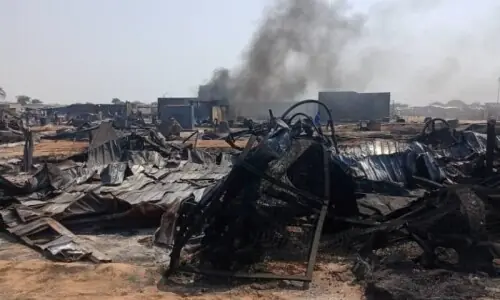
This is nothing like the Asian tsunami, which killed an estimated 230,000; nor does it approach the scale of the Bangladeshi cyclone that killed about 140,000 in 1991. But the provincial capital of Muzaffarabad has been reduced to almost nothing. At least 2 million people are homeless, and winter is just weeks away.
The response — or at least the announced response — has been generous and fast. The United Nations issued an appeal for $272 million, but its call appeared almost redundant: Kuwait and the United Arab Emirates have each promised $100 million worth of assistance; the Bush administration, which was slow off the mark after the tsunami as well as after Hurricane Katrina, has already pledged an initial $50 million.
Aid missions of various kinds have reportedly arrived from Britain, China, South Korea, Turkey, Spain, Iran, Russia, the Netherlands, Japan and Germany. The first US transport plane loaded with blankets and other relief supplies landed in the afflicted region on Monday. And US helicopters arrived from neighbouring Afghanistan to ferry in relief supplies and take the injured to hospitals.
Just as with Katrina, managing and coordinating a vast relief effort is no easy matter. Pakistan’s military-dominated government may be suited to delivering a quick initial rescue effort, but the lesson of past earthquakes is that top-down responses aren’t enough.
Pretty soon, the relief operation has to make a transition: The victims can’t be treated as passive recipients but must be helped to help themselves. In rural areas, villages can be rebuilt by their inhabitants if local leaders are given the cash to procure construction materials. In towns, cash assistance to families has been shown in past disasters to work better than handouts of food and blankets after the initial emergency has passed.
At the same time, Pakistan’s government needs to focus immediately on the decisions that only the public sector has the authority to make. Before urban rebuilding starts, geologists need to determine where reconstruction can most safely be located.
Once that decision is made, the government must arrange to buy the chosen land or set the rules by which private citizens can do so. It must establish procurement procedures for the reconstruction of public infrastructure that balance haste and sound financial management, and it must establish building codes. The lesson of past disasters is that this sort of planning has to happen fast, before dozens of aid agencies cut separate deals with different government departments to rebuild this or that in an uncoordinated manner.
If there is any silver lining to this tragedy, it’s that it may shock people into fresh thinking. This can lead to innovations, such as insurance schemes that create incentives to build in safer places, or it can lead to geopolitical progress. Greece offered help after Turkey’s 1999 earthquake, beginning the diplomatic thaw between these traditional enemies. After the Kashmir earthquake, India offered aid that Pakistan accepted.
—The Washington Post
| © DAWN Group of Newspapers, 2005 |