0
0

Afghanistan: no end to uncertainty
THE American pride and supremacy almost perished within less than an hour on September 11, 2001. The day when the World Trade Centre in New York and the Pentagon were hit by Osama bin Laden’s Al Qaeda, will go down in history as a day of a stunning blow to the world’s only superpower. The unprecedented incident undoubtedly panicked the United States and its allies in the West and elsewhere.
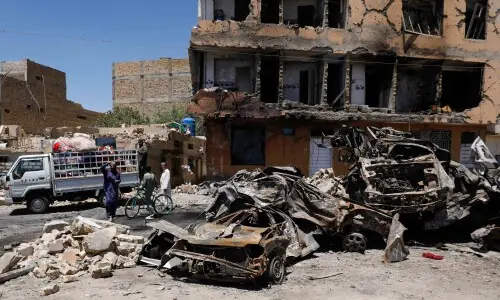
But there could be no better off-shoot of the blasts than the anti-Taliban campaign in Afghanistan. The limited action was rather overdue to restore peace and security in the war-torn country. The US-led coalition might have succeeded to the extent of restoring peace in the Afghan capital, but the problem of ethnic rivalries and the lust for power — the root cause of the bloodshed following the withdrawal of the Soviets — has hardly been resolved. Unless that was achieved, the prospects of peace will continue to be as bleak as ever and a renewed factional fighting may be expected any time.
Denying Al Qaeda and former Taliban elements a chance to rally and recuperate for a possible spring offensive, was as important an objective as destroying them. Surprisingly, Rumsfeld, during his address to the coalition troops in Kabul, made no mention of Osama, Al Qaeda or the Taliban — a significant retreat from the objectives that were originally outlined for the coalition. The focus rapidly shifted either to Pakistan where many Al Qaeda men and Taliban were believed to be hiding and on economic and political development of Afghanistan. This added to the growing confusion about the aims of the British and American military operation in Afghanistan which, it was believed, had subtly been redefined.
The US and its imposed leadership in Kabul were quite apprehensive of the possibility of a hostile reaction here and there and even the American defence secretary was said to have been told by Karzai that Taliban and Al Qaeda forces were likely to come out of hiding and stage further attacks. The American frustration can be judged from the fact that despite all the latest equipment, armaments and devices at their command, they were not sure whether Osama had been killed or is alive. And if alive, where he was.
Did anything positive emerge out of the much publicized Loya Jirga and the return of ex-King Zahir Shah. The answer is simply ‘no’. The opening session of the Loya Jirga provided an integrated forum to the warlords to attack each other and blackmail Karzai. Instead of promising peace and resolving the core issue of ethnic divide, the 1600 plus gathering of delegates with highly diversified views, could achieve nothing except granting extension to Karzai for two years till the national election scheduled for 2004.
Similarly the return of ex-King Zahir Shah was of no avail. Afghanistan of today is far different from what it was in 1975 when Zahir Shah — then 58 — was overthrown by his cousin Sardar Daud. That was the country under one command when Kabul’s writ was firmly established all over Afghanistan, while today’s Afghanistan is split into an unknown number of domains — each one of these being claimed by one warlord or the other.
Now the ex-monarch is 85. He is too old and weak to deliver the goods. He could, possibly, help resolve the crisis, had he returned through the courtesy of the then mighty Soviet Union, about twenty years ago instead of the US-led coalition today. But what spoiled the golden opportunity was the Soviet adventurism which resulted not only in the break-up of the empire but also in the devastation of Afghanistan and the Afghan nation.
Pakistan too suffered heavily by virtue of a senseless policy pursued by military dictator Zia. He had staked Pakistan’s security for the sake of Afghanistan and personal benefits. The damage caused by him because of the Afghan policy was irreparable and Pakistan will continue to pay a heavy price for that one folly for years to come.
Today it is an extremely different ball game. The traditions had changed and so had the priorities, temperaments and even the culture. Nobody was prepared to play the second fiddle. Personal ambition has become more important than the state and the institutions. Incidentally that is equally true about Pakistan.
Till the end of June 2002, a force of about 5,000 British, German, Turkish and other allied troops, was based in Kabul and the Bush administration was averse to the demand for a four-time increase in the number in order to cover the rest of the troubled spots in the country. There has been a change of command also — the Turks replacing the British. The change, however may not bear the desired fruit.
A people having no tolerance and humanitarian considerations for their compatriots and subjecting them to unheard of brutalities would obviously care a hoot for the foreigners whether they were Muslims or non-Muslims. The coalition forces are under constant threat of being attacked by the underground resistance and within two months or so since the holding of the Loya Jirga there had been as many as 61 attacks from different directions.
The turmoil in Afghanistan had started in 1979 when the Soviet troops marched into the country with one faction of the Afghans being backed by the Soviet Union and the other by the so-called Islamists, supported by the US and its allies including Pakistan. The US and Pakistan were in fact so deeply involved against the Soviet intervention that it was nothing less than a proxy war. But surprisingly the credit for the termination of the Soviet occupation was claimed by the rightist Afghans. The second phase of the civil war was more or less, purely Afghans versus Afghans while the third phase, beginning with direct involvement of the US-led coalition following the September 11 incident should be a hide-and-seek between the coalition and the Al-Qaeda and Taliban. The events suggest a prolonged game with Pakistan, once again, being the strongest base this time for both the sides.
According to analysts, it should not be a surprise if one fine morning the Russians also join in to secure their own borders against a possible infiltration by the Islamic extremists. The Russians and the Americans, fought the Germans together in the Second World War and they could do it again for the sake of a common cause, despite the bitter memories of Vietnam and Afghanistan following the country’s occupation by the Soviet Union.
According to Simon Tisdoll of The Guardian, “Afghanistan once again is an occupied country and may one day turn against its occupiers. Looking through the Pentagon ‘fact sheet,’ it becomes over clearer that the war on terror in Afghanistan is turning into something quite different from tough, bloody struggle initially envisaged. It is becoming a quasi-permanent, multinational military jamboree. Afghanistan is the Pentagon’s new playing field and parade ground, and everybody who calls himself a friend is joining in. Quite what President Hamid Karzai makes of all this, sitting impotently in Kabul, is anybody’s guess. But who’s asking him anyway? In effect, the ‘Great Game’ of old empire days has entered a new round, more skin to bingo than diplomacy. Everybody has a hand to play; all want a stake. Post-Taliban Afghanistan is a fun outing for military top brass.”
So far as Pakistan was concerned, it failed to grasp, after a sensible start, to curb the growing threat of religious extremists, whose combined vote bank totalled hardly four per cent but still excelled in exploiting their nuisance value.
Karzai, no doubt, is a Pakhtoon but the hiding Taliban and the Al Qaeda who too are mostly drawn from the majority ethnic group, consider him an American stooge and a nominee of the Northern Alliance, which successfully blocked their victory march to the remaining less than one-fifth of Afghanistan under its command. Obviously, the Pakhtoon dominated areas were the strongholds of the Taliban and the Al Qaeda during the internal strife against the Northern Alliance. That position has not changed since then with the coalition troops and their Afghan supporters being the target of the two, mostly operating from their hideouts in Paktia, Paktika, Gardez and Khost. Besides the American and British troops, the Pakhtoon component of Karzai’s government, has been the major target of the Taliban and Al Qaeda shoot-outs. In this context, the biggest jolt to the regime was the assassination of its Pakhtoon vice-president Haji Abdul Qadeer. His brother Commander Abdul Haq had earlier been killed by the Taliban a few days before being toppled.
Of late, the Al Qaeda and the Taliban seem to be concentrating on Kabul, in an attempt to create panic in the capital and destabilize the Karzai regime, which, despite enjoying not only the close coordination but also the protection of the coalition forces, has not been able to establish its writ in the country. The scenario that is developing, particularly since the holding of the Loya Jirga, suggests a prolonged uncertainty which has already halted the process of repatriation and rehabilitation of the refugees residing in Pakistan. The official figures put the number of these refugees at 1.2 million before the repatriation began but the actual number was not estimated to be less than 3.5 million. The official figures, do not perhaps include the growth of Afghan population during their twenty-two years’ stay in Pakistan.
Governance: some truths
WHEN I resigned from the Punjab government I was often asked what lessons I had learnt from my 14-month stint in office as finance minister. Well, I would identify six key ones. The top three, which are essentially linked, if not inter-twined, are quite basic in nature.
The first is that a leadership must have a vision. And when it comes to vision, you either have it or you don’t. You cannot walk into a doctor’s clinic or your neighbourhood pharmacy and ask for a 1,000 cc of vision to be injected into a leadership.
Secondly, the leadership should have courage, will and determination to take difficult decisions. Which means you must have a spine. Unfortunately, you cannot grow a spine or replace a wobbly one with one made of platinum. This factor, in a sense, is also connected with vision; it is pointless having one without the other.
Viewed as a pessimist by both friends and family, the period in office, instead of reinforcing my worst fears, converted me into an optimist, convinced that a lot more is ‘doable’ and achievable than one had thought from outside. This optimism may seem strange and contradictory to the decision to quit office. But the reasons for leaving lie elsewhere; they do not belie this conclusion.
Thirdly, given scarce human (development of human capital has never been a governmental priority) and financial resources, you must set your priorities. We cannot tackle all problems simultaneously. We must prioritize and select a, b and c to be taken up first (which may be driven by political considerations, but choose we must) and d, e, f, g ... to be put off or not taken up at all. This matter is also an integral part of what would constitute ‘a vision’.
The fourth lesson one learned was that government is a service of its employees, for its employees and by its employees. Hardly ever in the 14 months did I hear of the rights of the taxpayer or the rights of the recipients of services like education, health, water supply. Only the service providers — government servants — appeared to have rights. They are fully protected and practically unaccountable. It is easier to dismiss a government in this country than any public sector employee who fails to turn up for work regularly, let alone for failing to provide any service having turned up for duty.
Over the years we have created a highly bloated government sector which needs to be cut drastically. It is time to rethink the role of the government in terms of what it should neither do nor pay for; what it should do and pay for (only defence, foreign affairs, monetary and fiscal policy, justice and law and order readily come to mind as its sole responsibility and not that of any other agency); and those it should pay for (being its moral obligation) but not necessarily do it itself (ensuring that children get free good-quality basic education up to the elementary level without the government necessarily providing the service itself is an example of what I am trying to argue).
The middle class in Pakistan wants everyone other than itself to be regulated. We all want high quality of services but are not prepared to pay for them. Part of the problem stems from our history in which even the middle class did not grow independently of the dynamic process of economic growth, but flourished through state patronage, be it through employment opportunities in the public sector or through industrial units established in the public sector and then handed over to private entrepreneurs. It also benefited by setting up private industry which the state protected against competition, both domestic and international.
Although the role of the state is changing, albeit reluctantly and under external pressure, Pakistan’s civil society still does not believe that we can prosper without government benefaction. Hence, the refrain that I heard in the government: “so many doctors are unemployed; the government must do something about it”, the state being visualized more as an employment bureau, the employer of last resort. And then there is this hatred in our value system of anyone perceived to be making “unreasonable profits” (whatever the phrase may mean), the term almost carrying the connotation of a dirty word. These symbols and factors are the most formidable constraints to expansion of private economic activity.
The most startling statistics that a recent World Bank report reminds us of is that in 1965 Pakistan exported more manufactures than Indonesia, Malaysia, the Philippines, Thailand and Turkey combined compared to the situation today of our exports being half those of the Philippines, one-seventh of Thailand and one-ninth of Malaysia. Together with our shameful social indicators on levels of literacy could there be more telling evidence of where we stand among the nations today. For the mess that we have landed ourselves in, the blame cannot be placed at the doors of our favourite bogeymen, the IMF, World Bank, the US and India. We have done this to ourselves and with such aplomb and, seemingly, conviction that one is left aghast and speechless, unable to explain such behaviour.
What is, however, more worrying is that, given the quality of governance and the level of competence (within what is generally referred to as the “establishment”) to which one was exposed during the 14 months in office, this writer is convinced that we are quite capable of bringing ourselves to such a pass yet again given another opportunity to do so. Even at the level of civil society there is little evidence to suggest that we have learned anything either from our past mistakes or the experiences of other countries.
Which brings me to the final lesson I learned in office. Although there are some early signs of an emerging consensus on the major issues confronting Pakistan (with the exception of our continued confusion about the role of religion in our lives), there are few indications of a consensus on the solutions. We do not appear to be willing to acknowledge that the world has nearly given up on us and that we no longer appear on the radar screens of the major investing and trading countries. We do not seem to accept the fact that we have been marginalized even in South Asia, what to speak of the rest of Asia.
Despite all evidence to the contrary, there are still many in this country who seriously believe that we are the centre of the universe, that the world cannot ignore us or do without us and that one of the first questions that President Bush asks every morning is about the latest situation in Pakistan.
Whereas fundamental reforms are required, the widely held belief is that reforms will, and can, be painless; that somewhere there is a magic wand that can make it so; and through financial wizardry, Pakistan’s huge economic problems can be resolved overnight and then we can all live happily everafter.
The vast majority of the population seemingly continues to live in Cloud Cuckoo-land, believing that we can reach the ‘promised’ land without sacrifices having to be made. That bankrupt governments can continue to play Santa Claus, distributing never-exhausting bounties of goodies. Moreover, the realization has yet to sink in that we cannot continue to tax the people without the provision of services and that it is the expenditure side of the budget equation that needs to be addressed first instead of the revenue side.
The reforms that have become critically important demand sacrifices by all except the most vulnerable groups in society. And sacrifices, like charity, must begin at home — essentially by tackling the size of the civil and military establishments. This will require asking ourselves, to begin with, a rather simple question: should Kashmir ‘come first or Pakistan’ — which to us is more important? From this will flow the answers pertaining to the future role of the military.
Many bitter pills have to be swallowed and urgently, for there cannot be more of the same. Postponement of reforms through doses of rhetoric and sugar-coated placebos are no longer an option. And unfortunately we cannot wish our problems away. Things will happen by default, as the rest of the world moves on, restricting opportunities for us further. While we dither, other nations will surge ahead, the gap widening between us and them.
Irrespective of who will take over in October, it will be a very long haul in which there will be a lot of pain, even for the less affluent segments of society. There is limited, if any, room left for manoeuvrability. The only issue in this would be the manner of the sharing of this burden of adjustment, its equitable distribution among different income groups. All this will require a paradigm shift in policy and strategy.
In my view, we need to initiate an open public debate on television by engaging all groups in society, including political parties of different hues, on the bankruptcy at all levels of government and in the bulk of the public sector corporations. This dialogue will reveal the extremely narrow range of viable alternatives available for attaining financial sustainability. The participation of civil society in this debate will also enable the people to recognize that time has almost run out for us and further deferral of hard decisions will only make the inevitable surgery much more agonising and traumatic.
The writer is former finance minister of Punjab.
The other deadly threat
THE recent arrival of the West Nile virus in the Washington, D.C., area is only now waking up legislators to the threat posed by infectious diseases.
The virus, virtually unknown in the Western Hemisphere until three years ago, usually causes a mild, fever-like illness. However, it produces potentially fatal encephalitis in about one out of every 150 cases. The number of Americans afflicted by the virus, which scientists think may have arrived in the United States in the early 1980s when Asian tiger mosquitoes travelled in tire casings from Japan to Houston, has jumped from 160 to 371 in the last week and a half.
Meanwhile, some chronic illnesses are indisputably soaring. In the last decade, for instance, the rate of asthma in U.S. children has increased 20 per cent; in the last three years, multiple sclerosis in women has risen 50 per cent. And yet, while chronic diseases are the leading killer in the United States, the nation lacks a countrywide effort to research and control them.
Congress needs to create national chronic disease tracking systems modelled along the lines of the widely respected California Birth Defects Monitoring System. That research group made headlines recently with its finding that mothers exposed to automobile exhaust in the Los Angeles area were disproportionately likely to give birth to children with congenital heart disease.
CDC Director Julie Gerberding, a former UC San Francisco epidemiologist, wants to significantly increase the CDC’s budget for monitoring birth defects as well as other chronic and infectious diseases.
Since assuming office last month, however, she has been facing an uphill battle. Groups like the conservative organization Concerned Women for America are lobbying against the budget increase, angry that Gerberding has identified chronic disease and social and environmental dangers like guns and air pollution as health hazards that are as important as bioterrorism.
When Congress returns from summer recess next month, it should recognize that Gerberding understands something her critics don’t: Protecting Americans against foreign threats, be they biological or chemical, starts with health tracking at home.
After all — as the Asian tiger mosquitoes’ suspected arrival in tires attests — in today’s highly mobile world, viruses and other deadly pathogens know no borders. —Los Angeles Times
The blinkers and the truth
THE tragic loss of lives on September 11 last year at the World Trade Centre had another side to it: the humiliation of the strongest nation in the world by a handful of men. Here was America, which represented the unipolar world after emerging victorious in the cold war against the Soviet Union and defeating the ideology of communism.
Just one man hiding in a backward country masterminded a plan, which spanned thousands of miles to strike at New York and Washington to avenge the humiliation of helplessness against untrammelled power. True, almost every nation in the world came to rally behind the US. None dared stand aside. Countries like India offered even bases for operation against Afghanistan, where arch terrorist Osama bin Laden, who orchestrated the strike, without America’s asking.
Still, all this could not undo the fact that someone had dared challenge the world’s most powerful nation. By defeating the Taliban and Al Qaeda, America has put another government at the helm in Afghanistan. But it has not eliminated them, much less their ideology of fundamentalism. And the humiliation part still stares the US in the face.
When Washington talks in terms of attacking Iraq and eliminating Saddam Hussein, this humiliation is still at the back of its mind. The downfall of Saddam may establish that America can punish any country in the world. Those who believe that democracy has to be implanted by outsiders where dictatorships have come to stay may also welcome Saddam’s exit. Still America’s victory will not wash off the blot of humiliation.
That President Bush was justified in declaring a war against terrorism after the September 11 happenings has seldom been questioned. He should have done it long before when terrorism was at its peak in our part of the world. America was least bothered about terrorism till the fire reached its shores. But its fight against terrorism, which is far from complete, does not make up for the humiliation.
This is so because Washington’s eyes are still fixed on the wrong site. It wants to regain its prestige by acting as the world’s policeman — not as the one who cares about the humiliation of others. When the American president stands by Israel and justifies its acts of brutality against Yasser Arafat and the Palestinians, he apparently thinks that the humiliation of the weak doesn’t matter. This is the crux of the problem.
If the world is to be for the survival of the fittest, both respect and humiliation become relative words. They mean different things to different nations. Imposition by the strong does not mean humiliation of the weak. Every nation has its self-respect. When driven to the wall, it will fight back and do anything to protect its honour.
The Taliban and Al Qaeda were hawking the honour of the Afghans and even of the Pakistanis in the name of religion. America allowed such fundamentalists to come up and even fed it through arms and other assistance to serve its own purpose. It believed — and still does — that the people living in the Third World deserved to wallow in prejudice and bias and that their genius was not suited to democracy.
In any case, Kabul was considered too far and too weak to challenge the West and Washington. Moscow too had played with Afghanistan’s dignity. But none of these powers ever measured the resentment of the Afghans. The world woke up when the terrorists struck at New York. It was too late in the day. By then Washington had allowed the Frankenstein monster of fundamentalism and violence to take over in many countries.
In India, we are likely to recall December 13 every year as the date when a suicide attack was made on our parliament, the symbol of the country’s democracy. September 11 and December 13 together should have marked the autumn of 2001 as the advent of a new era in international politics. For, terrorism was posing the gravest threat to democracy and to all civil societies which cherished plurality and permitted dissent. India had long been familiar with the menace of terror but the vulnerability of the US came to it as a shock.
True, Islamabad also came to realize the mistake of supporting the fundamentalists when they began to kill people in Pakistan. Islamabad was happy as long as the target was India. But those who had tasted blood were bound to sniff for it everywhere. A mild Muslim was not good enough, nor was an aspiring democrat. Fundamentalists wanted to change them. And they killed the defiant.
It is difficult to say whether America’s ultimatum to Pakistan for taking sides or the killings by the fundamentalists made President Pervez Musharraf see the reality of the Al Qaeda’s cult. But he put his weight behind President Bush and Washington. It is another matter — no doubt, regrettable — that President Musharraf has a different face for India. His definition of terrorism undergoes a change when it comes to cross-border terrorism.
India’s case is pathetic. It announced all the assistance within an hour of the September 11 attack. I wonder if the then foreign minister, Jaswant Singh, embarrassingly pro-American, had consulted even the prime minister before the announcement. But the tilt of Washington towards Islamabad has not been straightened. Democrat America has all the good adjectives for the military ruler of Pakistan.
After hesitating in the beginning, General Musharraf came all the way. He had no choice. He could not afford to stand alone and become another Saddam Hussein. But India had an alternative. It could have used the opportunity to get the non-aligned nations together to decide on how to fight fundamentalists without America prodding particular countries. Washington would have then realized that it could not take every country for granted.
The manner in which America has gone about curbing terrorism — its proclaimed sole purpose after the attack on the WTC — makes one wonder whether the terrorists are sought to be punished or the nations whose views do not tally with Washington’s. If America had realized that the sovereignty of every country, big or small, had to be respected, the resentment against Washington would not have been so vocal as it is today. It is a tragedy that the animus of America is now against the Muslims. It is apparent from the way the Islamic countries or the Muslims living in the US are being treated. Sometimes one wonders if after decimating the ideology of communism, America’s target is Islam.
Washington should understand that the September 11 action could be repeated. Next time, the target may not be a building but something else. Such an eventuality can be warded off if people do not feel enslaved in their own country. They cannot be an exploited lot all the time. Many in the world are becoming desperate because they are not having enough avenues to overcome poverty, ignorance or ill health. They are helpless. Not just America, even the other western countries do not seem to realize this.
Washington cannot overcome its humiliation by humiliating the nations that do not see eye to eye with it on all issues. The international community is beset with contradictions — political, economic and social. It must resolve them peacefully.
Such countries would do well if they learnt a little humility. It is their refusal to acknowledge this truth that was at the back of the terrorist strikes in the US. If they had understood this basic point, the September 11 disaster could have been avoided.
The writer is a free-lance columnist based in New Delhi.