1
1

It is quite hard to ignore that 14-year-old Ali doesn’t quite walk straight. As he exits the local supermarket and heads to his car, he sways left and right rhythmically. After managing to walk another 40 metres, he reaches his car and slumps immediately in the passenger seat. Face flushed and panting, he turns around and asks his mother if he can drink the chilled can of soda they had just bought.
“Mama please, just once Mama let me drink it,” he pleads even though he had promised that he will not touch it till the weekend, which is still three days away. A few more protestations and his mother caves in.
This would not be the first or last time she has caved in to his demands even though she is well aware that, at 5 feet 4 inches, Ali tips the scale at 105 kgs and his BMI is close to touching the criteria for morbid obesity. Worse, he was diagnosed with diabetes mellitus type 2 just two years back and takes tablets thrice a day to regulate his insulin and weight.
“Ali is my first-born, and he had the most cherub cheeks as a little kid. We would indulge him and feed him because we thought it was part of growing up,” his mother says, oblivious to the fact that a meal two-three times the recommended serving size would have far reaching consequences.
“For the past few years, his appetite had been insatiable. We also noticed he was sluggish and obviously bigger than most children and looked older than his age. We took him to a doctor and he was diagnosed with type 2 DM.”
In fact, he had enough sugar running through his veins to put him in a coma.
Medical experts are unanimous that even though bemoaning the influence of Western lifestyles and food has become a cliché, the alarming rise in the number of young patients coming in with diabetes is anything but. Diabetes is classified into two types: the first has the individual unable to make insulin in his or her own body and hence needs to have it administered; in the second type, the body’s responses to the insulin are blunted. For decades Type 1 was an ailment of young children and type 2 of the middle aged.
But, trends and research show that the conventionally accepted age groups between type 1 and type 2 diabetes now intersect. More type 1 patients are being diagnosed, while the age threshold for type 2 has decreased so much that it is not uncommon for teenagers to be given this diagnosis.
In fact, given that their family did not have a history of diabetes, Ali’s mother, who declined to give her first name, expressed disbelief.
“How could he be diagnosed with diabetes at the age of 11? I thought it was for the old people,” she says.
Her sentiments are no different than those echoed by Obaid Abbasi, whose son Moeed was diagnosed with type 1 diabetes, a completely different form of diabetes, at seven. Type 1 DM is usually diagnosed in children in the first five years of life, but in Pakistan can go undetected till the teens.
“We were shocked. We had no history of the disease in the family yet there it was in front of us,” he says.
An energetic boy, Moeed’s parents had initially dismissed his erratic and irritable behavior as tantrums and “bad manners”.
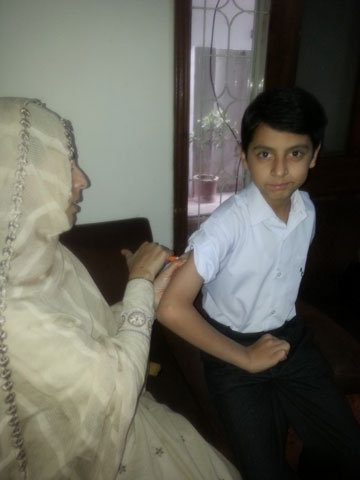
“Moeed would increasingly become irritable. Even though he was well past the toilet training age, he would wet his bed. Finally, one day he fell unconscious and we took him to the emergency room.”
At the ER, Moeed’s blood sugars level ticked at 500 gm/dl – 5 times above the acceptable range for a child his age.
Abbasi says that for the first few months, both he and his wife became overtly cautious. “We would monitor his each and every movement, but then we realised this approach was not making the situation any easier – for us or him. He was growing up and wanted his own space.”
A whirlwind of changes were to follow.
“We worked out the pattern of giving him medicines and reached out to his school to support him,” he says.
Deputed in Karachi at the time of Moeed’s diagnosis, Mr Abbasi remembers being disappointed with the quality of aid available in schools.
“You see schools sprouting up everywhere. But while they have basic medical aid kits they do not even have a glucometer,” he recalls.
His experiences in Pindi have been more somewhat better. “Once we came to Pindi, I personally went to the Army Public School to speak to each of his teachers and principal, to talk about his disease and what to do if he has a hypo or hyper spell. They have been completely cooperative.”
Moeed too is extremely aware of the changes in his own body and checks his own blood sugar levels without being prompted by his parents: “When I get a headache, spinning, nauseous, vomiting, I go and check my glucose levels himself and tell my mother if she needs to give me insulin.”
But while there is independence, similar to Ali, Moeed also has his bad days.
“If he gets into one of his moody phases, he will not let us give him insulin,” says his father.
Dr Fatema Jawad, veteran diabetologist, who professes to have seen ‘diabetic children grow up, get married and have children in front of her’ says that the awareness level about the disease is abysmal.
“In Pakistan, forget about education about diabetes, we have no education at all,” she says. “There is a general lack of knowledge.”
According to her, patients in rural areas suffer the most, and not just because of the rampant poverty.
“Even the doctors there lack an understanding of how to control the disease,” says Dr Jawad. “In Pakistan, if you have money then everything is easy but if you don’t then only God can save you. A couple of organisations have come up in the past few years that distribute free insulin and tablets, but they are few and far between.”
Talking about the economic costs, she says if a child is dependent on insulin, then parents should be ready to pay at least Rs 5,000 rupees per month. Mr Abbasi says the bill for Moeed’s two different types of insulin comes to Rs 16,000 per month.
“But it is not just the medicine,” adds Dr Jawad. “Parents will also have to think about the cost of checkups, appointments, and routine blood, eye and kidney tests.”
“The younger the age of diagnosis the longer they have to live with it. Often diabetes medications that work on adults have failed on younger children,” Dr Jawad says, “so you have to keep in mind all these factors and variables.”
Emotional and economic issues aside, Dr Jawad also feels that society’s perception of the disease needs an overhaul too.
“I have seen so many children grow up in front of me and when they reach a marriageable age I tell them that their future spouses can speak to me about any concerns they have,” she says.“I always ask them to bring your in-laws. With girls, this is more of an issue. I talk to them, I explain to them that she can have a baby.”
In the end she says that patients have to put themselves first and embrace lifestyle changes.
“Don’t have artificial sweeteners, get used to taking tea without anything in it. Invest time and have food on time,” she says. “Children are the parent’s responsibilities and if they do not make wise choices, then they can’t expect the child to either.”
That sense of responsibility, as far as Moeed is concerned, spreads beyond himself.
“Why can’t Wasim Akram, who has diabetes, establish a free hospital like Imran Khan did for cancer patients? If Allah gives me a chance, I will do this myself,” he says with conviction.