10
10
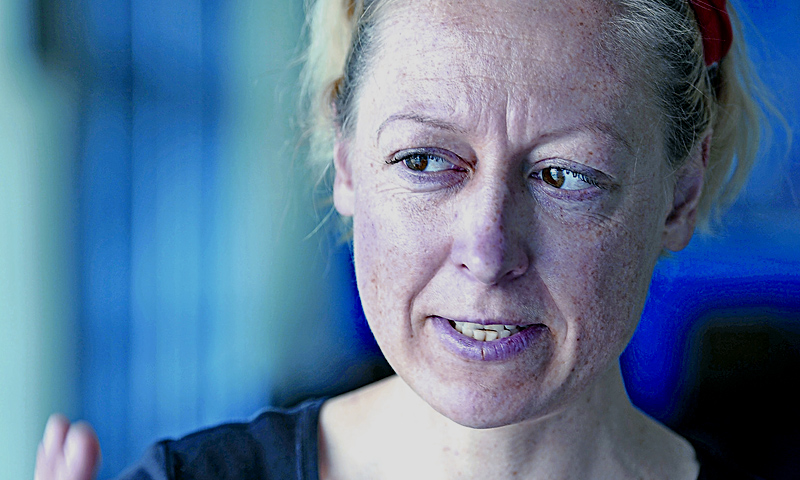

ISLAMABAD: Icefalls, changing weather conditions, steep ice walls and rock climbing - Anna Maria Baranska from Poland overcame them all and scaled Gasherbrum II, the 13th highest peak in the world.
The nasty gash on her shin and her snow boot constantly cutting into it made climbing the 8,034 metres high peak even harder.
Besides, the news of climbers dying, including the three Iranians on Broad Peak, a Pole on Gasherbrum I and three Spanish on GI added to the psychological pressure.
“But those 15 minutes that I spent on top of the world were worth all the risks in life,” said Baranska who was at the Alpine Club of Pakistan to collect her certificate to prove her conquest of Gasherbrum II on Wednesday.
After the conquest of her first 8,000 plus peak, the 8,201 metres Cho Oyu Mountain on Tibet-Nepal, Baranska was the first Polish woman to summit Mount Everest from the north-side in 2005.
“This is my third eight-thousander,” she said. Baranska was the only Polish woman to summit GII in the climbing season 2013.
She described the peak as beautiful and technically difficult with brief windows in weather to push higher.
In the three weeks she spent on the Gasherbrum II, Baranska had to climb fast. It took her over seven hours to maneuver over icefall to reach Camp I. After six hours of rest it took her another six hours to reach Camp II where she rested for eight hours. And then Camp III was another six hours of climb where she stayed for six hours before the final push at midnight.
Her Australian team member turned back but she was too close to give up now. Baranska explained how she climbed the whole night to reach the summit and watch the sunrise on July 21. Although she wanted to stay on longer but strong winds forced her to retreat to the safety of the base camp.
“Climbing at night is always safe because we have enough light to descend the next day. Descent is always harder. You are exhausted and extremely tired,” said Baranska who took 12 hours to climb and then return to Camp III.
She took dozens of pictures from the top. “It was heavenly everywhere I looked. The K2, Broad Peak and Gasherbrum I were all around me, one more beautiful than the other.”
Muztagh Ata: The three-member Pakistani climbers were as determined to summit Muztagh Ata as their Chinese comrades after the terrorists killed 10 climbers at the base camp of Nanga Parbat on June 22, said team leader Rehmatullah.
Speaking at a press conference arranged at the Alpine Club to celebrate their successful summit on the 7,546 metres high peak, Rehmatullah explained how bad weather almost forced the climbers to retreat to the safety.
“It was a split second decision that the Chinese climber leading the summit attempt made to push on,” he said, explaining how he was unsuccessful on Muztagh Ata last year in 2012 when bad weather forced him and his team to abandon the summit attempts.
Ahmad Mujtaba explained how he could not push on. Only an hour into the last stretch towards the peak, the 70 kilometres freezing breeze made breathing difficult and started slowing him down.
“I started falling behind. It also started to snow. Initially, I was following lights from the headlamps way ahead. When those disappeared, I started following footsteps which also started disappearing in front of me. I realised it was safe to head back before footsteps in the snow behind me also disappeared,” Mujtaba said.
Father of two, the 38-year-old climber walked for three and a half hours alone.
Nonetheless, Rehmatullah and Dr Naveed Iqbal became the first Pakistanis to have made it to the top of Muztagh Ata at 7am on July 24.
“We dedicate this successful summit to the climbers who were killed in the terrorist attack last month,” said Rehmatullah.
President Alpine Club of Pakistan Col Manzoor Hussain explained how there were no rescue organisations in Pakistan to assist climbers when they needed assistance and evacuation.
He said unlike in Nepal, Pakistan did not have teams of trained rescuers and private helicopters which could respond to distress calls within minutes.
“The four highest peaks fall in the restricted area where private helicopters cannot be called in for search operations. The only form of aerial support available is army helicopters which are available when they are not performing missions on the Siachin front,” Col Hussain added.