0
0

A long wait for change
IT is not just another government — ‘we’ have come to change the system appears to be President Zardari’s refrain. What change he intends to bring about and when he has never cared to explain.
He doesn’t seek revenge, he says, but would “avenge ourselves in history”. One has come to suspect that this is sheer rhetoric and that he has no idea or plan of bringing any change to either political and economic institutions or policies. The talk of change is only to buy time, for he has no instant solutions, as indeed no one else has, for the many and mounting problems of the people.
In any case, the time for radical, or even routine, change has already run out. A survey of public opinion conducted recently by the well-respected International Republican Institute has shown that the approval ratings for Mr Zardari and his government has precipitously fallen to more or less the same level as Pervez Musharraf’s and his government’s just before the February elections. That being the fate of the change, all that remains for Mr Zardari to do is to harp on the theme of parliamentary supremacy, although he is aware that parliament can lay no claim to the status so long as he retains the constitutional power to dissolve the National Assembly.
Nor has parliament shown itself to be the supreme organ of the state through its performance. Mr Zardari is committed to repealing Article 58(2)(b) but has given no reason for not doing so in the months since the elections. And the performance of parliament has been abysmal. It is hard to recall a single deed — law, resolution or question — that provided comfort to the people or lessened their worries.
The supremacy of parliament even within the constraints of the 17th Amendment must show itself in the rulings of the speaker of the National Assembly and not in the lip service paid to it by the president. The last ruling of any import was given by Syed Fakhar Imam. Illahi Buksh Soomro and Hamid Nasir Chattha did credit to the office of the speaker by their impartial conduct but hardly ever ruled on the powers of the Assembly. The current speaker is a party loyalist in the mould of her predecessor Chaudhry Amir Hussain, only more sophisticated.
Given the powers that Mr Zardari draws from the constitution combined with the authority of his position as PPP co-chairman and the legacy of his wife, a suspicion must arise as to whether the change he has in mind is about a switch from the parliamentary to the presidential system. This suspicion is only strengthened by the delay in implementing the Charter of Democracy signed by Benazir Bhutto and Nawaz Sharif in May 2006. An important provision of that charter was to curtail the powers of the president to the level they were before the Legal Framework Order and the 17th Amendment.
It is hard to imagine a high-profile president, that Mr Zardari undoubtedly is, being reduced to the pathetic image of Rafiq Tarar or Chaudhry Fazal Elahi. The old argument that the presidential system better suits the genius of the people of Pakistan may thus surface again. Past presidents subscribed to this view. So did Z.A. Bhutto. When he was forced to give in, the office of the president was shorn not of power alone but also of dignity. Even ceremonial functions were taken over by the prime minister.
It would be difficult to discuss the relative merits of the parliamentary and presidential systems here, but it must be said in passing that in the presidential system the ‘coupsters’ of the future wouldn’t have had to dissolve the National Assembly, impose martial law and then seek judicial cover. Both Houses of parliament as well as the provincial assemblies would have elected the military commander as president rather than risk supersession of the whole system.
Political conjecture aside, what people really long for is a just and sympathetic dispensation. The form of government is of little interest to them. They remember good or bad rulers, even officials, but not legislatures. All parliaments have been nondescript and are likely to be so in future. Gen Ziaul Haq reduced parliament to the level of a consultative council (Majlis-i-Shura) and so it still remains in the constitution.
It is a great misfortune that the people have been denied a just government under all kinds of systems — parliamentary, presidential and military. Change has been in rhetorical terms and has not affected policies and attitudes which remain rooted in self-aggrandisement, corruption and favouritism. Kith and kin come before the competent and deserving.
This does not apply to politicians alone. Even civil servants, generals and members of the judiciary appear to form part of this cartel of injustice in which, for example, there is quota for admission to medical college for the children of judges but none for the peasants. And there are allegations that the son of judge can get a high post in the police but that a poor youth has to pay Rs50,000 as a bribe in order to become a constable.
Every action of the government and every appointment it makes cause people to look for a motive. Merit, if any, is incidental. Job quotas are given to ministers, nazims and parliamentarians. It is the people’s good luck if the henchmen chosen are merely incompetent and not scoundrels. Every politician in power wishes to reward those who stood by him in adversity. The PPP is specially inclined. It was difficult for Benazir Bhutto to understand why she should refuse a government job or a plot of land to a youth who had set himself on fire for her just because the rules did not allow this. But she would draw the line or could be persuaded to do so unless other pressures were overwhelming. Cronyism or compassion had to stop short when it came to positions such as ambassadors, judges etc. This does not seem to be the case any longer.
Mr Zardari on whom greatness has been thrust by a tragedy that shook the country to its roots can only come into his own by giving the country a just, competent and impartial administration, and not by pledging ever elusive changes in the system.
kunwaridris@hotmail.com
Local autonomy needs
GOVERNMENTS throughout history have come into being in several ways. In a few instances, persons living in close proximity to one another got together, formed themselves into a civil society and set up by mutual consent institutions of governance to take care of their common concerns.
The more common way, especially in the old days, used to be that a man at the head of a band of armed men entered a land, vanquished its ruler and became its new king. The people at large took little notice of this regime change, for their local overlord and arrangements for resolving disputes remained essentially unchanged.
Communication and transportation being slow, the ruler found that he could not personally and directly govern distant places, and that he must leave much of their day-to-day administration to provincial governors and local notables. He understood also that they had to be left alone for the most part, because sitting in the capital he could not control their actions in any detail. Thus, the governors, and to a degree even the tax collectors and other officials (judges and sheriffs), became virtually autonomous. This was local autonomy born of necessity; it did not issue from any doctrine of the people’s rights.
In one case events took a different turn. Instead of declaring themselves independent or otherwise breaking up the realm, the local chieftains (the feudal lords) in England got hold of their king and made him sign a covenant (Magna Carta, 1215) in which he pledged not to transgress their established privileges and prerogatives, or the governance in their respective domains. Nowhere else in the medieval ages did nobles take this kind of initiative. Rebellion was their more common course of action, which succeeded or failed depending on the balance of forces on the field of battle.
As our modern age dawned another development began to surface. Political thinkers and publicists (John Locke in England and later Tom Payne and Thomas Jefferson in America) proclaimed the individual’s entitlement to autonomy and his primacy over society and state. The American Declaration of Independence made this claim sound divine when it asserted that all men had been endowed by their Creator with certain inalienable rights, including the one to govern themselves, form governments to serve their convenience and dismiss them if they did not perform well.
In this train of reasoning the people, having the right to govern themselves, may set up agencies to serve their needs at various levels. In a village or a small town they may establish a direct democracy in which all come to a town meeting to settle their collective concerns. In larger jurisdictions they will elect representatives to make decisions on their behalf, keeping in view their needs and wishes. Note that in this interpretation the people are the principal and governments are their agents. It follows also that local government exists as an expression of the people’s sovereign will, and it cannot be abolished or suppressed except as their own doing.
This is how units of local government came into being in parts of America, notably the northern states of New England (New Hampshire, Vermont, Maine). But this is not the way it happened in most other countries. As feudalism and local autonomy associated with it receded, and as the modern state emerged, ruling authority was consolidated at the centre. It spoke for the sovereign state, and created (or recognised) arrangements of governance at lower levels, and determined their jurisdictions, largely to suit its political and administrative convenience.
Even here, with the passage of time, a degree of local self-government was embedded in the political culture of certain nations. Strictly in law and theory, the British parliament may abolish the City of London as a body corporate and dissolve its government. But it would invite ridicule and intense opposition if it was found to be even contemplating such a move.
Things have been different in our own subcontinent. Here the central authority has always been supreme over all others. Even the provinces, not to speak of municipalities, exist at its pleasure. It may abolish some of them, divide one to create new provinces, take the territory of one and join it with another. The provincial governments in turn can do the same with the localities and their governments. The latter used to be the provincial government’s vassals, indeed creation. That remains the case in India. The relationship between the locality and the higher levels of government has recently undergone some change in Pakistan.
The exercise in devolution of governmental power and authority, initiated by Gen Pervez Musharraf, would seem to have had the purpose of further strengthening the central government at the expense of the provinces. It was advertised as a measure to bring government closer to the people. Closeness has been considered desirable because it will enable the people to tell the government what they want and it will then do the needful.
Closeness was instituted not out of Gen Musharraf’s generosity of spirit. The assumption underlying the devolution plan had to be that the people had the right to require the public authority to meet their needs. That this authority was to be elected by them could be interpreted to imply recognition of their right to be governed by their chosen representatives at the local as well as the higher levels of government.
Municipalities have traditionally carried the responsibility for water supply, sanitation, street cleaning and maintenance, education up to high school and control of infectious diseases. The guiding principle here should be that functions best performed at the local level are left there and those relating to larger jurisdiction are handled by the provinces and the centre.
If local functions are expanded so as to include, let us say, maintenance of a police force, courts dealing with small causes and minor violations of the law, clinics and small hospitals, voter registration and conduct of local elections, local governments cannot be kept dependent on provincial and central grants. They must have adequate revenue-raising authority of their own. They should be able to levy and collect property tax and be entitled to designated percentages of sales tax, excise duties, individual and corporate income tax collected by the provincial and central governments within their respective territorial limits. The collecting agency should promptly transmit their share of these taxes to the local governments concerned.
The writer, professor emeritus at the University of Massachusetts, is currently a visiting professor at the Lahore School of Economics.
anwars@lahoreschool.edu.pk
Huntington in Faridkot
SAMUEL P. Huntington, who passed away in the US on Dec 24, must have gone to his grave a contented man. Despite the outrage his thesis on the clash of civilisations caused among analysts, his theory has survived the test of time and events since it was first expressed in an article in 1993, leading to his controversial book The Clash of Civilisations and the Remaking of the World Order.
Huntington talked about “the increasing threat of violence arising from renewed conflicts between countries and cultures that base their traditions on religious faith and dogma….” He examined in some detail the growing influence of cultures that he branded as Western, Eastern Orthodox, Latin American, Islamic, Japanese, Chinese, Hindu and African, and asked that the policymakers be “mindful of this development when they interfere in other nations’ affairs”.
He argued that “A modernisation does not mean westernisation; economic progress has come with a revival of religion; [and] post-Cold War politics emphasise ethnic nationalism over ideology…”
An apparently old entry on the Internet says that “Most controversial will be Huntington’s tough-minded view of Islam. Not only does he point out that Muslim countries are involved in far more inter-group violence than others, he argues that the West should worry not about Islamic fundamentalism but about Islam itself, ‘a different civilisation whose people are convinced of the superiority of their culture and are obsessed with the inferiority of their power’.”
Sweeping as it may sound, this sure offers us Pakistanis one way of looking at problems we are beset with, the way that has at best been sparingly taken to view terrorism and its breeding in the country.
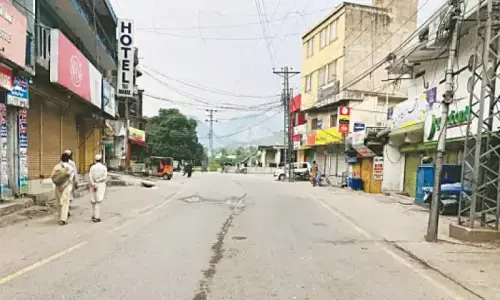
As the archetypal ‘remote’ and ‘dusty’ and ‘poverty-stricken’ village of Faridkot comes into focus for its possible linkages with the Mumbai terror strike, the emphasis remains on this being overwhelmingly a class issue, which it no doubt largely is. Yet the narrowing down of the problem along the rich-poor line pushes some crucial aspects out of the ambit of discussion. The vital question is: is it poverty alone that makes terrorists out of people? Consequently, is development, which is transient and hence forever elusive, enough guarantee against the rise of groups, which as elaborated by Huntington, can sufficiently strain the institutions of a state in the name of revolution?
From descriptions in the media, it would be hard to tell Faridkot from any other part of Pakistan. It is a small village fast on its way to urbanisation. The inhabitants are mostly farmers and those who earn their living by doing all kind of labour.
But it is not here that the alleged Mumbai attacker had supposedly tied up with his jihadi handlers. If reports are to be believed they discovered him either in Lahore or Rawalpindi, neither of which qualify to be called poor or remote in the popular sense. That reflects the expanse of terrorism which runs across poor territory and relatively affluent localities, sustained by a common ideology pinned on its believers’ concepts of cultural superiority and the inferiority of their power.
The situation bears a stark resemblance to the one painted by Huntington, but nevertheless, the classic poverty-ridden formula of explaining things continues to be indiscriminately invoked. This is like saying that the patients will be cured once a hospital is established, a school set up and a road built in a specified area which is assessed as more likely to give birth to anger. That simple?
It is not hard then to imagine how the analysis afflicted with a peculiar type of ‘non-religious dogma’ would treat the religion-based conflict that has been eating away at the foundations of Pakistan for long. It is a divide that pits a particular brand of culture (civilisation?) bred indigenously against a so called purer variety whose import to the land has become more pronounced in recent years. This places us firmly in the battleground of a clash of cultures (civilisations?).
Those who dismiss the clash of civilisations theory as being alarmist quite often do so by relying on the sheer number of people who do not see theirs as a different civilisation. The assertion is absolutely true until you come across the local jihad that for now thrives on the promise not so much of establishing a new order but on destroying the existing one.
Our Faridkots suffer from poverty of all kinds, of thought, material resources and attention. If the so-called jihadis are preying on these areas they do so secure in the knowledge that they are less likely to be spotted by the official eye there. Otherwise there is no reason for us to think that Lahore and Karachi are any less capable of throwing up terrorists of their own. They have indeed been contributing their bit to the jihad by providing absolutely ‘normal’ men with good education to stand shoulder to shoulder with their brothers from backward Pakistan.