0
0

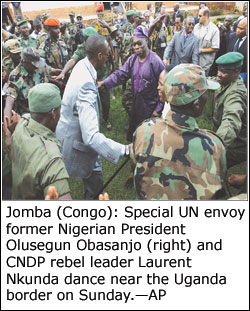 JOMBA (Congo), Nov 16: Congolese rebel leader Laurent Nkunda agreed on Sunday to take part in UN-backed peace talks, but fighting between the army and rebels raged on in the east despite his declared support for a ceasefire.
After meeting United Nations special envoy Olusegun Obasanjo at Jomba in Democratic Republic of Congo’s North Kivu province, Nkunda said he had agreed to three requests from him — to respect a ceasefire, open a humanitarian corridor to aid refugees, and support the UN peace initiative.
But he had asked Obasanjo, a former Nigerian head of state, to tell Congolese President Joseph Kabila’s government to also respect a suspension of military hostilities.
“We are behind him (Obasanjo) and we are going to do our part so we can get on with this peace,” said Nkunda, wearing a grey suit and holding a cane topped with a silver eagle’s head.
Speaking later in the North Kivu provincial capital Goma, before flying to Kigali in neighbouring Rwanda, Obasanjo said the Tutsi rebel chief had agreed to take part in UN-sponsored peace negotiations in the Kenyan capital Nairobi.
But he did not specify a date and did not expect it would involve face-to-face talks with Kabila, which Nkunda wants.
However, Obasanjo, who met Kabila on Saturday, said the president had told him he was “not averse to negotiation”.
Nkunda hosted Obasanjo at his home village of Jomba in the foothills of the Virunga mountains, close to the Rwandan and Ugandan borders. Afterwards, the two briefly danced with rebel fighters and children outside a church compound.
But as they met, UN peacekeepers reported heavy fighting between Nkunda’s National Congress for the Defence of the People (CNDP) rebels and Congo’s army near the village of Ndeko, 110 km north of Goma.
The UN trouble-shooter is seeking to prevent the fighting in North Kivu from escalating into a repeat of a wider 1998-2003 Congo war that sucked in six neighbouring states.
Obasanjo, who said the talks with Nkunda went “extremely well”, said the rebel leader had also agreed to a tripartite committee to monitor ceasefire violations, but on the condition that the UN peacekeeping force in Congo was not involved.
Nkunda says the UN peacekeepers are biased against him.
Weeks of combat between Nkunda’s Tutsi rebels and government troops and their militia allies have displaced around a quarter of a million civilians, creating a humanitarian crisis.
ROCKET AND MORTAR BATTLE: UN military spokesman Lt-Col Jean-Paul Dietrich said: “The army is firing rockets. The CNDP is using mortars. It’s not a good sign if they continue to fight while the special envoy is holding talks”.
Nkunda played down the latest fighting, saying it was “not a problem” and he had contacted the government to try to end it.
The United Nations could not say who had started the clashes. At least six government soldiers had been wounded.
The roots of the North Kivu conflict stem from Rwanda’s 1994 genocide, when extremist Hutu militias killed about 800,000 Tutsis and moderate Hutus before fleeing into Congo.
That led to two wars and a humanitarian crisis that killed more than five million people, mostly from hunger and disease.
In 2004, Nkunda rejected peace deals that ended the last war. He accuses Kabila of arming and using a Rwandan Hutu rebel group, the FDLR, which includes perpetrators of the 1994 genocide, to fight with the weak and chaotic Congolese army.
The Congolese president accuses Rwanda of supporting Nkunda’s rebellion.
Nkunda spokesman Bertrand Bisimwa blamed the government for Sunday’s fighting but said it would not derail the peace talks.
The Congolese army was not available for comment.
Nkunda initially took up arms saying he was fighting to defend fellow Tutsis in Congo from attack by the Rwandan Hutu FDLR. But, after marching to the gates of Goma last month, he is now calling for unconditional direct talks with the president.
Kabila has so far rejected negotiations.
—Reuters