



 0
0

Mai Safoora
 It wasn’t the gang war but asthma that forced me to leave my Janam Bhoomi, Lyari. The quest for a pollution-free environment ultimately led me to the last stretch of Gulistan-i-Jauhar’s Block 7 in the vicinity of Safoora Goth. I was happy with my choice of new residence when I was awakened by a sparrow’s chirping on the first morning at my new third-floor flat. Next day I was surprised to see a half-built pigeon’s nest in my washroom’s window.
However, a friend, Taj Mohammad Shah Mir, believes that the legend of Mai Safoora and her mother attracted me to this place, which is named after the former. According to oral history, Mai Safoora was one of the seven daughters of Mokhi, a legendary barmaid of the area that comprised the present Gadap Town.
People from far-flung areas used to visit her. The secret of her wine’s popularity was its royal recipe. In fact Mokhi was the daughter of Natir, a servant at the palace of Moomal of Rano fame, the characters immortalized by the mesmerizing verses of Shah Abdul Latif Bhittai. (I also love folklore of Sindh and anything associated with Shah Saeen and this way you are right, Mir.)
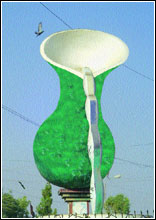
Mokhi became a myth later when the wine she served killed her seven dipsomaniacs. Maybe the tale was in mind of the architect of the ‘wine jug’ monument installed at Safoora Chowk.
Another feature of Safoora Chowk that fascinates me is the presence of a sizable populace of former Lyarians there, which makes me feel at the Nawa Lane home. Over and above, along with them live a number of families from upper Sindh and their typical dialect of Sindhi, marked by the use of the ‘sh’ sound instead of ‘chh’ and vice versa, makes me feel as if I am in my ancestral town, Rato Dero.
This serene slum at the far end of the maddening metropolis has a cluster of old villages comprising the Sindhi, Pukhtoon, Punjabi, Seraiki and Baloch population. Just like the people of other rural areas of the country, these villagers are fond of evening gossip sessions (locally known as kutchehry or baithak). They gather at Quetta-wala tea shops or at the roadside by placing charpoys and discuss a wide range of topics. Most interesting are the mixed gatherings, usually led by one or two village elders who captivate the crowds for hours with their sublime sense of humour.
Now after looking at a variety of all the rich cultures of the country combined together at one place, methinks that Safoora Goth is the wine of Mokhi that keeps its dipsomaniacs attached to it.—Abbas Jalbani
Publicity stunt
It was a quiet afternoon and I was enjoying my late afternoon nap just a few days before the end of Ramazan when I was rudely awakened from my slumber by a loud commotion emanating from the street below.
Getting up and peering over the balcony I was both surprised and amused to observe that price control officials, along with a magistrate aided by a police mobile van and, to add spice to the activities, accompanied by a television crew of a local channel, had descended upon the neighbourhood to check on hoarders and profiteers.
While the gallant effort is appreciated, what I failed to understand is why it had to be on the last few remaining days of Ramazan and not in the beginning or, for that matter, the entire year round on a monthly basis. And why the media crew? Or was it a publicity stunt by the local powers that be to impress Karachians and show them that the government genuinely cared about the price woes.
Needless to say the innocents were rounded up – including my friend, a young chap working in a general store in the neighbourhood affectionately and commonly called Munshi (accountant).
The real profiteers plying their trade in the big markets of Karachi seem to be unfazed by such snap inspections and the local reaction to the entire fiasco was that it was nothing more than a public relations stunt.—Farhan Sabir
Fading traditions
 Nobody knocks at the door in this day and age for now it’s the email or SMS that drops in. In this fast growing economic hub of the country we are missing out on life and its value. Everyone – with the survival of the fittest approach in mind – is short of time to continue with the old traditions and customs, whether good or bad.
There was a time when people used to visit and greet each other on many occasions, including Eid. Families and friends used to spend time together, exchange smiles and sweets, and share views and thoughts. Children used to ask for Eidi while the elders bargained. A few among us who found it impossible to see our relatives and friends made it a point to post letters and greeting cards and send gifts to fill in for our absence.
A visit to the market for the selection of a gift or a card followed by its purchase and delivery was something that expressed our love and affection to our nearest and dearest ones on such occasions.
Unfortunately, this situation no longer exists. For example the sale of greeting cards has drastically dropped over the past some years. Initially it was e-greetings and now it’s short messaging service that has replaced them. As for presents, some courier services have introduced packages to buy and deliver gifts on the senders’ behalf, though the convenience with which we send such presents can’t fully express our efforts, warmth and emotions.
And the results are clear – families are spending less time together.
The world is spinning fast and taking the souls of many with it. I’m not at all against technological advances or economic progress. However, it’s equally important that such advancement must not make us oblivious to our social and cultural development.—HA
Supardari laws
During the Mughal era when Indian emperors or their governors were displeased with a member of the aristocracy, they used to gift him as a lighter penalty an elephant or two for some unspecified, but temporary period. Since the gift was from the emperor or his governors, the host had to spend an enormous sum for keeping such royal visitors comfortable and well-nourished. But this was the crudest form of supardari as it never profited the host.
Then, came the British era as police stations were built and native constabulary was recruited. Unreported theft cases of cattle, horses, donkeys and camels were being reported. First information reports were registered. Stolen movable properties were recovered and deposited at the area precinct though their daily feeding at police stations always troubled the British provincial civil and police officials. After consulting some existing British laws the law of the land was devised, known as supardari laws. They were enforced in the undivided Punjab of an unbroken India. The supardari laws were extended and expanded. Then entered in the subcontinent the vehicles run by engines.
When the first such vehicle was stolen and finally recovered the police station was in trouble again. Whether it should be taken away temporarily or left at the police station was the question that perturbed them. Finally it was decided that the Darogha (SHO) of the police station would take the vehicle home, until the owner was found; considering the old practice of keeping the horses, donkeys etc. Since then the practice is followed by the officials.
In the long run, this supardari law benefited police and civil officials. They can keep the stolen and recovered vehicles as long as they want.
Today, statistics suggest that a vast number of such vehicles are under the “legitimate” possession of such officials, including a few senior ones for years. The archaic supardari laws, which are benefiting only a group of officials, should be amended now. Besides, our legal community, legislators in provincial and national assemblies, the chief minister and the governor should see how this unfair law should be repealed.
—Kunwar Khalid Yunus
Compiled by Syed Hassan Ali
karachian@dawn.com
Driving etiquette
Sir,
 Almost for the whole day traffic conditions are pathetic in Defence and Clifton. But one witnesses the worst situation in the morning during school hours.
Almost all drivers (car owners and their drivers) seem to be in a great hurry. They hardly observe any traffic rules and some appear to be ruthless and untouchable.
Some schools have made their own arrangements for controlling traffic successfully. But these arrangements are for a specified area or location.
My humble request to parents in particular is to show patience and have good temperament while they are behind the wheel. And they should direct their drivers to behave while children are in the vehicle.
CH. KHAN ABDUL NASIR
DHA Phase VI
Traffic wardens
Sir,
The CDGK has done a remarkable job by building spacious roads and U-turns, but what is now required is an effective and strict traffic monitoring and management system.
The present set-up of traffic police has failed to deliver. I propose a totally independent traffic warden system to work in Karachi with good pay-scales and educated young men and women as part of its team.
ARSALAN AHMED FARUQI
Gulshan-i-Iqbal
Bridge construction
Sir,
In the open space which used to be the parking lot for the Sunday Bazaar in Gulshan-i-Iqbal, a number of RCC beams are being cast for a bridge. Being a resident of the area, I pass by this site several times a day.
It pains me to see that after pouring the cement, not a single drop of water is poured on the beams to keep it cool for a number of days, as per procedures. Neither is the vibrator used to compact the cement after pouring.
Would some RCC expert throw some light on how strong these beams are going to be? Would they be strong enough to bear the ever-increasing heavy rolling loads on the bridge?
I had tried to pass on my concerns to the relevant persons through the workers, but I see no result!
N.A. KHAN
Karachi
Following the system
Sir,
I have been driving in Karachi for the last 35 years. My car was lifted by the PIDC traffic police recently in front of the Government Commerce College. The traffic staff sits in the plot adjacent to the college.
When I went there, four persons – not in uniform – told me that lifting charges were Rs500 and the traffic fine was Rs100. I would have to deposit Rs500, but, if I didn’t ask for a receipt, they would not issue the challan of Rs100.
I paid Rs500 and on second thought, I also asked for the Rs100 challan. If I could pay Rs500, I could also pay Rs100 for the challan.
This is what I call not following the system. The usual rate is Rs200 to Rs300, and no receipt is issued.
It is requested that these police personnel should be asked to follow the system.
IMRAN ALI KHAN
Karachi
Noise pollution
Sir,
The news published on page 17 in your paper on 20-8-2008 (‘Sepa launching study to find noise levels’) is not new.
This work has been done and published in scientific journals by many ENT surgeons before. My last work is published in ENT journal in August. Before this I, Dr Baig and Prof Zaidi have published such work in ENT journal and also presented papers in national and international conferences.
The noise is definitely harmful in many ways and can cause not only hearing loss but also upset the mental attitude of the person. There are three factors which can affect the human ears.
1. Intensity of noise
2. Duration of exposure
3. Individual susceptibility
The noise level according to our study using amplaid noise meter in places where there is heavy traffic such as Guru Mandir, Numaish, Boulton Market and Empress Market varies between 85-100 dB. Please note that noise level below 85 dB is safe, but it all depends on the three factors enumerated above.
What we need is regulation to control this and if the government is serious, the following steps should be taken:
1. Regulate traffic.
2. Completely ban the horn and pressure horn.
3. Autos should be completely banned or should ply with a proper silencer.
4. All factories must have proper checks of their workers and if the noise level is high they should be provided with protection.
5. Preliminary hearing test should be done on the workers joining such places to detect any hearing loss.
I suggest Sepa’s Dr Mohammad Ali Shaikh and his team come on the roads and see the environmental problem which is much more harmful than noise: that is smoke from various vehicles, which is playing havoc with the lives of the citizens.
PROF ISHTIAQ AHMED KHAN
North Nazimabad
city@dawn.com

























