0
0

 KARACHI, Oct 3: The controversy surrounding the excavation and embankment raising work carried out in and around the Makli Hills necropolis by a powerful politician keeps cropping up every so often despite official efforts to settle the issue amicably.
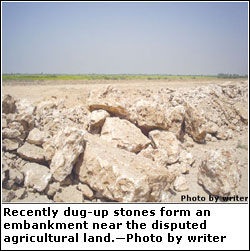
According to highly placed sources, former Sindh Assembly member Ghulam Qadir Palijo, who is the father of Sindh Culture Minister Sassui Palijo, owns land next to the Makli Hills necropolis, which is protected under the Antiquities Act, and was raising an embankment and also carrying out excavation for a trench on his lands to protect them from rainwater that comes from the Makli Hills and inundates his agricultural farm. The rainwater was supposed to be diverted to a nearby drain.
When this reporter visited the necropolis – one of the largest in the world – he saw that a trench had been dug and a small embankment had been raised while the heavy-duty mechanical excavator that had been used for excavation was sitting idly nearby, as no work was being carried out at that time.
The work had been carried out approximately 30 to 40 feet away on the left hand side of the road that originates from the Thatta-Jungshahi road and goes to the Shah Murad Shrine. On the right side of the road lies the Makli necropolis. There are no visible markings showing the boundaries of the Makli graveyard’s protected area.
The issue was raised by the Makli Hills monument curator, Nawab Kazim Ali, who claimed that Ghulam Qadir Palijo had illegally occupied the protected area near Makli. He approached the district administration seeking its intervention to safeguard the protected monuments. The necropolis is also a declared Unesco World Heritage Site.
The issue gained attention quickly as Mr Palijo had also been accused of constructing a road in the Makli necropolis in the mid-1990s when he was an MPA. The work was, however, stopped after the issue was raised by the archaeology department and picked up by the media. Inquiries were conducted, but the reports were quietly buried.
This time also, as soon as the news broke and was widely picked up by the media, the entire district administration woke up and revenue department officials became quite active. In a few days the tapaders, the mukhtiarkar, district officer and the executive district officer and other officials prepared reports and sent them to the Sindh revenue minister as well as the archaeology department, saying that the work was being carried out by Sarmad Palijo, son of Ghulam Qadir Palijo, on his agricultural lands, which are adjacent to the Makli Hill monuments, none of which were damaged by the activity.
The revenue department officials also took along the curator on the survey and demarcation of the land and he signed the report of the findings.
The archaeology department’s deputy director, Mazhar Mirani, who had initially raised the road construction issue in the 1990s when he was curator, was also sent by the department on the survey and had reported that the work was being carried out in Mr Palijo’s lands.
Responding to Dawn’s queries, Sarmad Palijo said that he was carrying out development work in his farm to protect it from rainwater coming from the relatively higher Makli Hills. He said he had not damaged any protected monument or violated any law, as the road was the boundary that separated his lands from the Makli necropolis, as had been confirmed by the revenue department.
He said that the work had been going on for the past few weeks without any break and would continue till completion. When informed that this reporter did not see any work going on, he said that it could be due to the Eid holidays. He, however, expressed his ignorance over the road construction issue of the ’90s in which fingers were pointed at his father.
‘Political victimization’
Nevertheless, he stressed that political opponents of his family were unnecessarily fanning this issue and that his family was being victimized for observing democratic values and practicing non-violence.
Meanwhile, responding to Dawn’s queries from Islamabad, the archaeology department’s director-general, Dr Fazaldad Kakar, said that he was surprised to see contradictory reports from his officials. So, rather than depend on these reports he was coming to visit the site in the next couple of days to get firsthand information.
He said the work at the site had been stopped and would not be allowed to resume until the issue was cleared. He said that the Makli necropolis is a world heritage site and all the maps of the protected area – spreading over 912 acres – were present and would be cross-checked.
He said that the Antiquities Act not only banned such activities in the core protected area but also restricted such activities in the buffer zone around the monuments, regardless of the fact who owned the land.
He said that nobody was above the law and if the minister’s family had violated the law by excavation or the curator or his superior had prepared false reports, stern action would be taken so that nobody ever took such liberty again.
The sources said that it was high time the government constituted a high-level committee to probe into the issue, adding that since a minister’s family was being accused of wrongdoing, preferably, at least one member from among the opposition parties should be included to ensure credibility of the findings.
Buried reports
The sources said the government should also dig out the two reports – one prepared by the then deputy commissioner Kaleem Lashari and another prepared by an inquiry team led by the late senator Hussain Shah Rashdi – regarding the road construction issue of the 1990s and make these reports public and take action against whoever is found to be violating the law and playing havoc with heritage.
They said that a proper boundary wall should be constructed around the necropolis so that the history and heritage of Sindh preserved here (stretching over 400 years between the 14th century and 18th century, when the area was ruled by the Samas, Arghuns, Turkhans and then by the Mughals), could be protected from modern day, influential tomb-raiders for future generations.