Zardari’s US visit
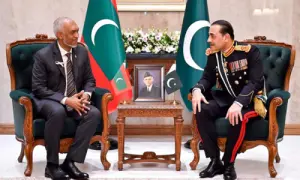
ASIF Ali Zardari’s first visit to America as president comes against a national background characterised by uncertainty and a fear of the unknown. While the attacks by the American military in Fata served to embitter relations between the two countries, the bombing of Islamabad Marriott Hotel shook the country to the core, demonstrated the terrorists’ power to strike in the heart of the capital and exposed the limitations of the nation’s security apparatus. US reaction to the bombing has been positive, and President George Bush and the two presidential candidates have pledged support to Pakistan. However, this support must be categorical, devoid of mistrust and include more than its military component. Here President Zardari has to be clear in his mind about how he presents Pakistan’s viewpoint to the American leadership.
Unlike the general impression, not all Taliban supporters are motivated by ideological considerations. A number of suicide bombers, as investigations showed, agreed to collaborate in return for the Taliban’s pledge to take care of their families. Fata is a poverty-stricken area and there is no possibility of a turn for the better so long as fighting continues. That is where the Americans have to realise that periodic forays into the tribal belt and the transfer of military hardware to Islamabad alone cannot turn the tide. Most tribesmen are fed up with the Taliban for having destroyed their environs, and both Islamabad and Washington would be missing the point if they did not adopt a welfare-oriented strategy pledging massive funding for Fata’s economic development. Besides being Pakistan’s own war, the war on terror is a global effort to be won or lost in the treacherous terrain straddling the Durand Line. Washington should realise Pakistan’s strategic importance, its sensitivities to the violation of its sovereignty and Islamabad’s justified anger at the hollow ‘do more’ shibboleth. Pakistan needs solid diplomatic and material support from the international community. Its economy is in dire straits and must be bolstered with an injection of funds.
Also on the agenda is the president’s meeting with Mr Manmohan Singh. The Indian prime minister has, no doubt, written to his Pakistani counterpart expressing his condolences over the Islamabad bombing, but the allegations against Pakistan by Indian officials, dragging this country into the New Delhi bombings, have vitiated the atmosphere. President Zardari has to do some plain speaking and give Mr Singh the Pakistan government’s perception of the Indian intelligence’s perverse role in fomenting trouble in Fata and supplying money and arms to militants for terrorist activity in Pakistan. Islamabad believes that with the Afghan authorities fully in the picture, the Indian consulates in Jalalabad, Kandahar and Kunar have become an operational centre for anti-Pakistan activity. It is New Delhi’s responsibility to remove Pakistan’s misgivings.
Securing Pakistan
IN the aftermath of the devastating bombing in Islamabad, serious questions are being raised about the level of preparedness of the emergency and security services. Depressingly, they are the same ones that are raised after each terrorist strike — and go unanswered each time. In the case of the Marriott bombing, two sets of questions arise: those concerning the events before the explosives-laden truck struck the security barrier of the hotel and those concerning the hours after the truck burst into flames. Consider the second set of questions first. It took more than 10 hours for Islamabad’s fire department to extinguish the blaze at the Marriott. We know that people died in the period between the initial explosion and the time by which the site was brought under control — the Czech envoy who died inside the hotel made a call to his embassy and asked to be rescued. Clearly, potentially life-saving time was lost by a fire department that does not have enough of the right equipment and does not know how to best use the equipment it does have. A report in this paper has claimed that 30 high-level posts in Islamabad’s fire department are vacant. Given the threats that Islamabad faces, negligence of this kind rises to a criminal level. The speed of the response of the gas and electricity utilities was also said to be sluggish though a spokesman for the gas company disputed this assertion.
The second set of questions concerns the performance of Pakistan’s security apparatus. Failures are apparent at every stage leading up to Saturday’s attack. How did such large quantities of lethal explosives make it into the hands of terrorists? How were the terrorists able to commandeer the truck and drive it into Islamabad? And what was that truck doing unchecked in the heart of Islamabad on an evening that every major leader of Pakistan — civilian and uniformed — had gathered there? In the aftermath of terrorist attacks, we learn of intelligence teams with obscure names — Special Investigation Authority, Special Investigation Group, Joint Investigation Teams. However, the public knows little of their record of failure or success. No doubt fully securing cities from suicide bombers is an all but impossible task. But equally obvious are the gaping holes in our security apparatus. We need help and we need it now. Misplaced nationalism argues that foreign help — especially from the Americans — is unwelcome and an intrusion in our ‘domestic’ affairs. Yet anything that helps saves Pakistani lives must be welcomed. From our emergency services to our intelligence apparatus, the international community can do much to raise our level of preparedness in the face of an unprecedented terrorist threat. The US must lead the way in providing such support. It has spent an extraordinary amount — several hundred billion dollars — in Iraq; investing a mere fraction of that sum in Pakistan’s anti-terrorism infrastructure would go a long way to defeating a common enemy.
Urban forestry
THE city government has vowed to plant more than a million trees in Karachi by December this year, however conspicuous by its absence is legislation to protect these trees. It is was therefore heartening to hear city nazim Mustafa Kamal’s call for the formulation of laws to protect trees in the city. Nature conservation is an integral part of city planning. Not only is it an effective measure for pollution control, it also adds to the aesthetic value of cities. The city government in Karachi should be lauded for its drive to establish parks and tree plantation. However, if these trees and green area development are to be maintained then legislation is the first step in that direction. Legal development in the care and management of trees in the urban setting of Karachi will ensure that these trees become a permanent feature of the city.
Tree protection in the urban centres of the West is commonplace. Laws are in place to prevent the destruction of trees. According to one report, in most western cities it is “prohibited to cut down, to remove, to fell, to damage, to destroy, to modify and to prune protected trees, and to enhance their decay”. Laws in Pakistan should be formulated on these lines. This is an imperative measure along with the constant monitoring of trees if tree plantation is to be sustained. Successful implementation of these laws is what will achieve the purpose. Thus these laws should be structured in a simple way so that the implementation is practicable and efficient. Implementation should not be marred by bureaucratic red tape as action will only yield positive results if taken in a speedy manner.
Settling down to rule
THE Zardari-Gilani government is settling down for what is a five-year term of rule by public representatives. The detractors are many and scepticism is legion. Doomsday scenarios regularly appear in the press, especially concerning civil-military relations.
But, all indicators are that the original constitutional nature of the state is destined to bounce back after the adventurism and dictatorial and arbitrary rule of Musharraf for nearly a decade.
More than anything else, the transition from Musharraf to Zardari is symptomatic of the transition from military to civilian rule. Does it mean that the dark shadows of Bonapartism have disappeared from the horizon? One can hope that what often turns out to be an unpalatable reality for the state elite becomes a permanent feature in Pakistan, in the form of democracy.
It is fashionable among the articulate sections of the population to project that the failures of governance are failures of democracy. The deficit of performance, which the present ruling set-up inherited from its predecessor, is a big challenge. Musharraf simply waited too long to resign and allowed public life to sink beyond reasonable limits.
For long, international diplomacy was hooked on to a profile of Pakistan which was unenviable. The world is accustomed to looking at this country in dichotomous terms vis-à-vis its eastern neighbour — a military state in Pakistan versus democracy in India. What happened in 2008 in Pakistan in the context of parliamentary elections soon followed by presidential elections represents a shift in the political initiative from non-representative to representative institutions, and hopefully leading to a change of profile.
The middle class, which traditionally served as the support base for non-representative rule both military and civilian, is gradually moving away from political conservatism to democratic goals and means. Civil society, in line with the media, has contributed to the cause of democracy in a qualitative sense. The classical mould of the state of mind in the middle class is changing thanks to the media explosion and emergence of a network society.
There was all the likelihood that the new set-up would have remained vulnerable to the vicissitudes of an adventurist presidency. However, potential for conflict between the two highest positions in the politico-administrative hierarchy represented by the president and the prime minister has been removed after the presidential election. Political stability, which shunned Pakistan from March 2007 onwards for more than a year, is expected to return.
Is Bonapartism down and out? Musharraf put or kept in jail President Asif Zardari and Prime Minister Yousuf Raza Gilani among others for years on end in the tradition of medieval kings. He turned the law into a petty instrument of personal rule. All this led to a playing field that was not level for electoral and constitutional purposes. And yet one hears the call for indemnity for his misrule spread over nine years.
How can the nation safeguard democracy in the face of the challenges emanating from powerful elements in society? What is needed is to cultivate the constitutional source of legitimacy in the form of mass mandate over and above all other forms of legitimacy. The message needs to be internalised by all those who operate from outside parliamentary politics. A move backwards to the age of non-representative rule cannot and should not be allowed ever again.
The progressive character of the present dispensation will come out fully only when the erstwhile concentration of power in the hands of the state elite moves away from it in favour of the smaller provinces. President Zardari’s elections was indeed a projection of the project of setting the disproportionate distribution of power right by Balochistan, the NWFP and Sindh reflecting their position as equal federating units of Pakistan. One hopes that their representation in the corridors of power will increase incrementally and reasonably, if not radically and massively.
Can Pakistan move away from state-centred policy frameworks and ideological trends in the direction of society-oriented means and goals under the present ruling set-up? Can the government address the issues close to the heart of the public in various parts of the country? These issues range from gas and electricity revenues for Balochistan and the NWFP respectively and the allocation of resources to various provinces taking into account factors other than mere demography.The PPP-led government at the centre has now consolidated itself and thus established ‘entrance legitimacy’. It faces the next challenge in the form of ‘performance legitimacy’. Never before has the public been so aware of political, economic and security issues as now, thanks to the activism of the print and electronic media for half a decade. The PPP government faces an uphill task in terms of addressing issues relating to the inflationary spiral and the much-feared economic meltdown.What is required is the qualitative input of the best available talent in the country in the formulation of policy and the allocation of resources. The ruling set-up very much needs to cultivate its profile as a government by policy not patronage. It needs to develop the potential to swim through contradictory currents of agenda in the war against terror on the one hand and the political and religious sensitivities of the public on the other. While the formal transition from military to civilian rule is complete, the government needs to address substantive issues relating to the bar and the bench and the Seventeenth Amendment.
The election of the leader of opposition in the National Assembly as chairman of the public accounts committee is a strong indicator that the mainstream players on the political stage are laying out the ground rules of the game in a spirit of commitment to make democracy work. One can hope that given a solid parliamentary support base, the backing of smaller provinces and non-hostile relations with its erstwhile ally the PML-N, the PPP government will be able to fulfill its mandate.
Romania’s migrants
ROMANIA is to launch a campaign to lure tens of thousands of its key workers and students back from Britain by telling them their long-term economic and professional prospects could be brighter in their homeland.
The action by the Romanian government — which is emphasising the high cost of living in the UK and the falling value of the pound — is the opening shot in a ‘competition for labour’ that could see UK companies and the tax-funded National Health Service (NHS) suffer a serious loss of manpower to former communist states over coming months.
Poland — with more than one million citizens in the UK — has drawn up similar plans to encourage so-called ‘reverse migration’, advertising the attractions of its own economy in English and Polish newspapers in this country and offering special loans to help those who return.
Ion Jinga, the Romanian ambassador in London, said that he wanted to encourage Romanians to take a pride in helping their own country to develop, rather than see them move permanently to the UK.
Romania, which enjoyed eight per cent economic growth in the first half of this year, is suffering from acute labour shortages caused by an exodus of workers following its accession to the European Union in 2007.
Next month the Romanian embassy will stage a conference for Romanian students in London at which it will promote the benefits of returning home after their studies. It has 50,000 workers in Britain, among them many doctors, nurses and construction workers whose skills are now in high demand at home.
Jinga said a number of factors including the high cost of renting homes in the UK and the falling value of the pound had to be weighed against the benefits of higher salaries in the UK. ‘Salaries are not everything,’ he said. ‘It is brilliant to work and live in England, but there are important incentives for returning.’ He added: ‘We cannot afford to lose our best brains.’
Although Jinga insists he is working closely with the British government, the Romanians’ action will be seen by many as a counter-attack against the UK in response to special ‘transition’ rules that London imposed on Romania and Bulgaria when the countries joined the EU in January 2007.
Because of concerns about the level of immigration at the time, Tony Blair’s government imposed a seven-year programme of restrictions under which Romanian and Bulgarian citizens had to apply for jobs in specific sectors in order to work in this country. Previously people from new EU entrant countries had been allowed in without any restrictions.
Romania and Bulgaria felt victimised. Their main thrust is now to make sure as many skilled people as possible remain in their homeland.
—The Guardian, London
OTHER VOICES - Sindhi Press
Lack of trust
Kawish
DESPITE the fact that the PPP and PML-N have vowed not to create problems for each other in the centre and Punjab, political wrangling continues in Punjab. The PML-N is accusing Punjab Governor Salman Taseer and Manzoor Wattoo of polarisation whereas the PML-N is averse to tolerating PPP members in the cabinet. Manoeuvring is also going on in the ranks of the PML-Q where some members have changed loyalties. New tactics are being adopted to win the numbers game. Owing to the fact that the PPP showed that it was pleased with the PML-Q, the PML-N launched a crackdown against the PML-Q. The PPP says that in case it is pushed out of the Punjab cabinet, the PML-N-led provincial government would not last. However, the PML-N is satisfied and sees no threat to its government. All claims of the two major parties depend on the support of some independents and PML-Q members because none have a simple majority in the Punjab Assembly.
The people’s mandate notwithstanding, politicians continue to indulge in political altercation. Today, Punjab is far ahead in political conflict than the other three provinces as the two major parties continue to work against each other. Constitutionally, there is ban on floor-crossing, but these two parties are busy trying to win the numbers’ game. The PML-Q and independent members are the targets of both parties. In this bid they are not paying heed to the constitution or to political ethics.
Hardly six months have elapsed since the present government came to power but political wrangling has resulted in destabilisation and political uncertainty. Both parties are responsible for creating this situation as they failed to show political acumen and tolerance. Lack of trust is the root cause of the issue. The PML-N had remained a political rival of the PPP in Punjab. Amidst fears that the PPP might take revenge, the PML-N has won over the support of some PML-Q members to reduce its dependence on the PPP…. If this political conflict continues, how will the mandate be honoured and how will people get relief?
We would like to recommend to the PML-N leadership to serve the people in alliance with the PPP. At the same time, we would like to suggest to the PPP not to be part of any agenda which may destabilise the Punjab government. — (Sept 19)
Selected and translated by Sohail Sangi