Swat accord
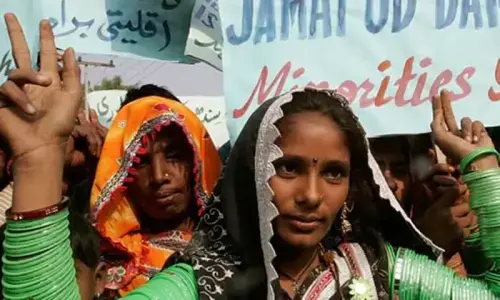
WHILE every effort ought to be made to salvage the peace deal struck with the Swat militants on May 21, Maulana Fazlullah and his men cannot be allowed to dictate terms. After all, only a month has passed since the accord was signed while Swat has been wracked by militancy for years. The writ of the state is still being established in the district’s more troubled regions and it is naïve to demand that all army troops be pulled out on short notice — by next Tuesday to be exact. What the militants should accept, and the state must concede not an inch more, is a phased withdrawal. If troops left the area en masse, who would ensure that the Swat Taliban are indeed living up to their side of the bargain? The police and local administration? Highly unlikely, given the latent firepower of the militants. At best, local officials can monitor the situation but they are in no position to enforce the terms of the deal: no private militias, no obstruction in the way of girls’ education and polio vaccine campaigns, cessation of attacks on barber shops and music outlets, a ban on the display of weapons and manufacture of explosive devices, dismantling of suicide squads, etc. For these and other reasons, a military presence is essential in the short term. Under no circumstances can the Taliban be allowed to regroup, recruit and otherwise strengthen themselves, which is precisely what happened after the September 2006 deal with militants in North Waziristan.
Enforcement of Sharia law in Swat is also not as straightforward as the Taliban make it out to be. True, the government accepted this demand on May 21 but the modalities of the new legal system need to be worked out and that will naturally take time. Dispensation of justice cannot be summarily handed over to the Taliban — it has to remain within the framework of the state irrespective of the changes being mulled. The release of militants captured by security personnel is a relatively simpler process, but there too a case-by-case review is perhaps in order.
It also needs to be asked why the Swat militants are in such a hurry. Does their urgency have anything to do with the ongoing surge in Taliban activity on the other side of the Durand Line? The militants must realise that laying down arms and making peace with the government is not only in the interest of Pakistan but also their own. If they resort to violence yet again, the military will be left with no option but to launch another crackdown. Worse, outside forces may take on the job without anyone’s permission.
Israeli attack plans
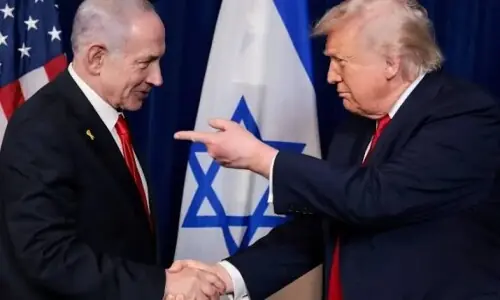
REPORTS that Israel is rehearsing an attack on Iran’s nuclear installations should surprise no one. Even though Israel itself is a nuclear power, it has repeatedly made it clear that it will not tolerate the presence of nuclear weapons in any other Middle Eastern country. Its destruction of an Iraqi nuclear reactor in 1981 was a clear indication that Israel would use force to ensure that its regional monopoly on nuclear weapons remained unbroken. In the case of Iran, Israeli leaders have gone public several times with their resolve to destroy Tehran’s nuclear programme, ever since the latter began enriching uranium. Under President Mohammad Khatami, Iran had pursued a relatively moderate policy, and the country made a determined bid to improve relations with Europe and the Gulf states. However, the assumption of power by Mahmoud Ahmadinejad has upped the ante because of the Iranian leader’s provocative rhetoric about the Holocaust and the existence of Israel itself.
Attacking a distant target is no problem for Israel. It has practised and honed this craft over the decades and has received a pat on the back from America and most European governments. It carried out a long-range mission at Entebbe in Uganda in 1976 to rescue hostages, and in 1985 it air-bombed Arafat’s headquarters in Tunisia. Earlier this month Israel rehearsed with 100 F-16s and helicopters to simulate surgical strikes on Iran, the confirmation of this exercise coming from the US defence department. Unfortunately, Israel is impossible to restrain. In fact, it must have felt encouraged when President George Bush the other day threatened force against Iran by saying that all options were open.
There are now two very harsh realities which threaten to enlarge the war theatre and push the Middle East toward greater destruction: President Ahmadinejad seems unperturbed by the danger to which he is exposing his country and the region, while Israel and America seem equally determined to destroy Iran’s nuclear installations. While Iran has every right to develop nuclear technology for peaceful purposes, Ahmadinejad’s continued pursuit of weapons-grade uranium is giving America and Israel a ready-made pretext for attacking it. Iraq and Afghanistan are already burning. An attack on Iran will mean the entire area from Fata to Gaza will become one big war theatre. The main victims will be the people living in this region. Tehran should show realism and cooperate more fully with the IAEA to pre-empt US-Israeli plans to unleash destruction on Iran.
Lahore’s traffic wardens
LIFE on Lahore’s roads is tough, if not brutal. Jam-packed and a veritable free-for-all, they at best offer a bumpy and uncertain ride and at worst a jerky and dangerous commute. The absence of the traffic police only made matters worse — until traffic wardens appeared on the scene last year. Educated, properly trained and most importantly reasonably well paid, the wardens were supposed to keep the traffic flowing while making an extra effort to let drivers and commuters feel safe and remain in good humour. They were supposed to be courteous and well behaved besides being honest and efficient. Some recent news reports, however, suggest that their performance is not as high as it was expected to be. Some of them have faced action for quarrelling with colleagues, a few others for involvement in crime and many more for lacking courtesy, discipline and the ability to deliver under challenging circumstances. Drivers and commuters are often heard complaining that the wardens are hardly an improvement on the ill-paid, ill-trained and semi-literate cops they replaced as far as treating people on the roads is concerned. They are reported to be rude or arrogant, or both.
In fact, such reports are becoming so common that the Lahore police chief has had to warn the wardens against ‘insulting and humiliating’ people. By paying heed to this warning, the wardens can give people back the feeling of relief they experienced when smart, educated young men — and women — were first seen handling the city’s unruly traffic. This is not to suggest that they be lenient in punishing the errant. Far from it: they should keep enforcing the law as diligently as they have been doing, with commitment, conviction and without fear or favour. But they can, and should, do it with courtesy and cheer. Being firm is not the same thing as being rude or arrogant. Lahore’s traffic wardens, educated and young as they are, are much better placed to understand this difference than their predecessors and the rest of the police force.
Today’s despot may be tomorrow’s statesman
HOW are the mighty fallen, we used to say. Now we turn it round. How did the fallen become mighty again? Remember the “mad dog of the Middle East” — Reagan’s stupid cliché — the “terrorist” sponsor who even sent a shipload of guns to the IRA?
A certain Moammar Qhazafi — there are 17 different ways of spelling his name in Latin script — was the crazed leader of Libya who wrote a mind-numbingly boring volume of pseudo philosophy called The Green Book and who wanted to mock the White House by calling his own palace the Green House until someone tipped him off that this would mean he would look even more of a cabbage than he already was.
Then suddenly, he gave up some imaginary weapons of mass destruction and Anthony Blair, now the commercial director of World Faith, went out to fawn over him in Tripoli and he was called “statesmanlike” by the absurd Jack Straw and then he was invited to Paris by the even more absurd Nicolas Sarkozy where he right royally made the French president look like a twat by behaving in an extremely unstatesmanlike way.
And now — bingo — Sarkozy has done it again. This time it’s Bashar al-Assad, another presumed “sponsor of world terror” — this twaddle comes from Washington, of course — who will (if he accepts the invitation francaise) be in Paris on Bastille Day to take his place in the reviewing stand at the end of the Champs Elysees. The man whom millions of Lebanese believe plotted the murder of former Lebanese prime minister Rafiq Hariri in Beirut on 14 February 2005 will thus be receiving one of France’s highest honours: to stand beside the French president as he reviews his military forces.
Le Canard Enchaine, my favourite French newspaper, carried a wonderful cartoon this week in which an extremely good likeness of Bashar asks Sarkozy and the gorgeous Carla: “What is it exactly, your 14 July?” And Carla replies: “It’s the end of a tyrant.” And Sarkozy, almost lost for words, then adds: “Er — a king.” Well quite. And both apply to Bashar, whose succession after his father’s death in 2000 did rather suggest that Syria was now a caliphate (as Egypt will become if Uncle Hosni is succeeded by his son Gamal Mubarak). But seriously, how did Bashar, a hate-figure of the United States and an adjunct to Bush’s crazed notion of the “axis of evil”, get on the guest list? Sure he’s been asked to attend France’s spanking new “Union of the Mediterranean” (along with Ehud Olmert), but there’s more to it than that.
For one thing, both he and Sarkozy smell American failure. The American disaster in Iraq — and in Afghanistan (a movie coming to your local cinema soon) — and its total failure to produce a peace between Israel and the Palestinians and the loss of Lebanon as its protege (now that the pro-Syrian Hezbollah can veto America’s friends in the parliamentary majority once there’s a cabinet) means that France can move in among the wreckage for a second crack at le mandat francaise.
The tribunal to judge Hariri’s murderers still does not exist and even Walid Jumblatt, my favourite Druze nihilist, has been in Saudi Arabia to ask the king to keep pushing for the court. He did the same in Washington, chatting to Bush and Gates and the rest along the same lines. But the United States has failed in the Middle East.
Bashar is thus to be allowed back into the civilised West, which Jacques Chirac once encouraged him to visit before feeling betrayed after Syria’s apparent involvement in Hariri’s murder. My own suspicion is that Baath party security was involved in the mass assasination, but not Bashar.
Either way, it’s only 17 months since Chirac’s foreign minister, Philippe Douste-Blazy turned up in Beirut for the funeral of young Pierre Gemayel (assassinated, the usual fingers pointing towards Syria yet again) to announce that Chirac was “the best defender on earth of Lebanon’s sovereignty”. Now, it seems, Sarkozy is the best defender on earth of Syria’s sovereignty. And of Bashar.
Of course, all this is presented in what I call the politics of candlelight. Olmert may meet Bashar al-Assad, the French tell us, and thus further their indirect peace talks. It’s time to bring Syria in from the cold — which is why two of Sarkozy’s top henchmen have been in Damascus, buttering up the Syrian president in the hope he won’t turn down the trip. France will be able to encourage Bashar to behave in Lebanon, open an embassy in Beirut, delineate the Lebanese-Syrian border, blah, blah, blah. It’s a reward, too, for Bashar’s support for the Doha conference which ended — up to a point — Lebanon’s latest bout of sectarian sickness, albeit to the advantage of Sister Syria herself.
Now the Lebanese parliamentary majority is groaning about Bashar’s visit. So is France’s largest Jewish organisation, although not very successfully; last time the Syrian president visited Paris, it symbolically blamed him for the Nazi Holocaust of Europe’s Jews, which ended well over a decade before Bashar was born. Now even that elegant old butterfly from Libya is objecting to the “Union of the Mediterranean”. Yes, the “statesmanlike” panjandrum Qadhafi denounced the whole shebang with the immortal words:
“We are not dogs to whom they throw bones.” Sarkozy should have guessed.
This was, after all, the same Qadhafi who turned up at a non-aligned summit in old Yugoslavia — this from a former Serbian diplomat friend of mine — with a camel and a white horse, the first to provide milk, the second to ride through the streets of Belgrade en route to the conference. He got to keep the camel. The horse was banned.
But that’s how things go when you see yourself as a “guide” — Qadhafi’s description of himself; oddly the very same term used by A Hitler — and there really is no knowing what happens to wayward folk when they climb on our wheel of fortune. We gave Kurt Waldheim an honourary knighthood, then withdrew it when we found out he had a dodgy Second World War past. We took away Ceausescu’s knighthood when he was executed on Christmas Day. We loved Saddam when he tortured and killed all his communists — when mayor of Paris, Chirac fawned over him too — and when he invaded Iran, then hated him when he invaded Kuwait and were happy to see him hanged 17 years later.
Fear not, such a fate will not await Bashar. He will honour the downfall of the tyrant-king and he will no doubt receive economic help from France. And thus his people will not have to eat cake.— © The Independent
The concept of consultation: Is the judiciary independent? – 2
AGAINST the background of a constitutional commitment to fully secure the independence of the judiciary and separate it from the executive, the question of the true meaning and effect of the expression ‘consultation’ came up before the Supreme Court in the famous case of Al-Jihad Trust vs Federation of Pakistan (PLD 1996 SC 324).
After considering the constitutional provisions of India and Pakistan, relevant precedent from the Indian Supreme Court, certain principles of Islamic law and other material, the court held that the question of appointment of superior court judges was inextricably linked with the independence of the judiciary.
The consultative process laid down in the constitution was mandatory and was intended to be effective, meaningful and purpose oriented i.e. to select the best possible person to hold a responsible office, with a high degree of competence and unimpeachable integrity and is capable of dispensing justice free from all biases. In this context, it was held that while the chief justices may be most suitable to speak about the competence or fitness of a candidate, appropriate information regarding his character or general reputation may be more accessible to the executive and a consensus oriented consultation is required. The court, however, further held that the opinion of the Chief Justice of Pakistan ought to be accorded primacy and could only be ignored for recorded reasons which would be justiceable.
Since some parts of the judgment in Al-Jihad case did give rise to a political controversy in some quarters, it may also be appropriate to refer to the approach of the Supreme Court of India on this aspect of the matter. The preamble to the Indian constitution also speaks of securing the independence of the judiciary which provides a similar scheme of consultation with the chief justices in the appointment of judges though separation of the judiciary from the executive is not an operative provision but merely a directive principle of state policy.
In Supreme Court AOR’s Association vs Union of India 1993 SCC 441 their Lordships laid down the following precepts:
(i) When the constitution was being drafted it was realised that the independence of the judiciary had to be safeguarded not merely by providing security of tenure and other conditions of service after appointment but also by preventing the influence of political consideration in making the appointment if left to the absolute discretion of the executive as the appointing authority.
(ii) If the selectee to a judicial office carries a particular stamp for the purpose of changing the cause of his decision then the independence of the judiciary cannot be secured….
(iii) The concept of separation of the judiciary from the executive cannot be confined only to the subordinate judiciary totally discarding the higher judiciary.
(iv) To safeguard the will of the people enshrined in the constitution it is necessary to keep the judiciary truly distinct from both legislature and the executive. The independence of the judiciary is the basic feature of the constitution which is inextricably linked with the constitutional process of appointment of judges of the higher judiciary. To expect a judiciary to be independent when the power of appointment of judges vests in the executive is illogical.
The provisions relating to appointment of judges in the proposed constitutional package, apart from several others relating to the judiciary, betray a conscious intention to destroy the very concept of the independence of the judiciary, which has been recognised to be an essential feature of the constitutional fabric of Pakistan. The last word in all judicial appointments, be those of the chief justices or of judges, is sought to be given to the political executive throwing overboard constitutionally recognised principles of seniority respecting chief justices and meaningful consultation relating to judges.
The concept of consultation in relation to all judicial appointments is sought to be completely done away with. Instead commissions are sought to be established to propose two names for appointment to each vacancy in the offices of the chief justices or judges of superior courts. The chief executive of the federation or the province in his sole discretion will pick one of them who will be appointed after confirmation by a joint parliamentary board.
For the appointment of high court judges, the proposed Article 193-A stipulates a four-member commission, comprising the Chief Justice of Pakistan, the Chief Justice of the High Court, and the federal and the provincial law ministers. They must nominate at least two candidates for each vacancy. It means that if the two ministers agree on one, he has to be nominated even if both chief justices find him entirely unsuitable. The chief minister, in all likelihood, will approve the ministers’ nominee by way of final choice. The joint parliamentary board, in terms of the Charter of Democracy, is only required to confirm the solitary nominee of the chief minister. It has no role to play in the selection process.
The commission for appointments to the Supreme Court is required to comprise the Chief Justice of Pakistan, the chief justices of all high courts and the federal law minister. In the first instance, it is incomprehensible how judges of lower courts, i.e. high court, rather than the incumbents in the Supreme Court itself are found more competent to advise on the capability of a person to be appointed to the apex court, particularly when some of them might themselves be legitimately aspiring for elevation. The only ostensible logic in such dispensation could be that being potential candidates themselves, they could possibly be more amenable to the influence of the law minister as compared to sitting judges of the Supreme Court.
When the office of the Chief Justice of Pakistan becomes vacant, the federal law minister and the five high court chief justices will constitute the commission to propose two names for consideration to the prime minister. Since the concept of disqualification of a prospective candidate would have been done away with and the seniority principle abandoned, what would prevent the members of the commission from proposing two from amongst themselves only, consciously ignoring all competent senior judges of the Supreme Court?
To be continued
OTHER VOICES - Indian Press
Changing cricket
Daily News & Analysis
CRICKET … has been going through rapid changes in recent times. New formats have been introduced to sex it up … changes are also being wrought to some of the governing rules and regulations. Cricket has also suffered steady blows to its credibility because the on-field arbiters of the game, the umpires, have been exposed as fallible.
How often have we seen a batsman being given LBW or caught behind when the action replays show clearly that he was not out? It is a strange situation indeed when millions of viewers with the advantage of slow motion replays know that they are right and the umpire has got it wrong, though it may have been a decision taken in good faith....[I]t would be silly not to take advantage of technology … to ensure a fair verdict…. Towards that end, the decision by the Indian and Sri Lankan cricket boards to incorporate the player referral system in the … Test series in July between the two countries is a welcome move.
Once an on-field umpire’s decision is referred, the television umpire will give the final decision after looking at slow motion replays.
While this is a good experiment, it also ought to be seen as part of the ongoing process of modernisation of the game, and the adding of innovations to keep it exciting…. — (June 17)
Grading classrooms
The Indian Express
GOVERNMENT schools in India are plagued with many and diverse problems. Almost as many and varied are the projects that have been launched … to solve those problems. Few of those succeed. Why, then, would the Pune Municipal Corporation’s … plan to link teachers’ pay to their performance, as judged by parents’ councils, be any different? …
Operation Blackboard, an ambitious scheme to provide teaching aids to thousands of primary schools, did not perform as well as expected precisely because it did not take into account their unwillingness to adapt their methods to those aids.
The committees in each school will have parents as well as representatives from NGOs that specialise in the education sector. It is important that these committees be insulated as far as possible from political manipulation, and be focused exclusively on performance.…
An ambitious experiment conducted in Andhra Pradesh over 500 government schools demonstrated fairly conclusively that merit-based bonuses significantly improve educational outcomes and reduce dropout rates. Strangely, the same study demonstrated that a large improvement was noticed even in those schools where teachers were monitored regularly, without being paid bonuses. — (June 20)