‘Political dissent is now tarred with the brush of terrorism’
 Dr Yunas Samad
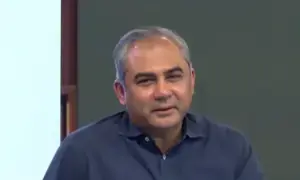
CERTAIN academics and nearly all armchair pundits tend to use incredibly smug language when discussing terrorism and often detach their theories from ground realities. However, Dr Yunas Samad, a United Kingdom-based scholar, offered a rather refreshing take on the topic when he mentioned at a recent lecture in the city that terrorism is, in fact, political blowback.
Originally from Lahore, Dr Samad was recently in Pakistan to launch the latest book he has edited (along with Kasturi Sen) titled Islam in the European Union: Transnationalism, Youth and the War on Terror.
Director of the Ethnicity Research Centre at the University of Bradford, he has numerous books, articles and papers to his credit on subjects as diverse as forced marriage, Pakistan’s entry into the nuclear club, the media and Muslim identity, and multiculturalism, while he has also taught at Oxford and Sussex universities.
He was asked whether – in the current context — terrorism was being used to bludgeon out dissent worldwide.
“Well, the problem today is that the definition used by the United States for terrorism is incompatible with the (relevant) United Nations declaration, because the declaration talks about the right of self-determination. So there is this dimension within the charter which actually challenges the notion which the US (has used to) define terrorism,” he said.
“I think what this does is that all political dissent by non-state actors is now actually tarred with the brush of terrorism. If you have a wider definition of terrorism, in that context state terrorism comes into play. Then what you find is that even the US itself is guilty of terrorising various states in the world. So it depends on how the term is used,” he added.
He also observed that the present geo-political situation has given a carte blanche to dictatorial regimes to tighten the screws on their populations in the name of combating terrorism.
“What has happened is that a lot of governments and authoritarian regimes have jumped on this bandwagon and used it to legitimize their own rule and at the same time behave in a very authoritarian manner with their own population. You don’t even have to talk about Pakistan. You can look at Uzbekistan and at various states such as Jordan and the Arab countries. All the critique for democracy and for freedom in these societies has now been brushed aside.”
Considering that certain states in Europe as well as the United States often use the club of democracy and human rights to browbeat others, particularly in the Third World, Dr Samad was asked if there is an honest debate within Europe about past support for people like Saddam Hussein, who was – once upon a time – the blue-eyed boy of the West and later dramatically fell from grace.
“I think there is a continuous reminder … Even people in the Bush government like Dick Cheney and Rumsfeld were supportive of Saddam at that particular juncture. I think people are aware that there is a kind of duplicity. Here are countries or individuals that were trading and very happy to do business with him, and then at a later stage saying that he’s now unacceptable. But that’s primarily because when he invaded Kuwait … at that point everything changed.”—QAM
Books on Sindh and Sindhi literature
 Some linguists and scholars rank the Sindhi language among the oldest languages of the subcontinent. Whether it is an offshoot of Sanskrit or even older than that language or is a developed form of Prakrit is a debate too scholarly to be settled in a column. But all scholars agree that it has a literature that is rich and centuries old.
Sindhi has the unique distinction of being the first language of the subcontinent in which the Holy Quran was translated. An Arab scholar is said to have translated the Quran into Sindhi in around 270 Hijri, or AD883, that is, even before it was rendered into Persian. Another feather in Sindh’s cap is the fact that Rabia, Persian’s first female poet who had collected verses in a dewan, is believed to be from Sindh. Sindh prides itself in being the cradle of the Urdu language as well. Allama I. I. Qazi has written that ‘Urdu’ was a Sindhi word meaning ‘heap’ or a ‘collection of many things’.
It is an oft-repeated lament that despite Sindhi’s pre-eminence, Pakistanis in particular and non-Sindhi-speaking people settled in Sindh in general are indifferent to the Sindhi language and Sindhi literature.
 Though there are scores of non-Sindhi scholars who have vastly read Sindhi literature in the original and many have enriched the language by contributing to its literature, the fact is we Pakistanis, this writer included, have not been curious enough about a rich language and literature that exists in our backyard. And this elegy is not for Sindhi alone as common reader does not take as much interest in Pakistan’s regional languages and their literatures as he does in English literature.
This has created a gulf between different ethnic groups of the country and we are totally oblivious of the aspirations and apprehensions of different ethnic groups that reflect in the literatures of regional languages. For instance, the hatred for imperialism and dictators recorded in Sindhi literature of the fifties and sixties -- or at a later stage, anger and grievances over the One Unit and the atrocities of the Zia era -- simply do not exist for the rest of us. But the fact is that if we had been a little less callous to the feelings of the Bengalis and Sindhis, the tragic events of the 1971 could have been averted and the chasm between the urban and rural Sindh would be much narrow today.
In such circumstances when an exhaustive book on Sindhi literature is written in Urdu or the moans of Sindh as recorded in Urdu literature are presented in the shape of a well-researched work, one can only rejoice.
 Syed Mazhar Jameel has done the scholarly job wonderfully well. The first one, ‘Aashob-i-Sindh Aur Urdu Fiction’, records the chaos and atrocities through which Sindh had to pass during the last 150 years or so. He has not only traced the glimpses of Sindh in Urdu fiction of the pre-independence era but has also analysed the social, political and ethnic problems faced by Sindh after partition, as depicted in Urdu fiction.
Whether it is the economic turmoil or political unrest in Sindh, be it social evils or the tussle and the love-hate relationship between Sindhis and Mohajirs -- their psyche, their dreams, political tendencies and nostalgia -- nothing has escaped the meticulous eyes of Urdu fiction writers and Mazhar Jameel has been keen to evaluate and judge it. Having read both Urdu and Sindhi literature in depth and lived in Sindh for some 60 years, he has also evaluated some Sindhi short stories that discuss Karachi and its culture. It is heartening to note that the book was received well and the second edition has just hit the bookshops, a rare feat for any book written on criticism.
The second book, titled ‘Jadeed Sindhi Adab: Mailanat, Rujhanat, Imkanat’, is a truly exhaustive and voluminous one. The 1584-page book is a treatise on modern Sindhi literature and its trends. It analyzes the political movements, literary trends and social problems as reflected in modern Sindhi literature. To give background knowledge of the history of Sindh, Sindhi and its literature, he has done in-depth research and has presented the essence in an elegant prose. The book is a labour of love and to have an idea how he has burnt the midnight oil out of sheer love of the language he learnt after migrating to Pakistan, one just has to glance over the bibliography that is spread over 25 pages and cites about 500 works in Urdu, Sindhi and English.
Mazhar Jameel has not only amassed facts as many scholars do in their dissertations, he has also weighed and analyzed them in his own and independent perspective. One may disagree with him at times but has to acknowledge his grasp over the minute details and appreciate the ease and insight with which he joins the small pieces to draw the big picture. And he researches and treats his subject so well that he deserves a doctorate more than those who just compile facts and call such documents a thesis without bothering to prove it.
The scholars and intellectuals who have expressed their views about the book are all praise for the book and its author but, it’s not the usual ‘feel-good rhetoric’ that is loaded with trite expressions and which one hears at book launches and sees on the dustcovers of every other book. They have done some hard work and said many things worth reading.
Published by Academy Bazyaft, Karachi, both books are a ‘must read’ for anyone who is seriously interested in Sindh, Sindhi, Sindhi literature and, of course, Urdu.
drraufparekh@yahoo.com