0
0

Judiciary’s tryst with destiny
A CANTANKEROUS debate is going on among politicians, analysts, lawyers and ordinary folk as to whether the future of an independent judiciary is contingent upon the restoration of the deposed judges, including the ‘maverick’ chief justice, Mr Iftikhar Chaudhry.
The sceptics, if not the opponents, of the restoration question the judges’ credentials as custodians of the Constitution, given their being sworn in under the PCO and their adherence to an extra-constitutional framework imposed by a military dictator.
They also refer to a long list of incidents featuring the miscarriage of justice at the hands of partisan judges, starting with Zulfikar Ali Bhutto’s ‘judicial murder’, Benazir Bhutto’s persecution, Asif Zardari’s long incarceration and the ‘perfidy’ of Justice Sajjad Ali Shah which led to the dismissal of the last PPP government. Therefore, this time round they say they don’t want to take chances with individuals and would rather bring in institutional reforms to strengthen the judiciary.
It is also pointed out that, except for his conviction in the hijacking case, Nawaz Sharif has, by and large, received political benefits from the judiciary, be it in the form of the restoration of his government by Justice Nasim Hasan Shah, the successful showdown with Justice Sajjad Ali Shah or the recent judgment by the deposed judges in the Nawaz Sharif case allowing him to return to Pakistan in the teeth of opposition by a pro-military government.
The proponents of the judiciary’s restoration, however, attribute much of the current democratic spirit to the judges’ ‘valour’ and ‘leadership’. They also cite the sizable pro-judges’ mandate received particularly by the PML-N from central Punjab, an area which matters a great deal in politics, economy and the recruitment of the army.
Looking at the divergence of views among political parties, one feels jittery about the future of the judiciary and the success of the coalition government in dealing with a plethora of political, economic and constitutional problems which require, inter alia, a robust judiciary to administer justice to the people as well as to the centre and provinces.
True, elections have set the course of democracy. But historically, elections alone have never removed injustice from society. The elected Roman senate treated non-Romans as second-class citizens, the elected Nazi government persecuted the non-conformists, and the tenets of Apartheid and Zionism have also been followed by the ‘elected’ governments.
Nor does constitutional rule ensure fundamental rights, unless of course judicial recourse is available to the citizens. Take the example of the US. The Fourteenth Amendment to the US constitution had long guaranteed ‘equality before law’, but an American student of African origin had to wait until 1954 when the US Supreme Court in Brown v Education Board finally declared ‘racial segregation in school to be unconstitutional’.
And how does a robust judiciary come into being? When the citizens remain vigilant and assert their democratic rights. Behind the supreme court’s decision in Brown v Education Board was a powerful civil rights movement which aimed at ending racial discrimination in the US
However, that does not mean that judges should always look to the gallery before giving important judgments. Their individual courage and fairness are also factors. A lone judge sometimes changes the course of history by giving a seminal judgment.
Sir Edward Coke, the chief justice of the Court of Common Pleas (1606-1616), struck a mortal blow to the jurisprudence of ‘divine right’ by ruling that ‘the common law is supreme law, even when the Crown disagrees’.
As a rule, judges are barred from interfering in the political affairs of governance. In fact, they need the government’s aid to enforce judgments. President Andrew Jackson famously taunted the US chief justice: “John Marshall had made his decision, now let him enforce it.”
However, under extraordinary circumstances, judges do transcend their arbiter/interpreter role and use the constitution as a means of achieving higher political and jurisprudential objectives. When the US was threatened with a civil war, the same John Marshall ‘saw the constitution as an instrument of national unity and federal power’.
Unfortunately, before these judges emerged on the scene Pakistan had never had judges interpreting the constitution for higher objectives. They blindly followed the dictators, notwithstanding recurring martial laws, civil commotions, emergencies and international conflicts.
It was for the first time that the deposed judges led by Chief Justice Iftikhar Chaudhry broke this tradition and dared to look beyond the window. And what they saw outside was by no means business as usual.
They saw protests against the violation of constitutional rights in the name of the war on terror; families petitioning for the recovery of their ‘missing’ relations; lawyers and civil society striving to stop the ‘hasty and improper’ sale of the ‘family silver’; the media unfolding numerous scandals of corruption; common men being reduced to a state of utter helplessness at the hands of inflation, unemployment, violence and crime; and the country at large tightly bound by the shackles of a powerful feudal-industrial-military combine.
It was under these extraordinary circumstances that the judges decided to perform their constitutional duty, namely, render justice to the people wronged by the general-led government. Naturally, their style and utterances caused a flutter in the power corridor. But their actions were well-directed and well-meaning, hence they received universal acclaim.
Seen against this backdrop, it would be wrong to presume that the judges had their political agendas to pursue. In fact, they would have never faced the steel mills or ‘missing’ persons’ cases, had there been a democratic government in power.
And suppose they had followed the tradition of kowtowing to the government like most of their predecessors, where would the hordes of helpless peasants, persecuted minorities, exploited women, victimised politicians and ‘missing’ persons’ families have gone to seek relief?
Who has benefited from their showdown with a powerful general? Obviously, the judiciary, democracy and the incumbent politicians. And who faced the wrath of the establishment? The judges, their families and numerous lawyers/civil society/the media. The rest were either sitting on the fence or operating on the fringes.
Now as a new ‘era’ of constitutional rule is about to set in, it would be a betrayal on the part of the ruling coalition to ignore the sacrifices and plight of the deposed judges. They deserve not only honourable restoration but their due role in the process of judicial reforms.
Let posterity remember them among those who helped the judiciary have its tryst with destiny so that finally an era of justice and fairplay could be ushered in — an era long promised by the founding father, yet eluding many a generation. n
shahabusto@hotmail.com
The evil that men do
‘The evil that men do lives after them; the good is oft interred with their bones’.
— William Shakespeare
I RECENTLY watched ‘Live with Talat’ on Aaj TV. Despite being a practising psychiatrist for over 20 years and having come across countless stories of human misery, trauma, hopelessness, violence, aggression and abuse I was shocked at what I witnessed.
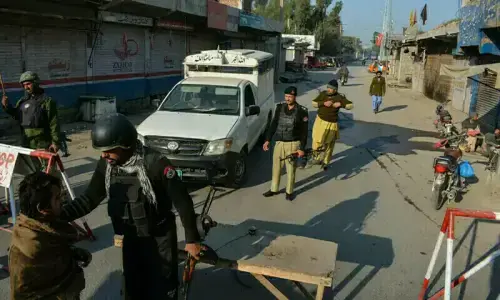
Here was the state apparatus let loose on protesting but absolutely unarmed lawyers, journalists, students, housewives, the general public, the young and old, men and women. And let loose as though it was dealing with the most vile criminals on the face of earth.
Uniformed policemen, with the help of other men in white shalwar kameez, were laathi-charging and tear-gassing the protesters in the most violent manner possible. They would first charge towards the crowd and disperse them, then would isolate one individual and about eight to 10 uniformed men clad in white shalwar kameez would descend on him, hold him by his arms, pull his hair and start punching, slapping and kicking him before violently pushing him into a waiting police van. (Please visit www.flickr.com, type ‘Pakistan police lawyers’ and see the treatment meted out to those who dare to raise their voice).
As I watched the programme, I thought to myself: what have to come to? How have we managed to sink to this level of depravity? Where are we heading? Who is responsible for this brutalisation? And does anybody care?
Are we inherently violent? Or have we become so because of what we constantly witness around us? Do the policemen who swing the laathis and those who give the orders not belong to the same religion — one that espouses peace and love, brotherhood and tolerance — as the protesters? Do those who give the orders not have mothers and daughters and sisters and sons and brothers? What kind of brutes rule this land of the pure?
In terms of psychological evolution our society is functioning at what Sigmund Freud called the ‘id’ level. This is the level where we want instant gratification, cannot postpone our desires, do not think of the consequences of our actions and give free vent to our innate aggressive drives. We have yet to enter the ‘ego’ and ‘superego’ levels when individuals and societies develop concepts of ethics and morality, right and wrong and a conscience that rewards and punishes good and bad behaviour respectively.
There is a serious crisis of governance in the country. Corruption is not only institutionalised in Pakistan, but internalised as a societal norm. We have no qualms about not paying taxes or not stopping at traffic lights or allowing our 14- and 15-year-old sons to drive.
Witness the number of guns on our streets. Witness their naked display by the growing number of security guards. What if the gun goes off accidentally? How many guns have gone off accidentally? Does anyone know? Does anyone care to know?
Our television channels have dehumanised brutality. By showing acts of violence repeatedly — witness the security guard being knocked down by the rampaging truck at the FIA building in Lahore or Dr Sher Afghan being manhandled — we have trivialised acts of violence to the level of everyday events, in the process increasing our tolerance for them. No wonder that six people were burned alive in Karachi in the afternoon and by evening everything was back to normal.
Why has no government invested in institution-building? Why do they always bring in their ‘own’ president and their own judges? Nawaz Sharif brought in Rafiq Tarar (remember him?) while Benazir Bhutto brought in Farooq Leghari. The motive in both cases was ulterior (‘our’ president would not go against us). While the former got away with it, the latter bit the hand that fed it. It is the law of nature — actions that are not morally right will be undone in due course of time.
Now we have another illegitimate situation initiated in October 1999 that has continued to this day. It came with a promise to do away with ‘sham democracy’ and to give us a government ‘of the people, for the people, by the people’ (shamelessly using Abraham Lincoln’s hallowed words). In the intervening eight years every institution of this country has been decimated and emasculated, the law treated as a nuisance and the Constitution trampled upon so many times that it has become almost irrelevant. We forget that when those in high positions break the law and violate the Constitution, the lowly-ranked police constable and man on the street take it as a signal to do the same.
Is there a way out of this morass we find ourselves in? Can the rot be stemmed? Can the blatant brutalisation of this society be stopped? The answer is — yes. But there is a big BUT after the yes.
First, we have to accept that the present generation is a lost one — it cannot be rescued. Its value system is so flawed and sense of ethics and morality so poor that trying to salvage the behaviour displayed by it is all but a lost cause. There is hope, though, that future generations may fare better, provided we declare an emergency and invest heavily in education, healthcare and the social sector. We have to include the teaching of ethics and morality in our curriculum. We have to build, strengthen and make all pillars of state truly independent.
We have to stop using violence against unarmed innocent men and women who have every right to raise their voices in protest against injustices. Our leaders, whether politicians or retired generals, have to publicly recant on violence. They are all part of this system and all have directly or indirectly contributed to the brutalisation of this society. They must apologise to the Pakistani nation. Reconciliation does not mean turning a blind eye to the excesses of the past and carrying on as though nothing has happened.
True reconciliation means realising, accepting, confessing and being genuinely sorry for the wrongs done and asking for forgiveness from those who have been wronged. Only then can the wounds begin to heal and a true spirit of understanding be fostered. There should be no ‘sham reconciliation’.
This country was bequeathed by the Quaid to honest, decent, hardworking and law-abiding Pakistanis and not to the crooked and corrupt, who trample on our rights, who have no respect for the law and Constitution and who take the law into their own hands. Pakistanis deserve better than this. This brutalisation has to stop.
The writer is professor of psychiatry at the Aga Khan University, Karachi
muradmk@gmail.com
Berlusconi’s poll victory
YOU have to admit the man has talent. Silvio Berlusconi’s triumph in Italy’s general election to win a third spell as prime minister –– at the age of 71 and less than two years after his defeated five-year government had left Italy as the slowest growing economy of western Europe –– is quite remarkable.
It is testimony to his resilience but also to a campaign full of jokes and provocations. His victory should, however, be deeply troubling for anyone who cares about democracy.
For, in addition to his undoubted personal appeal, Berlusconi had some powerful advantages. He is Italy’s richest man by far, enjoying a near monopoly of commercial television, a big publishing empire, and lots of other interests. Such a domination of the broadcast media by a party leader would be considered an unacceptable infringement of democracy in any other west European country. In fact, if Italy were a candidate for EU membership, such concentration of power would be an obstacle. Since it was a founder member in 1957, neither governments nor the European commission dare raise this issue.
As an opposition candidate, ownership of all the commercial TV channels, bar the weak La7 channel and the cooperatively rightwing Sky Italia, helped Berlusconi enormously. In government his advantage is even greater, for he can, did and will exploit Italy’s tradition of political interference in the Rai public broadcasting system. An important reason why he lost so narrowly in 2006, despite his government being widely considered a failure, is that he essentially controlled the entire TV news output. Such fears cannot have been absent during the campaign from the minds of every Rai political reporter and commentator who wants to stay in a job.
I should disclose at this point that there is history between me and Berlusconi. In 2001, when I was editor of the Economist and another Italian election was imminent, we conducted a long investigation into his finances and his many legal entanglements. As a result of that investigation, and aware of his conflict of interest as a media owner, we declared him on our cover to be “unfit to govern Italy”.
Half of Italy vilified the Economist for that cover and the other half beatified us. The still victorious Berlusconi branded us as “communist”, correctly pointed out my resemblance to Lenin, and presented us with the first of two libel suits, which are still rumbling their way through the Italian courts.
The notoriety that this brought was good fun. But behind it lay some serious issues. Berlusconi’s defenders say that there is plenty of competition in the Italian media, so his TV ownership doesn’t matter. Of course it does matter, for TV is far more powerful than print, but Berlusconi also uses a mixture of lawsuits, patronage and threats to intimidate Italian journalists.
His defenders argue, moreover, that he has never been found guilty of any legal charges. This is blatantly untrue, but he has been saved by the statute of limitations and by the way his own government in 2001-06 shortened those limits and decriminalised the false accounting with which he was charged. Berlusconi should be a cautionary tale for us all about what happens when you allow one man to dominate the media and when the interests of big business and of government become intertwined.
But what will happen now? Berlusconi has won a more decisive victory than most pundits expected, and will govern in a coalition with the Northern League, an anti-immigrant and regional-rights party that was the election’s other big winner. His government can be expected to last rather longer than its weak centre-left predecessor.
The party representation in Italy’s parliament has been simplified drastically thanks to this election, which is surely a good thing. But with no communist or socialist representatives –– for the first time since 1946 –– there is some danger that extra-parliamentary activism will break out in response to the new government’s programme.
Italy does have law courts and a president to act as constitutional checks on the government, so there is some hope of restraint –– even though during the campaign Berlusconi proposed menacingly that all prosecutors and judges should be given sanity tests. His government is likely to be corporatist rather than free market, at least on the evidence of a campaign in which he promised to block the sale of the near-bankrupt Alitalia to Air France/KLM. That intervention and any new state aid will bring him into conflict with the European commission; and a likely increase in Italy’s budget deficit –– thanks to his promised tax cuts and spending rises –– will bring him into conflict with other member governments.
In which case, the important thing is that they stand up to him. Neither Gordon Brown nor any other European leader should repeat the disgraceful toadying to Berlusconi that was exhibited by Tony Blair, which showed that this supposed idealist had no principles at all. They will have to treat the Italian prime minister with the diplomatic politeness that is due any head of an EU government, but should go no further than that. Brown’s holidays would be far better spent in Dorset than Sardinia. n
—The Guardian, London
The writer is the former editor of The Economist.