0
0

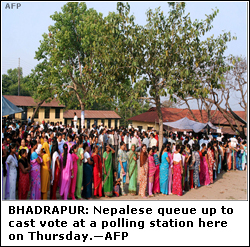 OKHARPAUWA (Nepal) April 10: Confounding pessimistic predictions of widespread violence, Nepalis turned out enthusiastically on Thursday to vote in a historic and largely trouble-free election they pray will bring lasting peace.
Many queued from dawn and others trekked long distances in the Himalayan foothills to cast their votes in the country’s first national poll in nine years. Turnout was estimated at around 60 per cent.
The vote is the centrepiece of a 2006 peace deal with Maoist guerillas to end a decade-long civil war, and marks the transformation of the rebels into a legitimate political party.
Peace was the first word on almost every voter’s lips.
“We came for peace,” said Chini Phuyal, 50, who trekked for three hours to reach a polling station perched on a steep, terraced hillside near the village of Okharpauwa.
“The main thing is that people should not get killed,” she said, dressed in a bright red saree commonly worn by married women in the countryside.
Nepalis were electing a 601-member assembly that is supposed to write a new constitution, abolish a 240-year-old Hindu monarchy and serve as a parliament for at least two years in one of the world’s poorest countries.
One candidate was shot dead and a party worker killed in a separate clash in Nepal’s southeastern plains, but observers and officials said the election, guarded by around 135,000 police, had passed much more peacefully than expected.
“Given the fears we had, it was a very peaceful election,” said Chief Election Commissioner Bhojraj Pokharel. “We are very happy ... and I feel proud.” The Election Commission ordered re-polling in 33 out of more than 20,000 polling centres after clashes or threats to voters and officials. But a home ministry spokesman said the vote had been “unexpectedly smooth” and very enthusiastic.
United Nations spokesman Kieran Dwyer said it had been a “very significant day for Nepal”, with many people very happy and relieved to be given the chance to express their will.
INTIMIDATION: Violence and intimidation had marred the campaign, with Maoists in particular accused of threatening voters and rival party workers. At least 12 people were killed in election-related violence in the run-up to the poll, including two candidates.
In one polling station in the village of Jitpurphedi, members of the Maoist youth wing joined hands in a line outside the polling station, in an apparent show of strength, although they said it was an innocent attempt to prevent queue-jumping.
But voters there and in other polling centres in the Kathmandu Valley and the surrounding countryside told Reuters they had voted without fear.
“I am very happy because I have been able to vote for a peaceful future for my grandchildren,” said 92-year-old Maili Maya Lama, bent over double with age and holding a stick.
“We all want peace but we don’t know whether our hopes will turn to frustration,” said 45-year-old housewife Sudha Rajuwar.
VOTERS IGNORE BOYCOTT CALL: But Nepal is unlikely to change overnight, and first has to survive a tricky post-poll period, with results likely to take more than 10 days and a chance losing parties might cry foul.
Maoists insist they will respect the “verdict of the masses”, but a poor performance could prompt hardliners to split from the party and take to the streets.Armed groups in the southern plains bordering India have called for a poll boycott, saying they did not believe a promise of regional autonomy after the elections, and activists waved black flags and tried to turn voters away in Janakpur town.
Perhaps the biggest loser is King Gyanendra, who seized absolute power in 2005 but retreated the following year after street protests. Nepal’s main parties promise the new assembly will start by abolishing the monarchy.
Voters have to choose between 54 parties, represented by symbols including the sun, a tree, a buffalo, a football, a radio, a baby, and, of course, the Maoist hammer and sickle. “We have seen other parties, let’s see the Maoists,” said 31-year-old farmer Kalu Lama. “We need water, roads, electricity, telephones and cheap fertiliser.”—Reuters