0
0

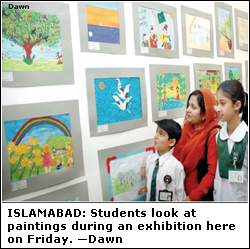 ISLAMABAD, March 14: An exhibition of some 200 paintings by Japanese and Pakistani children started at the National Art Gallery here on Friday.
Under the theme of “War and peace”, the exhibition has jointly been organised by the embassy of Japan, children’s art workshop Pakistan National Council of the Arts, Asian Cultural Exchange Association, Tokyo; Pakistan-Japan Cultural Association Islamabad and Mext Alumni Association of Pakistan.
As many as 10 paintings of professional Japanese artists are also on view, giving an in-depth look into the Japanese artistic trend.
Besides, 10 paintings and 20 works of calligraphy by Japanese children are also on display together with 140 paintings of Pakistani children.
From imaginatively coloured village scenes, birds pecking in bright green grass in front of yellowish mud houses, women carrying pitchers frozen in time to gracefully dancing Japanese women wearing kimono to impressions of nature, sea life, still lives, mountains, portraits and figurative, almost every subject has been covered. Few highlight the given subject - war and peace.
In a boldly painted collage of national symbols, flags, smiling faces and colours was the work by Komal Irshad from Roots School System, Harley Street, Rawalpindi. “I’m trying to show the bond between the two countries and friendship their people share,” said the-12-year-old.
Bilal Pasha Tahir, also from the same school, had drawn a bridge connecting Japan and Pakistan. Aeroplanes flew into each other’s air spaces and cars from both countries travelled across the bridge. “I have tried to show the two countries can progress sharing technology,” Bilal said.
Out of the 180 drawings and paintings, 140 paintings by children from some 50 schools were selected for display. Excited to see her drawing on wall of gallery-11 of NAG was Ambar Yousaf. The 11-year-old from City School’s junior B had drawn Japanese and Pakistani students holding hands on a blue-green globe. “I have called it ‘Unity’,” she said.
Calligraphic works by Japanese children brought for the purpose were among the outstanding ones. Children could be seen trying to get close to some works on the wall trying to touch the black paint with their fingers.
The 10 paintings of senior Japanese artists, Hiromichi Ishiyama, Maiko, Kinata Hiramasa to mention some, were a breathtaking blend of distinctive styles, colours and energy.
Japanese girls wearing kimono in a heavenly garden gave the illusion they were poised to dance and in one work an expressively rendered woman’s face looked prettily out of the portrait but away from the viewer.
The exhibition will continue till March 22.