No ‘leaders’ in sight
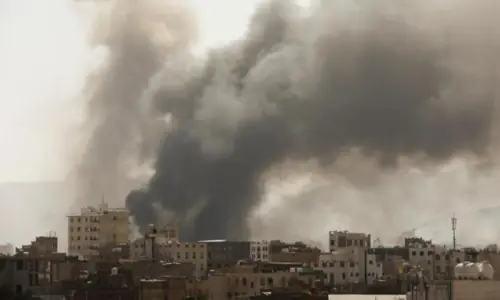
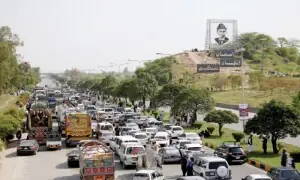
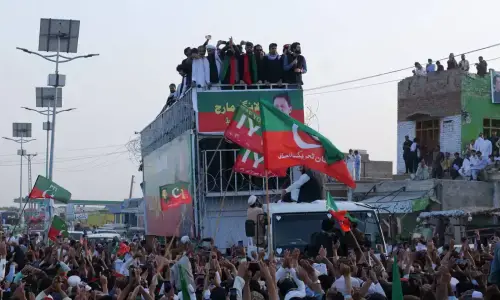
ANGER and mayhem ruled the streets of Karachi, Hyderabad and dozens of cities across the country for several days after Benazir Bhutto’s assassination. The events of the past few days have shown how helpless the civil administration is in the face of widespread rioting that, in this case, left many dead or injured. Even the assistance of the army and paramilitary forces deployed at various points proved ineffective in checking the violence that brought life in several places to a grinding halt. It is not only the mourners who wreaked havoc as their grief turned explosive on the streets; criminal elements, too, taking advantage of the general chaos, indulged in looting while profiteers cashed in on the shortage of supplies by raising the prices of essential goods. People suffered from the absence of public transport, the non-availability of fuel for their own vehicles, the closure of most shops and the thin attendance of medical staff at hospitals. In Karachi, just as business was resuming on Monday, more riots, fuelled partially by the false rumour of an attack on MQM’s Farooq Sattar, led to disturbances in many parts of the city.
As the cities burned, where were the political leaders? Many of them, including President Musharraf, had been spouting pledges of bettering the lot of the common man, until last week when Benazir’s assassination cut short their election campaign. They have proved themselves unequal to the task of assuaging grief and protecting private and public property, let alone providing the leadership Pakistanis need in this hour of gloom and doom. They have made no attempt to reach out to the people. It is as if the country has been left rudderless, adrift on a turbulent ocean of terrorism, poverty and general lawlessness with no shore in sight - and no answers to the burning questions regarding Benazir Bhutto’s assassination. This, then, is the calibre of leadership that decades of military rule in Pakistan’s 60-year history has spawned; one that is insensitive to the people’s grief and unable to take control when frustration finds an outlet in rioting.
Ordinarily, it would be a sad comment on the fate of a nation if its people are left to pick up the pieces by themselves. But in Pakistan, where leaders appear to concentrate more on Byzantine intrigues than governance and where a military, obsessed with itself, holds the reins of power, there seems to be no other choice. Pakistanis must depend on their own maturity and level-headedness for a way out. Since role models are rare, a sense of responsibility can only be self-inspired so that the people learn to devise their own methods to deal with crises and prevent matters from getting out of hand.
Beyond professional hazard
THE year 2007 bowed out after causing much anguish around the world. It was by no stretch of imagination a particularly bright or cheerful year for Pakistan. That the Fourth Estate took the brunt of all the negative happenings across the land and in the process lost as many as seven media practitioners was a reflection of the challenges that beset this country in every area of national life. According to figures released by Media Commission Pakistan and the South Asia Free Media Association (Safma), Pakistan topped the ‘death table’ in South Asia, followed by Sri Lanka and Afghanistan. Seen in the larger context, Pakistan ranks third behind Iraq and Somalia. This is hardly something to do us proud. The pressures under which the media operates in Pakistan are enormous. There is a tangible sword of Damocles hanging over its head and much worse is the fact that the sword happens to be a multi-edged one. For starters, it has to face all kinds of pressures from the government and its various agencies. Then there is the stress of dealing with certain political parties that have no qualms about using violence as a means to instill fear and intimidate people. And, finally, there is the threat —much under-rated, but potent all the same — from corporate and criminal mafias that are no less threatening once they feel the heat of media scrutiny.
It is fashionable for many to criticise journalists for being irresponsible and sensationalising news. True, not all criticism is misplaced. But when seen against the backdrop of the risks journalists run while ensuring that people receive information as a matter of right, one must appreciate the job the media people do. It is not easy, for instance, to venture out on to the roads to carry out professional duties when the police and the Rangers take refuge in their dens only to come out when the arsonists have worn themselves out. As can be seen through statistics —out of the 21 deaths of journalists during the Musharraf era, seven have come in 2007 alone — the risks are only multiplying in these days of intolerance, extremism and quick recourse to violence. While we back Safma’s demand for insurance coverage for reporters and cameramen, it has to be reminded that insurance may come handy for those left behind. It doesn’t offer protection to the man himself. Pakistani media has a rich and proud tradition of courage and resilience to withstand all kinds of intimidations and enticements to live beyond zealots, despots and tin pot dictators. It is very much in the national interest to keep it going. A threat to independent media is a threat to an independent nation.
Creativity to channel emotions
FEW among us realise that arts and humanities instil and sustain idealism and optimism in a people. As tools of collective catharsis, the arts are fundamental rights of a nation, from articulations of joy such as classical dance, murals and music to spiritual expression. Much like the whirling dervishes of Turkey, we have our own qawwali, ‘dhamaal’ or Sufi poetry. However, the real advantage of creative manifestation lies in its ability to become the ultimate safety valve in times of discontentment; emotions can be unleashed on stage, celluloid or in memorials that congeal memories of icons. The use of creativity for expressions of sentiment was manifested in the sand sculpture of Benazir Bhutto carved by an amateur artist on a beach in Puri (India), as shown in a picture in this paper.
It is a pity that the creative tradition in testing times in our society has found expression in random vandalism, from disparaging graffiti on city walls to wanton tarnishing. This cannot be excused as the poor man’s art forms. The ruinous aftermath of Ms Bhutto’s murder is an example of how the absence or suppression of constructive expression can explode into rampant rage. Dignified forms of expressions such as in art forms, vigils, flowers, etc emerge from the deepest recesses of the heart and do much for remembrance. One reason for our collective austerity can be our conditioning which compels us to take ourselves too seriously which doesn’t allow expression of grief with dignity and beauty. Murals to mark moments or simple courtesies are considered inappropriate and out of place. We see unrestrained anguish or petty aloofness as ‘serious’ and therefore acceptable. We need to inculcate the use of creative choices as expression of our grief and emotions in the formative years when a child should be encouraged to give free rein to his/her cultural creativity to articulate his/her feelings.
OTHER VOICES - European Press
The stakes are too high
WHETHER Al Qaeda was responsible for the assassination of Benazir Bhutto, the intentions of those behind this murder are hardly difficult to discern: to destabilise further the Pakistani state; to push Pakistan out of the American orbit; to force the political parties and the Musharraf government to turn inwards and against one another; and, as a result of all that, to see the parliamentary elections planned for Jan 8 deferred indefinitely.
The violence has already begun, and figures such as Imran Khan are openly asking why President Musharraf hadn’t ensured Ms Bhutto’s safety….
Longer term, the prize — for Ms Bhutto’s murderers — must be to see Pakistan slowly turn into a backward, fundamentalist regime modelled on the Taliban’s insane, cruel rule in Afghanistan — only this time a nuclear state occupying a still more vital strategic position….
Were Pakistan, long an American ally, and her weaponry to fall into the wrong hands, it would be the ultimate mark of failure of George Bush’s foreign policy, and without question one of the greatest foreign policy reverses for the United States since the end of the Second World War…. The stakes, for the West almost as much as Pakistan, could scarcely be higher.
… Given the trauma that has befallen Pakistan and the grievous blow to Ms Bhutto’s Pakistan People’s Party (PPP), it would be understandable if the elections were called off, allowing the nation’s wounds to begin to heal …. A postponement of a few weeks would not offer the terrorists a huge victory in real terms….
However, the case for going ahead on Jan 8 is a powerful one…. the test of democracy is how resilient it proves when events threaten it most.… Pakistan has waited long enough to go to the polls; when the mourning is over, she must face the future. — (Dec 29)
| © DAWN Group of Newspapers, 2008 |