0
0

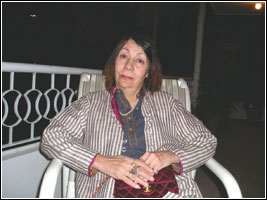 KARACHI-born Sara Suleri was two when the family moved to Lahore. Her father, a well-known journalist, was the editor of The Times of Karachi and, according to her, also the editor of The Evening Times, the first and perhaps the only evening English daily from Lahore. Her father was in jail for a few months because he had annoyed the people in power. When she was six and had just completed her kindergarten the family moved to the UK, the country which her mother belonged to. For the last so many years she has been in the US.
Where does the eminent writer have her base? “Let me tell you one incident which will answer your question. My very dear friend, Abida Hussain, had thrown a party for me years ago where she introduced me as a renowned Pakistani American. I interrupted her by saying: I am a Pakistani.
Period; It’s just that I am staying in Connecticut these days,” answers Suleri.
“But you are in Pakistan after three years?” I argue. “So what?” she retorts implying that home is where the heart is. “Listen, I am going to make amends. I am planning to spend half the time in a year in this country, but that will be from the next academic year,” she says at a dinner where an eminent historian, Dr Francis Robinson of the University of London, is the chief guest. On Monday, the OUP will be hosting a reception for her at the Second Floor. She will speak there and field some questions too.
I avoid referring to her books because I have read only one — Meatless Days —, her first book. I tell her that I read it a long time ago. “That’s because I wrote it a long time ago,” she says as she smiles, something which she doesn’t do very often or perhaps she doesn’t find me interesting company.
The soft-spoken Suleri teaches at Yale. She is currently taking, what she calls, post-colonial literature, and from the next semester she will also conduct a course in Urdu literature. At Yale, she is at the same time very much involved in South Asian Studies Committee, where her responsibilities include advising students on choosing subjects for studies. The students who come to her are predominantly from Pakistan.
While there are senior Pakistani professors at Yale in science and technology, she is the only senior professor from this country in the field of humanities.
While her first three books were independent ventures, her third one is in collaboration with an eminent Pakistani oncologist, Dr Azra Raza, who is practising in New York. They have just finished translating Ghalib — not a very enviable job but going by Suleri’s track record and her laudatory comments about her co-translator, it would be well worth-seeing the poet in a new garb.
Before the reader thinks I am not even acquainted with the title of her second and third book, let me say that before Suleri comes home again I hope to have read “The rhetoric of English India” and “Boys will be boys”, a daughter’s elegy.—Asif Noorani