0
0

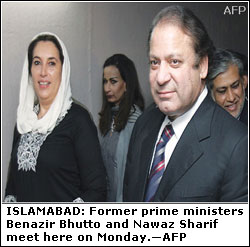 ISLAMABAD, Dec 3: Pre-election politics on Monday took yet another dramatic turn as former prime ministers Benazir Bhutto and Nawaz Sharif decided to bury the hatchet on the issue of general elections and after a marathon meeting made the decision of boycotting the polls dependent on President Pervez Musharraf’s response to their charter of demands for ensuring free and fair elections.
An over three-hour meeting between the country’s two most important politicians and their aides at Ms Bhutto’s residence may well prove to be a turning point in the country’s politics as, for the first time, there were clear signs that a decision on whether or not to boycott the polls could be unanimous.
The post-meeting news conference by the two leaders was held in an atmosphere of extreme optimism as neither Ms Bhutto nor Mr Sharif was willing to insist on any of their policies or demands that could have been a cause of friction. Instead, the PPP and PML (N) leaders repeatedly supplemented each other, with Ms Bhutto criticising the move to reject Mr Sharif’s nomination papers, and the PML (N) chief praising the PPP leader for her role in strengthening the opposition’s struggle for democracy.
The two former prime ministers were accompanied at the news conference by several senior opposition politicians, including Amin Fahim, Mehmood Khan Achakzai, Raja Zafarul Haq and Liaquat Baloch.
Perhaps the most concrete outcome of the meeting was their decision to declare that the elections under the present set-up and in the current atmosphere could not be free and fair. With this agreement, the two sides decided to move away from their respective positions of participating or boycotting the elections and instead decided to form an eight-member joint committee to prepare a charter of demands, which Mr Sharif said would be presented to President Musharraf.
The demands are primarily aimed at ensuring an atmosphere for free and fair elections without which it may become difficult for them to take part in the process, Mr Sharif said.
It was immediately supplemented by Ms Bhutto who said if the right conditions were not created for an election process which was seen to be fair and transparent, the committee could recommend pulling out of the polls.
The committee would comprise representatives from the ARD and APDM as Monday’s meeting between the two former prime ministers was dubbed as talks between the representatives of the two pro-democracy alliances.
However, like Ms Bhutto the PML (N) leader also kept insisting that they too wanted to participate in the elections and were opposed to the idea of boycotting, but said participation would only be fruitful if they were made to believe that the process was going to be fair and without any official interference.
While indicating that the two sides were sincerely planning to take part in the election if the charter of demands was accepted, Ms Bhutto said. “The ball was now in the court of the regime.”
During the course of the news conference, the two leaders were asked a barrage of searching questions, mainly on issues that have remained contentious, but both Ms Bhutto and Mr Sharif kept their cool and either avoided giving a direct reply, or advised the journalists to wait for the committee to prepare the charter of demands.
However at one point Ms Bhutto said it was not correct to say that none of their demands had been met by the government. She cited the announcement of elections, date for withdrawal of emergency and President Musharraf’s doffing the army’s uniform as some of the demands that had already been met. But she was quick to add that many other demands for ensuring free and fair elections, like neutrality of the caretaker set-up or transfer and posting of staff, and favours being given to PML (Q) were yet to be recognised by the regime.
The eight members of the committee are: Mian Raza Rabbani, Dr Safdar Abbasi, Naveed Malik and Abdul Qadeer from the ARD and Ishaq Dar, Ahsan Iqbal, Abdur Rahim Mandokhel and Prof Khurshid Ahmed from the APDM.
The committee will suggest ways of making the electoral process transparent and complete its proposals in two to three days.
When Ms Bhutto was asked about the legitimacy of President Musharraf’s rule, she said: “Only elected representatives will determine this question and the issue of judiciary.
“We want that the elections are held on January 8 and the demands that we are going to put up through the charter of demands are met in the given deadline so that the poll schedule is not disturbed,” she added.
Mr Sharif said the APDM had taken the decision to boycott the elections after discussing and reaching a conclusion that no election under the present set-up could be free and fair.
“We have now decided to move a joint charter of demands which will include the demand for setting up a neutral interim government to replace the present partial set-up,” he added.
He said that although his nomination papers had been rejected, the APDM did not want to boycott the polls, but if all opposition parties boycotted them no one would accept the elections in which only the ‘king’s party’ would participate.
Interrupting, Liaquat Baloch of Jamaat Islami clarified that the MMA would adhere to whatever decision the combined opposition took and if it was taking part in the polls, the religious alliance would do the same.In reply to question, Ms Bhutto said that her party had demanded the release of all judges, including the chief justice, and political prisoners.
Answering a question with regard to the concerns being aired in Washington about Pakistan’s nuclear assets safety, both PPP and PML (N) leaders said that such apprehensions only surfaced when a political turmoil erupted and a non-democratic regime took over.
They said that restoration of democracy would allay all such fears as there was no real threat to the country’s nuclear assets and these were in safe hands.