0
0

 INDIA has been rather slow in enacting social security legislation to bail out the poor, the jobless and the aged in times of crises, because of lack of funds and an inadequate machinery to execute and monitor the projects.
The first notable social security act was introduced by the Maharashtra government way back in the mid-1970s, at a time when the state was facing a major crisis caused by drought. Millions of rural workers were migrating to the cities in search of employment, abandoning their homes and farms. Politicians and bureaucrats panicked and soon responded by introducing an Employment Guarantee Scheme (EGS), which was funded by taxing professionals and employees in the organised sector.
The funds were used to provide employment to the rural poor, whose labour was utilised to execute public works – constructing rural roads, building canals or dams. The poor were usually provided foodgrains for their labour. Of course, most of the projects failed to take off and appeared directionless, but the poor were gainfully employed for a few months a year and earned some money.
The apparent success of the EGS, which slowed down the process of rural migration and provided succour to the needy in many of the backward districts of the state, triggered off similar programmes elsewhere in the country.
Southern states like Tamil Nadu came out with innovative programmes like the Midday Meal scheme, in the 1980s to lure the poor to send their children to schools. Other states, including Gujarat, Kerala and Madhya Pradesh came out with similar schemes; in 2001, the Supreme Court directed all government schools to provide meals to poor pupils.
The relative success of the Maharashtra EGS also saw the central government introduce a National Rural Employment Programme in the 1980s, followed by other programmes including food-for-work schemes, none of which, however, made much of an impact.
Recent years have seen a slackening in the implementation of the EGS in Maharashtra as well, with corrupt officials and contractors siphoning off a large chunk of funds. The enactment of the landmark Right to Information Act has seen several NGOs and individuals seeking details about specific projects, shedding light on numerous scams.
Billions of rupees have been spent on social security schemes in India in recent years, but there is a huge question mark about the effectiveness and success of these schemes. Former Prime Minister Rajiv Gandhi had in the late 1980s noted that less than 15 paise out of every 100 spent by the government on such schemes reached the poor.
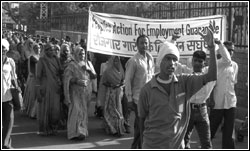 THOUGH politicians of mainstream parties like the Congress and the Bharatiya Janata Party (BJP) have been reluctant to splurge on social security schemes in India, there has always been a vocal section of society – including members of NGOs, left parties and academicians – that has been demanding allocation of increased funds for pro-poor schemes.
When the Congress got the support of the left parties and formed the United Progressive Alliance government at the centre in 2004, it had to agree to the demand for initiating a nationwide employment guarantee scheme. The result was the National Rural Employment Guarantee Scheme (NREGS), which was initially rolled out in 200 districts across the country.
Described as a remarkable initiative, representing a paradigm shift in the government’s approach towards providing employment for the poor, it was launched in early 2006 in 200 of the most backward districts of the country. Later, the government extended the scheme to another 130 districts.
The NREGS act guarantees at least 100 days of assured wage employment every financial year to a rural household that is willing to do unskilled manual labour, providing a safety net to the poor. For the first time in India, a member of a poor rural household could demand as a right a job from the government for 100 days in a year.
Prime Minister Manmohan Singh noted that the legislation aims at not only providing wages to the rural poor, but also creating durable assets for them. It would also hopefully strengthen the third tier of governance – the Panchayati Raj institutions – as 50 per cent of the programme would be executed by these local bodies.
According to the government, in financial year 2006-07, about 21 million households have been provided employment under the NREGS. They include nearly 60 per cent of scheduled caste and scheduled tribe households, and 40 per cent of the beneficiaries were women.
Nearly 800,000 projects were taken up and over 45 per cent of it has been completed. The government allocated over Rs120 billion for the scheme and nearly 75 per cent of it has been spent.
The NREGS was to have been expanded gradually and all the 604 districts in the country were to have been covered within five years of launch. But the apparent success of the scheme has seen the project being fast-forwarded.
Rahul Gandhi, who was recently promoted as general secretary of the Congress, in a much publicised move, urged the Prime Minister to extend the NREGS to cover all 604 districts in the country. And Singh responded enthusiastically, agreeing to do so immediately, instead of waiting for a few more years. Rahul’s mother, Sonia – who is the Congress and UPA chief – has also been hailing the implementation of the NREG.
BUT has the ambitious social security scheme of the UPA government been effective in alleviating rural poverty? Two recent studies conducted by NGOs indicate that the scheme has been a huge failure, and the only beneficiaries are corrupt politicians and bureaucrats.
According to a study by the Society for Participatory Research in Asia (PRIA), just six per cent of the registered households under the NREGS that were surveyed could get 100 days of employment in 2006-07. In the first phase of the study that was conducted last year, PRIA noted among other things that there was low awareness among people about the procedure for registration and getting employment and a “lack of transparency and accountability in the absence of proactive disclosure, functional monitoring and vigilance committees and social audit.”
The second phase of the study, conducted across 14 states, revealed that just 45 per cent surveyed among the registered households had demanded a job. And only 27 per cent of such households had been given a receipt. Less than half of those who had demanded a job got employment within 15 days as prescribed by the law; worse, no unemployment allowance was paid to these people.
Similarly, over 40 per cent of those who responded claimed they were paid less than the minimum prescribed wages.
Another Delhi-based NGO, the Centre for Environment and Food Security, was scathing in its criticism of the government regarding implementation of the NREG scheme in Orissa. The organisation conducted a survey in 100 villages in Orissa and found that of the Rs7.33 billion spend under NREGS last year, over Rs5 billion “has been siphoned off and misappropriated by government officials of executing agencies.”
The CEFS study revealed that a large number of needy households were denied not only jobs but even job cards, and not more than five days of average wage employment was given to each of the needy families in the 19 NREG districts in the state.
“We have found that more than 75 per cent of the NREG funds spent during last year have been siphoned off,” the NGO wrote in a letter to Prime Minister Singh. “However, we are absolutely certain that there are thousands of villages in Orissa where the scale of misappropriation is 80-90 per cent. It is distressing to note that there has been open and participatory loot of NREGS funds in Orissa.”
Aware about the potential for scams in such multi-billion-rupee schemes, the government is now trying to tighten up the rules. It is toying with the idea of issuing multi-application smart ID cards to monitor schemes like the NREG. The Planning Commission has been urging the government to go in for an integrated smart card system for entitlement schemes to check corruption and fraud.