0
0

 FURIOUS opposition from farmers in rice-growing states of India forced the government last week to partially withdraw the ban it had imposed on the export of non-basmati rice. The powerful farm lobby in Punjab, Haryana and Andhra Pradesh brought tremendous pressure on the government, forcing it to back-pedal and partially lift the ban on export of premium grade rice.
Worried over the shortfall in procurement of paddy, the government rushed through with an ill-thought of ban on export of non-basmati rice about a fortnight ago. Many exporters, who had committed to supply superior grade of rice to buyers around the globe were caught in a trap, as customs officials at ports refused to clear the export of rice consignments.
While farm leaders brought pressure on the Agriculture Ministry, exporters complained to the federal Commerce Ministry. Chief Ministers from several rice-growing states also lobbied with the central government, forcing it to revise its hasty decision. But many rice exporters fear that the damage has already been done, and India’s growing profile as a major exporter of rice would have taken a severe beating.
Total rice production in India last year added up to nearly 93 million tons. In the current year too, India’s rice exports were likely to remain buoyant, thanks to strong international demand.
The strengthening of the Indian rupee – it has gained by over 12 per cent this year against the dollar – did hurt exports of rice to some extent. But the Food and Agriculture Organisation (FAO) estimates that India is likely to export 4.4 million tons of rice in 2007 despite the strengthening of its currency.
Last year, India exported 3.7 million tons of non-basmati rice and a little over a million tons of basmati rice, earning about Rs70 billion. The share of basmati in rice exports has been declining steadily over the years; in the last five years alone, it has fallen from over 30 per cent to less than 23 per cent. Premium grade, non-basmati rice is being marketed by some in the export market ‘as good as basmati’ rice.
The premium, long grain variety of rice – ‘as good as basmati’ – fetches handsome returns both for farmers and traders/exporters. Many exporters want these varieties (Pusa 1121 and CSR 30, for instance) to be classified as ‘basmati,’ as it is cheaper to procure, but will fetch better rates.
Farmers, especially in Punjab and Haryana, are happy with the premium variety, as it has higher productivity per acre and also gets them higher returns.
Earlier this month the government imposed the ban on export of all non-basmati varieties of rice, following fears there could be a sharp fall in procurement for the public distribution system (PDS). Paddy procurement has dipped by nine per cent to just 8.36 million tons (compared with 9.17 million tons this time last year). The public sector Food Corporation of India (FCI) had managed to buy just a little over three million tons of paddy by the first week of October as against arrivals of about 4.6 million tons.
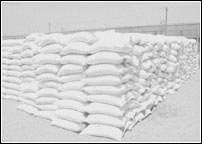 Last year, the figure was 4.2 million tons of procurement against arrivals of 5.2 million tons. The sharp 22 per cent drop happened despite a significant hike in bonus for farmers. The fall in procurement could have a disastrous impact on food security, and in times of political uncertainty – with the prospects of a mid-term poll still hovering over the nation – no government would want to take any risks.
The government supplies nearly two million tons of rice at a subsidised price to the poor every month, and needs about 24 million tons of rice a year. With procurement likely to touch only around 27 million, the authorities were worried about the impact on food security.
Rice for PDS is used in many of the ambitious new programmes launched in recent years by the United Progressive Alliance (UPA) government, including the National Rural Employment Guarantee Scheme and the mid-day meal scheme for school children. With low stocks the government imposed a ban on exports earlier this month, hoping to build up adequate reserves.
Wheat stocks are also running low and there are concerns that food grain prices could escalate next year. The fact that this is happening in a year of good monsoons is also not a good omen; imagine if the rains fail next year, there could be a disaster in the making.
Despite these concerns, the pressure from the farmers’ and exporters’ lobby was intense. The government decided last week to exempt exports of superior quality non-basmati rice – priced at over $425 a ton – from the ban, and also directed customs officials to allow exports of all varieties of rice for which letters of credit had been opened till October 9 – when the ban was imposed.
However, paddy farmers are upset and are demanding the government pay them Rs1,000 a quintal for procurement. The government recently went in for a sharp escalation in MSP for wheat – because of an acute shortage domestically and high international prices – raising it to Rs1,000 a quintal.
Last year, the MSP was Rs750, and there was an additional bonus of Rs100. This year too, the additional bonus has been fixed at Rs100. Rice growers are demanding that the MSP for rice be also raised to over Rs900 a quintal, as the cost of production is soaring.
The spurt in MSP for wheat has seen the government buy about 11.4 million tons of wheat this year – as against 9.3 million tons during the same period last year. Last year, the government was forced to import wheat for the first time in several years, resulting in a huge controversy. Even this year, the government has been forced to import an additional 1.3 million tons of wheat, paying a hefty premium.
But wheat output is likely to touch nearly 75 million tons this year as against about 69 million tons last year.
Farmers in the major rice-growing states including Punjab (which accounts for 35 per cent of rice output in India), Andhra Pradesh (18 per cent), Uttar Pradesh (12 per cent) and Haryana (six per cent), besides states like Tamil Nadu (less than five per cent) have been demanding a hike in the MSP.
Even the DMK government in Tamil Nadu (which is a partner in the UPA government) has demanded an MSP of Rs1,000 a quintal for paddy. Politicians in the southern state point out that farmers have to spend almost Rs1,000 a quintal to raise paddy, and the low MSP would discourage them from cultivating it.
Recently a delegation of ministers and lawmakers from Andhra Pradesh called on UPA chief Sonia Gandhi, urging her to direct the government to raise the MSP for paddy (and also to withdraw the ban on export of non-basmati rice). The Congress party chief assured the delegates that the government would look into their demands.
Even former deputy prime minister – and BJP leader – L.K. Advani sought a hike in MSP to Rs1,000 a quintal, and warned the government of unrest among paddy growers, especially in the south.
Farmers in the south claim that the minimum ceiling of $425 a ton relating to the ban on export of non-basmati rice will hurt them. Most of the rice grown in the south sells for around $300 a ton internationally, and the partial withdrawal of the ban would not help them in any way.
The last thing the UPA government – fighting its own allies with its back to the wall on several issues – would want is to be confronted with charges of discriminating against farmers in the south. But that is exactly what it is likely to face over the coming days.