0
0

 INDIA’S economic reforms programme was launched in 1991, and over the years the government has thrown open several segments of the economy to private participation. Virtually every industry that was opened up to private participation has fared exceedingly well after the reforms.
These include civil aviation, telecommunications, insurance (including life), banking and financial services, infrastructure, ports and even oil exploration and production. Sectors like civil aviation and telecommunications have blossomed and seen remarkable growth, and the changes witnessed in these segments are nothing but revolutionary.
Yet despite the overwhelming evidence, indicating the benefits that the consumer has gained – airfares have tumbled encouraging even the less affluent to fly, and telecom costs have plunged, and even the poor have access to mobiles – because of the opening up of several sectors to competition and private participation, there are many in India who still equate the private sector to profiteering and consider it evil.
And those reflecting such views are not necessarily the uneducated and ignorant; many academics, bureaucrats, politicians (of the right and the left), trade unionists, opinion-makers and intellectuals continue to cling to the belief that there are certain segments of the economy that should never be thrown open to the private sector.
These are not necessarily only the so-called ‘sensitive’ sectors like atomic energy and nuclear installations, the defence services, the mint, or air traffic control. Even ordinary ones like the railways and public transportation are considered to be sacred cows that are best left under the control of the government.
Indian Railways continues to be a monopoly and any talk of reforms – by allowing private players to operate high-end services including luxury trains for tourists, or commercially exploiting the vast tracts of land that the railways own – is shot down in the corridors of power.
The monopolistic operator was reluctant to allow even the efficient Delhi Metro to function independently. The federal government, however, now allows state governments to set up metro corporations in joint ventures with private partners, and the Indian Railway has no role to play in the new projects.
The government is also keen that the ambitious Delhi Mumbai Industrial Corridor (DMIC) project – which will run parallel to the Dedicated Freight Corridor (DFC) linking the two metros – costing a whopping $100 billion be executed by an independent corporation, with a minority government stake in it.
ONE major sector that is crying for reforms is surface transportation. As in the case of the railways, the road transportation sector – both inter-city and intra-city – is reserved for government monopolies. In the few places where the private sector has been allowed to operate bus services, it has been crippled with unnecessary restrictions.
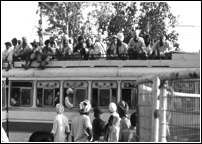
A majority of state transport corporations are loss-making units, and state governments continue subsidising them, instead of winding them up. Most state transport buses are unsafe, stripped down of all valuable parts (including television sets and VCRs that are installed with great fanfare), and often breakdown in the middle of a journey.
Passengers are forced to travel in these dangerous vehicles because of a lack of an alternative mode of transport. But there is near unanimous belief among politicians and other decision-makers in India that the road transportation sector should remain a government monopoly.
Accident like the spate of recent ones involving Delhi’s Blueline buses – which are privately operated – reinforce this belief and even the courts direct the government not to give permits to private operators. Blueline buses are owned and managed by unprofessional operators, many of whom are crooks out to make a quick buck.
Last week seven pedestrians were killed in the capital when an over-speeding Blueline bus mowed them. Delhi’s notorious private bus operators have killed several people in recent years, a ghastly track-record that further confirms the suspicions of many that road transportation should not be handed over to the private sector.
State monopolies have made a mess of the transportation sector and vested interests have developed a huge stake in them. Most of the undertakings are starved of funds by the state governments, and politicians refuse to allow them to raise fares, as they fear a backlash from passengers.
Most of the users of state-owned bus services are the poor, and many politicians genuinely believe that they cannot afford to pay higher fares. But the fact remains that millions of poor Indians pay much higher fares to truck-drivers, who over-load their vehicles with passengers, picked up on highways.
State transport undertakings are also headed by politicians – generally those who could not be accommodated in the council of ministers – many of who are corrupt and openly loot the corporation. Every state government owned transport corporation has a fleet of a few hundred buses, and it is easy for the top bosses to make a quick buck in deals involving the procurement of millions of rupees worth of tyres, spares, even television sets and other unwanted items from favoured middle-men.
THERE are two major factors that have prevented reforms in the transportation sector: the lack of a regulator and abysmal lack of infrastructure. For a country that has some of the best private airlines, it is surprising that there is not a single professionally-managed company operating a fleet of buses.
Local laws discourage large companies – with deep pockets or access to funding – from entering the sector. Ministers give permits to operate buses to their favourites, ostensibly the unemployed, the disadvantaged, etc. And they want to protect them from large firms, so most private bus operators run one or two vehicles, and are content with their small outfits.
Running a modern fleet of even a few hundred buses requires millions of rupees, professional skills, the ability to recruit the right drivers and technicians, and also the infrastructure to park, service and run the buses. The operator has to buy or lease land for depots, garages, restrooms for the drivers, booking offices, and other facilities.
In the absence of a regulator for the industry, private sector players are reluctant to enter the business. In Maharashtra, politically well connected businessmen run bus services from the capital Mumbai to near-by cities. Those without such connections are harassed by the police, transport officials, and hoodlums, who extort money from the operators.
Blueline operators in Delhi face enormous problems, including a shortage of skilled drivers. There is pressure on them to bribe local goons and even the traffic cops, so they overload their vehicles. The combination of badly-maintained and over-loaded buses and poorly-trained and over-worked drivers can be deadly, and accidents are frequent.
The Delhi high court last week asked the government why it cannot operate an efficient service, like the one run by the Bombay Municipal Corporation – the BEST, or Bombay Electric Supply and Transport undertaking.
But Uttam Khobragade, the BEST general manager, knows exactly how efficient the organisation is. According to him, the BEST’s transport wing has run up losses exceeding Rs15 billion. The bulk of the revenues – 96 per cent of it – go by way of wages to the staff. The undertaking is unable to invest in new buses, and has to depend on international agencies for funding.
And politicians in the civic body refuse to allow him to raise fares, as they falsely believe that commuters will be annoyed by the move. The fact is that most passengers – both the well to do and the poor, the urban and the rural – want a reasonably good and efficient service, and don’t mind paying for it.
Reforms in the transportation sector are inevitable, despite the reluctance of unimaginative politicians and bureaucrats and unscrupulous elements both within and outside the government. Unfortunately, delays in bringing in the changes will take a heavy toll by way of increasing financial losses (ultimately borne by the tax-payer) and the tragic loss of life on the highways and roads because of accidents.