0
0

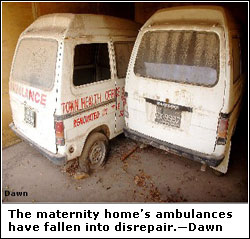 KARACHI, Sept 11: While the lack of facilities is a major reason why so many government healthcare units fail to operate round the clock, there are instances where administrative compulsions, bureaucratic hurdles and lack of interest on part of the officials concerned impede the provision of health services. The Manghopir Maternity Home, situated in Site Town, is one such case.
Built more than two decades ago, the maternity home has recently been renovated at a cost of Rs7.5 million through an MPA’s funds. The Unicef, too, has extended its support and under its project, the Women’s Right to Life and Health, provided two midwives and assisted in establishing a well-equipped labour room and a midwifery school. But, despite having these facilities, the maternity home has failed to function properly. Few women visit the facility and fewer still opt for delivery.
“This is because the maternity home has remained temporarily dysfunctional many times in the past. Though at present two doctors are working here in the morning, there were times when this facility was without any doctor and those appointed were quite irregular. The officials concerned are not serious about making this health facility fully functional, which is evident from the fact that they have stopped two midwives, appointed under the Unicef project, from working,” says an official requesting not to be named.
Under the Unicef project, the maternity home has been provided with labour tables, trolleys, a baby warmer and surgical equipment. Expensive machines such as an incubator, an autoclave and X-ray and ultrasound machines bought with MPA Fareeda Baloch’s funds are all lying covered in a room. The situation is deplorable considering the fact that there is no government hospital in Site Town, having a population of more than 0.7 million. The government health facilities in the town comprise only two maternity homes; the other being closed for renovation.
This pathetic situation does require immediate corrective measures by the government, but more appalling is what the girl students are facing at the so-called midwifery school opened here three years ago.
The midwifery school
“What we have got in the name of a midwifery school is a classroom, a book and an administrator-cum-teacher. At times, we are thrown out of the classroom when a workshop is to be held here. For clinical training, students are sent to the Sobhraj government hospital, and for passing exams they have to take notes from girls studying in other schools,” a student complains.
The students have a host of other requests to make, including the installation of a water filter, payment of stipend and provision of proper furniture for the classroom.
What is strange, however, is the fact that the 14 students who have been enrolled here for over eight months have never been given an opportunity to observe a delivery at the maternity home.
Explaining the reason for it, Town Health Officer Dr Moosa Memon, who looks after the maternity home, says efforts are under way to make the maternity home fully functional and till that time students have more opportunities to learn at hospitals such as the Sobhraj, Qatar and New Karachi hospitals, where a large number of deliveries are performed daily.
“Erecting a concrete structure is not the end and we do realise that the health facility needs to be fully functional. The renovation is near completion and soon we will embark on a plan to hire more staff,” Dr Moosa Memon says, adding that he is also aware of the problems students are facing and something will be done about them soon.
For the executers of the Unicef project, the Manghopir Maternity Home experience has been a huge disappointment.
The project initiated in 2002 has failed to bring about any improvement in the health status of women in the locality, according to Dr Shershah Syed, who heads the WRLH project in Sindh.
“There is nothing to boast of. The government is non-cooperative which is why we failed to bring about a change for the better. The midwifery school is in miserable shape since there is no teacher there.
“We want to continue our support, but if the conditions persist, we will prefer to invest our energies in an institution where people are willing to work,” Dr Syed says.