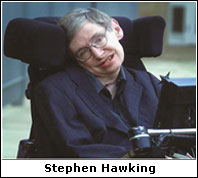
 CAMBRIDGE: British astrophysicist Stephen Hawking revealed his desire on Sunday to make “real science as exciting as science fiction” as he publicised a new book for children about the cosmos.
“It is easier to explain things to children because they have open minds and are eager to learn,” he told reporters at the prestigious Cambridge University, where he is a professor.
“George’s Secret Key to the Universe”, the first book in a planned trilogy, explains the workings of the solar system, asteroids, black holes — one of Hawking’s favourite topics — and other celestial bodies with the help of a set of young heroes.
It will be released in French on Thursday, and in English a week later, and is set to be sold in 29 countries. The second book in the trilogy will be published next year.
The book was written with his daughter Lucy, who came up with the idea, and Christophe Galfard, the first Frenchman to write a doctorate thesis on Hawking’s observations.
“Our aim is to make real science as exciting as science fiction,” Hawking said.
Lucy Hawking, a journalist and writer, told the press conference that one of her father’s common refrains was, “That’s too much science fiction, we do science fact.” The trio wanted to “provide a modern vision of cosmology from the Big Bang to the present day,” without presenting it as magic, Galfard said.
“All of what we see (in the universe) corresponds exactly to what has happened already,” he added.
The sole element of fiction in the book involves Cosmos, a supercomputer that opens a door allowing George and his friends to travel into space aboard an asteroid.
“I don’t know of any other book quite like ‘George’s Secret Key to the Universe’,” Hawking, 65, said.
“I think we may be unique.” Hawking, who is Lucasian Professor of Mathematics at Cambridge University — a post once held by Sir Isaac Newton — suffers from amyotrophic lateral sclerosis, also known as Lou Gehrig’s disease.
He was diagnosed with the muscle-wasting motor neuron disease at the age of 22. He is in a wheelchair and speaks with the aid of a computer and voice synthesiser.
His work has centred on theoretical cosmology and quantum gravity, looking at the nature of such subjects as space-time, the “Big Bang” theory and black holes.
In April, he experienced weightlessness for the first time, on a zero gravity flight, on a modified jet that flew a rollercoaster trajectory to create the impression of microgravity.
Asked about the choice facing the heroes in his book — saving the world from global warming or finding another planet that is habitable for humans — he said that, like George, he would opt to focus on both.
“I’m very worried that global warming might become self-sustaining and the temperature might continue to rise even if we cut (carbon) emissions. I hope we have not reached that point yet but it is urgent,” he said.
“I think the human race doesn’t have a future if we don’t go into space. We need to expand our horizons beyond planet Earth ... Sooner or later, disaster such as an asteroid collision or nuclear war, could wipe us all out.”—AFP