



 0
0

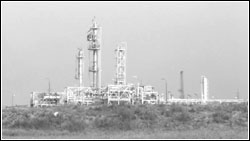 The North West Frontier Province (NWFP) is on the threshold of an economic boom with its nascent oil and gas sector undergoing an rapid expansion, continuation of which largely depends on the security situation in the volatile region of North and South Waziristan.
Production of oil and gas on commercial basis in the area started in July 2004 when Chanda Oil and Gas field at Shakkar Darra, district Kohat went into operation. Since then, the sector has continued to grow. In January 2005 and exactly a year later, one oil and gas field each went into commercial production at Gurgury and Makori in district Karak.
Ever since 1990 when local and foreign investors stepped into the mineral-rich southern parts of the Frontier, there has been no stopping in exploration and production activities. Three oil and gas fields have gone into production mode, whereas, exploration activities are underway at several sites in Kohat, Karak and Hangu districts, netted together in close proximity with the restive Waziristan region.
Amidst growing influence of Taliban and Al-Qaeda elements in NWFP’s areas bordering with Waziristan, economic turnaround is also taking place in Karak and Kohat areas. Though people of Shakkar Darra, Gugury and Makori have yet to reap economic benefits of the naturally bestowed potential of their areas, benefits yielded by the growing economic activities are quite visible. But the people are sceptical as to how the benefits would accrue to them.
The natural resource, particularly gas will not be of much direct benefit to them till distribution pipelines are laid down in their areas. Things seem to be moving in the right direction, although at a snail’s pace.
With construction work on major roads likely to take a couple of more years, gas pipelines are being laid and quite a few hundreds of unskilled local men have got minor jobs.
Presently, the provincial government appears to be a beneficiary of local and foreign investments—including capital spending by the Oil and Gas Company Ltd and MOL Pakistan Oil and Gas Company, an off shoot of Hungarian MOL Group that has invested Rs220 million in Karak district.
The economic benefit pocketed by the investors is hard to figure, but their future expansion plans give a rough idea of the viability of their businesses after the MOL Pakistan entered into a 30-year lease agreement with the federal government at the start of 2007 for oil and gas production and exploration activities.
Nonetheless, the positive impact on the cash-strapped Frontier government appears to be sizeable. With the commencement of commercial production of oil and gas fields in 2004, it found a new source of revenue and its receipts have grown substantially over the past three years. And this year, the provincial finance managers anticipate an all-time high receipts from the federal government.
In 2004-05, the NWFP received an amount of Rs487 million on account of royalty on oil and gas in accordance with article 161 (1) of the Constitution. The receipts swelled to over Rs1.18 billion in 2005-06, whereas in the last financial year the province netted out a total of Rs2.22 billion.
On the basis of projections conveyed by the federal government, the province expects a net sum of Rs2.25 billion for fiscal year 2007-2008.
The growth in receipts will enable the provincial government to over come a part of its staggering budgetary deficit, which, according to official sources, has already left the provincial cash balance account with the State Bank of Pakistan in the red.
“The provincial government is showing its account in the plus only because of the district governments’ account (No-4) which provides fiscal cushion to the government,” said a senior official of the provincial government.
The production of oil and gas in Kohat and Karak needs to be protected from the spill-over effect of militancy and insurgency in the adjoining Waziristan region.
Janos Feher, managing director of MOL Pakistan Oil and Gas Company says the industry has advised the federal government to declare its oil and gas fields as ‘key point installations’, to put them on high priority for security cover.
“ We believe that the government recognises that the production of oil and gas from Thall block ( an area with oil and gas potential which spreads over a vast area of Karak, Bannu, Hangu districts in NWFP and parts of FATA) is very important for the energy security and for the overall development of the province,” Janos Feher told this scribe.
The government recently deployed men of Frontier Corps at Chanda and Mela oil fields in Shakkar Darra for giving security cover to Chinese engineers working at rigs set up by Oil and Gas Development Company Limited (OGDCL).
The measure to enhance security for foreigners was necessitated after a recent spate of suicide terrorist attacks in Islamabad and parts of NWFP including Malakand, Peshawar, Bannu and Tank.
Tank and Dera Ismail Khan districts, situated in close proximity with Karak and Kohat, have been hit by the spill-over effect of militancy in Waziristan.
According to the NWFP government’s documents, Thall block has an estimated gas reserves of 2.56 trillion cubic feet and oil reserves of 58.6 million barrels with an estimated life span of about 178 years in the case of oil and 117 years for natural gas.





























