



 0
0

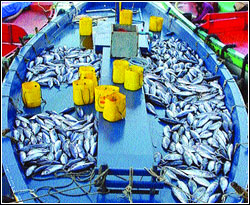 When you are deep in the dumps, it is better to dream big and shout loud to convince yourself if not others you have a brighter future. That is precisely what the federal fisheries development commissioner, Dr Hayat Mohammed Khan is doing when he talks of raising the fish exports to $1 billion from under $200 million while losing $90 million of fish exports to the European Union (EU) of 27 states.
Pakistan’s fish export to the EU were stopped in March last after a consignment of contaminated prawn turned up at the Rotterdam port.Alarm bells rang all around the European markets and Pakistan was forced to ban fish exports to the EU until the contentious issues were resolved.
All the 11 fish processing plants at the Karachi fish harbour have been de-listed by the EU. And the de-listing has not been stopped despite efforts made by the exporters. And Rs50 million have been spent on improving the export facilities and making export process more hygienic.
Dr Hayat has a three-point strategy to raise fish exports to $1 billion, with the EU as its centre piece. But the strategy he has devised to boost the exports is not much of a strategy. First, he says the heavy post harvest fish losses which run to 30-40 per cent, will be reduced . To achieve that, the techniques adopted by the major fish exporting nations will be followed. Second, efforts will be made to add value to the exports. When the fish exports are in the raw form, how much of value addition can it make. Third, aqua-culture and shrimp farming will be developed,
The government is also using the assistance of UNIDO to acquire the right expertise and improve its yield.
What has happened in March had happened several times before. The Karachi fish harbour was declared the dirtiest in the world some years ago and it took a lot of effort for the port authorities to get out of the damning label. In 2005, the fish exports were stopped about five times so the government and the fishing industry and the fishermen as a whole should have taken adequate measures to assure the EU of absolute hygienic conditions. That has not been done. Instead, the businessmen blamed the government for not putting enough pressure on the EU not to de-list the processing plants.
Now Sardar Hanif Khan , chairman of Pakistan Seafood Industries says that its members had done all they could to improve the facilities and spent Rs50 million on making such improvements and the chairman of the Pakistan Fisher Folk Forum Mohammed Ali Shah blames both-- the federal government and the provincial government for the total mess they have created.
The cosmetic changes brought about by the fish processing industry have not satisfied the EU and the UNIDO experts. Nor has it satisfied the Pakistan Marine Department which feels the need for a good deal more to be done to satisfy the EU which is not ready to take any chance with its health protection measures.
The Fisher Folk Forum called for a general strike on Thursday and it was a total success as it affects the livelihood of about 50,000 fishermen for whom August and September are the best months for fishing.
The dispute with the EU should have been conclusively settled a long time ago, as it was not, other countries too are demurring from importing fish from Pakistan.
Of course, it is difficult to convince the fishermen of the relevance of the high hygienic standards of the EU in respect of food, particularly fish. The fish processing industrialists also make improvements but lapses invite the ire of the European importers.
While the fishermen complain about having to sell fish at low prices because of the EU ban, the people in Karachi who want to consume fish find it even more expensive except for prawn.
Dieticians advise the people to eat fish at least once a week but the people find it expensive. Some fish shops which have opened in the city are also selling fish at high prices. If aqua culture is made more popular and shrimp farming made more extensive, fish prices can come down. If the large lakes like Keenjar and Manchar can be better used for fish production, supplies can go up and fish can be made available cheap.
In fact, the fishermen of Sindh have appealed to the Chief Minister, Dr Arbab Ghulam Rahim to let them fish in the lakes of Sindh after paying a nominal license fee.
Developing fisheries industry to meet the demands of the importers like EU and Japan is difficult but the government has to make the best efforts to educate the fishermen and the fish processing industrialists who have to be more cooperative. And the marine fisheries department and the fisheries department in the province should be re-organised and made effective tools of government policy and more experts from UNIDO should be obtained to train the fishermen and educate the fish processing industrialists.
Finally, what Dr Hayat has come up with is no effective strategy , much less one that will lead to a billion dollar of fish exports.
A five or six fold increase in fish exports is an uphill task which demands the voluntary and willing cooperation of the fishermen, fish processing industrialists and the fisheries department officials who have to be realistic and practical men and not billion dollar day dreamers.





























