Uniting against extremism
THE Lal Masjid showdown may be the catalyst for the current upsurge in terrorism but the roots of the problem go far deeper. Though the effects of Friday’s suicide attack in Islamabad — the second in ten days — are being felt in the here and now, its causes have been years in the making. The genesis of today’s bitter harvest can be traced to what was sown in Afghanistan with the help of the Americans and the Saudis, as well as the patronage bestowed on Islamists within the country by Ziaul Haq in pursuit of his pro-American policy. But Pakistan’s ‘strategic depth’ misadventures did not die with Zia, and support for jihadi organisations and the Taliban regime continued. More recently, it was the US-led occupation of Afghanistan and, later, Iraq that galvanised the forces of extremism in a way never witnessed before in the Muslim world. The Bush administration’s ‘with us or against us ultimatum’ and Pakistan’s resulting status as a front-line US ally then brought the war on terrorism well and truly to home soil. While support for the Taliban insurgents in Afghanistan remained part of the agenda pursued by homegrown militants, the focus of the ‘jihad’ turned inward from that point on. Stamping their obscurantist version of Islam on the country became the rallying cry of the clerics and their militias.
Thanks to radical madressahs and their wealthy benefactors — not to mention the lack of economic opportunity in the tribal belt and countrywide disillusionment with the status quo — there was no shortage of either recruits or funding for the jihadi cause. Matters were made worse by the state’s abortive pursuit of militants in Waziristan and subsequent capitulation in the form of the September 2006 ‘deal’, which created a virtual state within a state and allowed the Pakistani Taliban to establish their writ through harassment, intimidation and brute force. The militants rapidly spread their sphere of influence to the ‘settled’ areas of the NWFP, and there are reports that even the Lal Masjid brigade in faraway Islamabad had direct links with tribal militants, including foreigners. It is now abundantly clear that the ‘problem’ cannot be confined to Fata, a flawed approach that was far from desirable to begin with and which betrayed a callous disregard for tribal agency residents who do not subscribe to the views of the Taliban.
The need of the hour is for progressive forces and genuine patriots to put aside their differences and come together to fight an enemy that threatens not individuals or a particular government but the entire country. Tailored democracy and its lack of legitimacy have created a political vacuum that is being exploited by extremists and this void must be filled forthwith by a government of national unity. In this connection, the ongoing talks between political rivals are a healthy sign. However, much will depend on the motivation behind these parleys. Opportunism, self-empowerment and aggrandisement have so far been the hallmarks of the political process in Pakistan and old habits do not change overnight. Be that as it may, the need to put country before self has never been greater. This is the time to forge and further a national agenda, a goal that will remain unachievable if personal ambitions and rivalries continue to dominate the discourse. For once, self-preservation should not be the priority.
Saying ‘no’ to obscurantism
THE hailing alone of the Supreme Court verdict in the Chief Justice case as a win for the rule of law and democracy, as all opposition parties have done, is not enough. For the democratic process to take root, active and persistent effort is needed on the part of the political parties, which has been found lacking. Most parties do not practise democracy within their own ranks. Leadership in most cases is based on kinship or follows the pattern of cult politics rather than democratic norms. The disarray most parties are in today, in an election year, reflects their neglect of the homework that they had five long years to complete (since the last election) but did not. An independent judiciary is indispensable to a democratic set-up, but an independent judiciary cannot exist in its own oyster. It is the job of the politicians to ensure that democratic governance is practised all around, and attempts are not made to pressure judges into acquiescence — as done in the past.
The political parties have little time left to put their own house in order before the next election. What, then, is the next possible way of giving the polity a sense of cohesion? The challenges are many in a society divided along ideological lines, as recent acts of terrorism show. Radical Islamists justify whatever means they adopt, including coercion and terrorism, in pursuit of their goals; others say religion-based politics is anathema to both democracy and national cohesion.
On the opposite spectrum are the mainstream national non-religious parties with sizable vote banks in their respective strongholds. They stand for liberalism and democracy, but do little else besides. It is time they got their acts together and played a more positive role in constraining the obscurantist elements which are threatening to alter the basis of the state. The secular parties can do so by making their political agenda relevant to the aspirations of the people, by addressing poverty, inflation, unemployment, lack of social services, etc., thus giving hope and forging a common front against the forces of regression. The democratic process has never been in greater danger. It must not be dislodged by obscurantist forces.
Preservation of history
IT is a pity that cultural matters, especially those connected with a rich and extensive heritage, have held little interest for Pakistani society. The state of neglect that surrounds our historical monuments and sites is so appalling that it begs the question: if we are unable to preserve the past, should we, or more appropriately foreign archaeological teams, be digging for new finds? At a seminar on cultural inhabitation in Balochistan, experts pointed out that more exploration of historical ruins could lead to the discovery of possibly thousands of ancient sites. This is not a far-fetched idea, considering that despite the presence of vast swathes of unexplored, often impassable, terrain in Balochistan, sites of great historical value — including Mehrgarh that dates as far back as 7,000 BC — have been discovered there. But a combination of factors, including disinterest, political tensions and tribal feuds, has made it difficult to access hidden historical treasures.
Perhaps it is just as well that the mysteries of our past remain deeply interred. Out in the open, they may not be taken care of and left to crumble. However, this need not be the case if the past, as a moulder of the present, were to be given its due importance. Ideally, the archaeological authorities and related government departments should take the lead in instilling a sense of ownership of the past among the people. The government can be helped by the private sector, including interested individuals and public-spirited companies that can give of their knowledge, funds and expertise to ensure that historical sites and monuments are protected from the ravages of man and nature. It is only when people themselves show concern for their history that it would be possible to encourage further excavations. At present, ancient civilisations and other historical relics are best preserved in the earth that holds them.
Time to bury the hatchet and seek cooperation
IN the last decade or so the most discussed topic in the global economy has been the rise of India and China as emerging superpowers that will compete for prominence in the 21st century. With regard to China, it had appeared for some time that as the sleeping dragon awoke, it would cause tremors in the world’s economic powerhouses.
India, however, is a more recent phenomenon, and as Pakistanis, we do sometimes suspect that the Indian upward spiral is more a manoeuvre of clever marketing than actual reality. That is why on a recent visit to India I was keen to discover the truth.Let us analyse the major variables which comprise the economy and then try to evaluate the perception from reality.
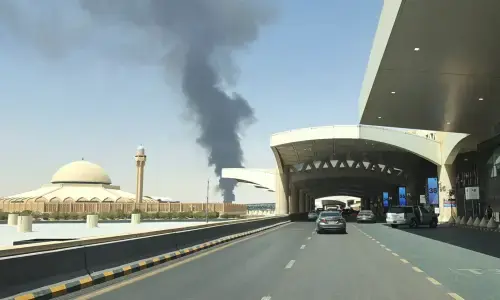
It is interesting that the first impressions of India and Pakistan are not quite the true impressions. The airport of New Delhi and Lahore are contrasts. While Lahore airport represents a clean, new and organised look where people and planes are all easy paced and relaxed at the time of take-off and landing, New Delhi airport is a place of frenzy, disturbance and disorientation.
The flying time from Lahore to Delhi is 50 minutes but you have to hover over Delhi for as long, to find landing space due to air traffic congestion. Once landed you see a rather dismal looking airport, more similar to the ones found at smaller stations of Pakistan, than befitting one of the largest capital cities of the world.
The infrastructure in India is generally facing the same fate i.e. roads, airports and other facilities are old, worn-out and totally inadequate for a population growing in size and scale. That is why the average Indian is taken by surprise when he lands in Lahore. The roads and the availability of all types of facilities is the first change of paradigm that they have about a country they had considered as one of the most backward in the region.This of course highlights the issue of how well marketed India is and how badly marketed Pakistan is. The marketing starts the minute you enter Indian territory. While flying, you are presented the disembarkation card the back of which reads “incredible India” with information on tourist sites.
This message you see on airport walls, public places, documents, on the media and literally everywhere.
The strategy to play on one’s strengths and project them in outstanding way to gloss over weaknesses is perhaps best at display in the case of India, while in Pakistan’s it is the opposite. Our weaknesses our so well projected that they overshadow the multiple strengths we possess.
The first sense of why the world is taking India so seriously comes from interaction with the business community. The corporate world is moving at an amazing pace. There is a flood of foreign investment in every sector of the economy. From fast food chains to IT to the financial sector to the nuclear industry, every big and small business is in the race for growth.
The sense of opportunism within the Indian business community and the foreign investor is at an all-time high. Some companies in India have actually turned the tables on the West.
The trend of western multinationals coming in South Asia and acquiring local businesses has been reversed by some of the Indian companies. Tata steel has just acquired Corus steel of Britain, Mittal Steel has acquired Arcelor Steel of France and many other companies are looking overseas for takeovers.The best example of the new India is Gurgaon, which is about 22km away from Delhi and on first sight reminds one of a more dusty and polluted form of Dubai. The high rising corporate offices of all big names in the world are visible and the endless chain of shopping malls is a signal of the tremendous boom the economy is experiencing.
The Pakistani corporate sector has always been more open but has a huge dearth of talented human resource to sustain the business growth that has been witnessed over the last few years. Moreover, growth is not a widespread phenomenon and is mostly spurred by the boom in banking and telecom industries. Thus the lack of professional and skilled human resource and a diversified industrial growth are factors which hinder sustainable market growth in Pakistan.
The Asian economies represent the best growth opportunity for all who want to make big money. India and China have experienced nine to 10 per cent growth in the last few years; Pakistan has been averaging six to seven per cent. Thus the time to cash upon this global focus is ripe. Indian and China have not only marketed their economic growth successfully but have also taken advantage of their huge population to market their potential.
A new study by McKinsey Global Institute (MGI), one of the top consulting houses in the world, predicts that India will surpass Germany as the world’s fifth largest consumer market.
This study says that the economic growth will have an impact on all socio-economic classes. As the huge middle class moves up the ladder, there are bound to be changes at other levels of society. The poor, those who earn less than Rs90,000 a year and include subsistence farmers and unskilled labourers, move up into a class called the aspirers.
This group comprises mainly of small shopkeepers, farmers with their own modest landholdings and semiskilled industrial workers, and the income level ranges between Rs90,000-Rs200,000. The group is expected to shrink from 41 per cent of the population to 36 per cent.
The new middle class will be made up of two groups, which have been classified as seekers (earning between Rs200,000-Rs500,000) and strivers (Rs500,000-Rs1million). Right now, the middle class is about 50 million people but by 2025, the numbers would expand dramatically to 583 million people.
Poverty in India is still a huge issue and though the numbers are mind-boggling the government has realised the voting power of this segment which rejected BJP’s growth claims and has also warned the present government of the same consequences if their lives do not improve.
In Pakistan, we have seen dramatic growth in the telecom sector as well but Pakistan’s growth unfortunately has not resulted in expanding the middle class, leave aside reaching the poor; thus the only market of attraction for foreign investors is the elite class which is evident by the success of attracting luxury car brands and fast food chains in the country but nothing significant for the middle and lower segments.
The cultural similarities of the two countries are now a matter of debate. With a westernised society emerging sharply in India, the vices and virtues of the West’s mode of living are prominent. While the ‘work hard, play smart’ ethics is prevalent, the deterioration in family values and individualism are also visible.
Most young people leave home early and follow the path of their western peers in independent living and working. However, their apparent western ease is not at the cost of their Indianness. They still feel tremendous pride in being Indian, support Indian brands and are very clear about their future being linked to their country and society.
In Pakistan, the younger generation may still be more family-oriented comparatively; however, they are facing an identity crisis where their fascination of anything non-Pakistani is evident by how they disown their own brands and do not take pride in being a Pakistani.
In India, there is a sense of hope among the youngsters where they actually feel that it is just a matter of time before India will emerge as the new superpower. Politics and politicians play a minor part in their discussions and most middle-class families are focused on providing the best form of education to their children to enable them to position themselves for a higher status in society.
This was substantiated by the fact that the public education system in India is very competitive. The public schools have a tough indigenously developed examination system which provides good quality basic education. There is no ‘O’ and ‘A’ level imported degrees and all classes in society are ensured a reasonable level of education.
Thus the average Indian would be communicating in English and would have the requisite knowledge of functional expertise. It is perhaps this difference in educational standards which has made Pakistan lag in its progress.
Quality education is still a privilege only the rich can enjoy, leaving the masses struggling for learning and making a decent living for survival.
Despite all the progress in India and all the problems in Pakistan, there is a good future for both countries especially if the attitude of the business community and the political leaders’ changes from win-lose to win-win.
India is going to experience the rising cost of labour and human resources given the exploding demand for them. Indian businesses are good at marketing but may still be far behind quality products in many categories. The quality of textiles, leather and many of their consumer good items is far behind Pakistan’s.
Unfortunately, Pakistani companies lack the marketing skills of the Indians, and perhaps even more so, the self-belief that they can compete and be better than Indians. It is time for each country to view the other not as a threat but from the perspective of opportunities and look for areas of cooperation.
With Indian savvy marketing skills and the raw talent of the Pakistanis the two countries could very well present a formidable marketing and production base for global companies. However, to reach that state, both have to start using their strengths and not attacking each other’s weaknesses to create positive synergy which could make them the most promising and prosperous region in the world in the 21st century.
| © DAWN Group of Newspapers, 2007 |