0
0

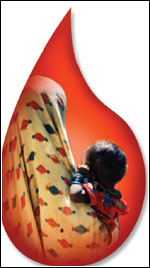 KARACHI: On World Blood Day, this year’s theme being ‘Safe Blood for Safe Motherhood”, the World Health Organisation (WHO) is to launch an initiative to improve the availability of safe blood for women who suffer child-birth complications.
A noble task, yet convincing people to actually roll their sleeves up remains a challenge for people such as Dr Syed Abdul Mujeeb, Associate Professor, Blood Bank, Jinnah Postgraduate Medical Centre (JPMC). He blames not attitudes but a lack of awareness about the great need for blood donors. The question is, how to convert a potential donor’s good intentions into action. And, what do you do when women in need of blood are accompanied by queasy relatives? This becomes particularly important because the lack of donors forces blood banks to ask for blood to replace that being released.
Last week, for example, Shazia (not her real name) came to the JPMC. She was in the eighth month of her third pregnancy and suffering severe bleeding. Had it not been for her husband’s friends, who donated blood to replenish the hospital bank’s stocks, she may well have lost her life. Asked why her husband did not donate his own blood, Shazia hesitated and then said, “He can’t, since he’s very weak.”
Such an attitude has been observed frequently by Dr Shireen Bhutta, professor of obstetrics and gynaecology at the JPMC. “Many women refuse to let their husbands donate blood, citing his ‘weakness’”, she says. Even when such decisions can be the difference between life and death, “there are times when men fear the prick of the needle or refuse to countenance the sight of blood.”
Her view is endorsed by Mohammad Jawaid, a senior technician at the hospital’s blood bank. However, he points out that while the JPMC blood bank tries to maintain a balance through the blood replacement system, “in emergencies the patient’s need always takes precedence over the need to replenish the blood bank.”
The JPMC is a tertiary hospital and emergency obstetrics service is available round the clock. According to Dr Bhutta, this means that the hospital often gets the complicated cases and of the 35 deliveries daily, her department deals with 2 or 3 cases of postpartum haemorrhage (PPH) – the loss of over 500ml of blood after delivery.
PPH is often related to multiple pregnancies or unsafe deliveries, while another major cause is chronic anaemia because of poor dietary practices. “The loss of 500-800ml need not be too dangerous for a healthy, well-nourished mother,” explains Dr Mujeeb, “but it can lead to disastrous consequences for anaemic women.”
Of Pakistan’s 145 million strong population, 33 million women are of childbearing age and it is estimated that a woman dies from childbirth complications every 20 minutes. One-fourth of the preventable deaths among these are due to haemorrhaging, which Dr Mujeeb terms “cold-blooded murder.” The maternal mortality rate is officially estimated to be 533 per 100,000 live births.
“This year’s theme highlights how voluntary blood donation can play a pivotal role in saving the lives of thousands of mothers and their babies,” says Dr Mujeeb. This would help Pakistan meet the Millennium Development Goals by 2015, he adds, pointing out that this seminal aspect of development has be completely missed by those working to meet the millennium challenge. After all, blood transfusion is one of the eight key life-saving interventions in healthcare facilities that provide emergency obstetric care.
Countrywide, registered blood banks collect approximately 300,000 voluntary donations a year. The requirement is put at 3-4.5 million. “Only two people of every 1,000 donate blood voluntarily,” estimates Dr Mujeeb, calculating that if a mere two percent of the population gave a single unit of blood on their birthday, no citizen would die for want of a timely blood transfusion.
So why don’t people donate blood?
Dr Mujeeb believes that many people are not aware of the dire need. “It’s not that charitable feelings have been snuffed out within us,” he says, “we saw donors thronging blood banks after the 2005 earthquake and people come willingly during emergencies. But why do people wait for emergencies?” According to Dr Mujeeb, the failure lies in converting potential blood donors between the ages of 17 and 60 into regular voluntary donors.
Referring to the blood replacement system, Dr Mujeeb points out that on many occasions, patients’ family members are unable to provide safe blood. “Often, poverty and malnutrition renders men unfit to donate blood, while sometimes the potential donors are fewer than the blood bank’s requirement,” he commented, emphasising the need to develop a voluntary donation system.
It all boils down to institutionalising the blood banking system. “A centralised system is needed and this is possible given developments in information technology,” believes Dr Mujeeb. “We could develop satellite centres where blood is collected and then preserved at a central place from where it can be distributed according to need. Given that the shelf-life of blood is 35 days, this would be cost-effective since less blood would be wasted. Usually, we give whole blood since the various components have not been separated, but if it were, one unit of blood could fulfil the needs of multiple patients.”
Dr Mujeeb also believes that donors should be made to feel special for their act, which is after all a noble one. As an incentive, he suggests free diagnostic facilities for regular voluntary donors.