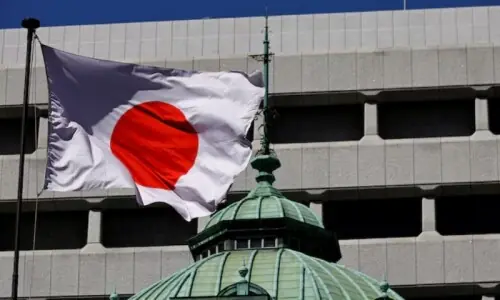
TOKYO, May 8: Japan’s defence industry risks being left further behind in high-tech arms development as an export ban excludes it from big international projects such as Lockheed Martin Corporation’s $299 billion F-35 Joint Strike Fighter.
Even as Japan readies the world’s most sophisticated ballistic missile defence – triggered by North Korea’s firing of a missile in 1998 that flew over Japan – growth prospects for local defence contractors remain grounded by the 40-year-old export ban.
Japan is the only country that forbids the export of arms, a rule rooted in a pacifist constitution imposed by the United States after World War Two.
Takao Taguchi, general manager of government systems sales at Nippon Avionics Co. Ltd., said Japan needs to relax the rules and let companies join international projects so the industry can grow amid a shrinking domestic market.
“We see more and more joint projects in this area, and if we can sell products here and abroad, that would be a good opportunity for us,” he said.
Japan plans to trim overall defence spending in an effort to cut costs, but it will spend $6.7 billion on missile defence between 2004 and 2011. This year’s 4.8 trillion yen defence budget includes 182.6 billion yen for missile defence, up by a third on last year.
This has helped push up shares in Mitsubishi Heavy Industries Ltd., the government’s biggest supplier, by more than 35 per cent so far this year, outperforming a 10.5 per cent gain on Tokyo’s machinery subindex IMCHN.
But experts doubt if Japan-made fighters and other weapons could compete in the global market even if the arms bans were lifted.
“Japanese arms products don’t have any competitive edge as the industry has been protected by the government,” said Credit Suisse analyst Teruhiko Nishimura. “Even if the government suspended the rules on arms exports, I doubt anyone would be interested in buying them. They are too expensive.”
Still, Nishimura said defence contractors such as Mitsubishi Electric Corp. and Kawasaki Heavy Industries Ltd. could benefit from Japan's recent defence build-up.
He noted Mitsubishi Electric’s sophisticated know-how on electronic parts and Kawasaki Heavy’s P-X patrol plane and C-X container plane would likely be competitive in the global market.—Reuters