0
0

 KARACHI, May 3: Sufism is said to be the esoteric path to God. However, on the opening night of the International Mystic Music Sufi Festival 2007, a few obstructions made walking on this path just a tad difficult.
Organised for the first time in Karachi by the Rafi Peer Theatre Workshop (RPTW), as expected the festival got off to a late start, running an hour and a half behind schedule. The Baradari, the venue of the event, was swarming with security personnel as the governor of Sindh was invited as chief guest. So paranoid were the organisers about security concerns that they turned away quite a few journalists, while giving a hard time to others, despite the fact that they had press invitations from the RPTW.
An organiser, requesting anonymity, revealed that the stepped up security was in view of a ‘threat’ received. This claim was highly suspect, as the governor, along with several provincial ministers, did in fact make it to the venue, albeit fashionably late.
These hairy incidents aside, when the show actually started, organisational goof-ups were largely forgotten.
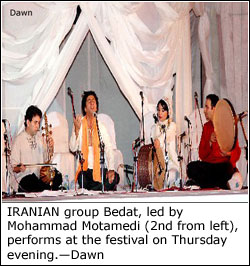
Shah Jo Fakir started off the evening with their sublime rendition of Shah Abdul Latif Bhittai’s kalam. Their primal, fine harmonising gave way to the bombastic rhythm attack of Goonga and Mithu Saeen, who perform every Thursday night at Shah Jamal’s shrine in Lahore. They were accompanied by three male dancers who worked themselves up into an ecstatic frenzy, in tune with the rhythm of the dhols. The first foreign group of the night, Bedat, led by Iranian Mohammad Motamedi, delivered majestic Farsi verses accompanied by select strains from Persian classical music. Front and centre was a bowed instrument that sounded like the Arabic oud, or the local rubab, while the group was anchored by the soft percussive thud of the zarb.
From this writer’s limited understanding of Farsi, the first song seemed to be about breaking chains, while the second echoed the saz-i-dil (tune of the heart).
Following the mournful, majestic Iranians, the Sindh Governor, Dr Ishratul Ibad, was asked to say a few words by Usman Peerzada, who was followed by a spokesperson for the telecom company that had sponsored the event.
While the governor’s request for the festival to be held yearly in Karachi was welcome, the whole exercise, however, managed to break the rhythm of the performances.
Sheema Kirmani, accompanied by other dancers, took the stage following the speeches. They troupe danced to a pre-recorded version of Ameer Khurau’s immortal kalam, Aaj Rung Hai. It was a pleasant enough performance, even though Sheema was not on the schedule. Needless to say, the order of performers, as per the schedule, was thrown to the wind for reasons best known to the organisers.