0
0

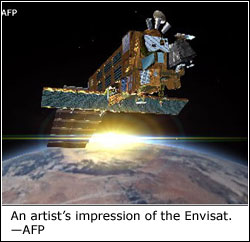 MONTREUX (Switzerland): Eight hundred kilometres above the earth’s surface, a huge European satellite that tracks greenhouse gas emissions, melting ice packs and rising sea levels is getting a new lease of life.
The European Space Agency’s environmental satellite, Envisat, was launched in 2002 with an expected lifespan of five years, but its mission is turning out to be ever more pertinent amid heightened concern about climate change.
The eight tonne, 10-metre long module – the largest satellite to be sent into space so far – and its 10 data-collecting instruments, have also proved so reliable that it will now carry on for another five to seven years, said mission director Henri Laur.
More than 900 scientists gathered in the Swiss lakeside town of Montreux last week for an ESA conference on satellite observation of the world’s land, oceans, ice and atmosphere, which also marked Envisat’s fifth anniversary.
The 250 gigabytes of data the satellite beams to earth every day has allowed them to literally map out changes in levels of pollutants from industry or transport or even to spot oil tankers that illicitly clean out their tanks on the high seas.
“You can see the impact of economic change on the environment,” Laur said.
“Emissions have remained stable in Europe and the United States but have increased sharply in China,” he explained.
A spectometer on the satellite can measure levels of carbon dioxide and methane – two of the main greenhouse gases blamed for climate change – in the earth’s atmosphere.
“Our understanding of the phenomenon has benefitted enormously from satellite observations,” said Laur. “There are many things that we would not have seen otherwise.” Envisat, which fits into a network of earth observation satellites, helped determine the speed of the meltdown of glaciers in Greenland, which has doubled in the space of 10 years.It also revealed a three millimetre increase in sea levels, and the extent of the warming of the oceans, according to ESA.
Another instrument, a radar altimeter, can measure the rate of thinning of the melting polar icecap, even at night or beneath cloud cover.
The 230 technicians at ESA’s data processing centre at Frascati, Italy have also been used to spot deliberate environmental damage by oil tankers venting their tanks.
As oil is heavier than water, the telltale hyrdocarbon trail can be spotted because its smoothes the surface waves of the sea.
“Envisat is well known to tanker captains,” Laur said, adding: “We think that they know our orbit, when we pass overhead.” Laur said observations by Envisat helped reduce illegal fishing off France’s Kerguelen Islands in the Indian Ocean by 90 per cent.
Envisat is likely to be replaced after 2012 by an armada of smaller satellites called “Sentinel,” each with a specialised task in observing the chemistry of the earth’s atmosphere.
However, ESA is still seeking funding from its 17 member states for the broader project, which would allow continued European monitoring of greenhouse gases.
Laur said the meeting in Montreux, which ended on Friday, underlined the importance of such monitoring.—AFP