0
0

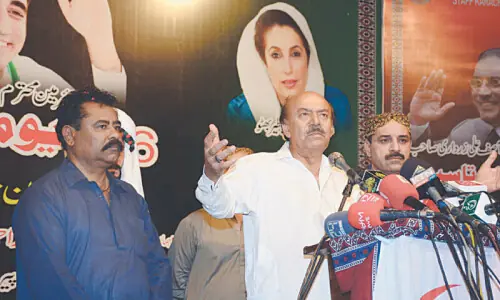
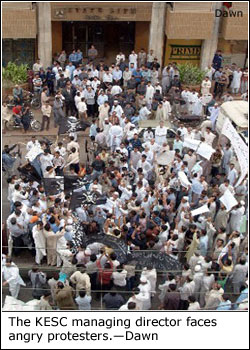 KARACHI, April 27: Enraged traders and representatives of the industry took to the streets on Friday and protested outside the Karachi Electric Supply Corporation’s headquarters against massive load-shedding and power breakdowns. Protesters threatened to withhold the payment of bills and taxes if the problem was not immediately and permanently resolved.
The peaceful protest was organized by the Action Committee of the Alliance of Market Association and Chamber of Small Traders, which had the backing of the Karachi Chamber of Commerce and Industry, whose leaders also addressed the rally.
Lt-Gen (Retd) Mohammad Amjad, Chief Executive Officer of the KESC, tried to mollify the protesting crowd and referred to the fire-fighting measures the utility was embarking upon. He also claimed that there was no load-shedding in the industrial areas. But the protestors would have none of it, claiming that they had been hearing the same thing for several years, while the problem had gone from bad to worse. The protest rally was addressed by Atiq Mir and other leaders of the Alliance, besides KCCI President Majyd Aziz, Siraj Qasim Teli and Zubair Motiwala. The protesters, who were carrying banners against load-shedding, also chanted slogans against the Federal Minister for Water and Power, Liaquat Jatoi, for his reported remarks in which he had blamed power theft for the problem.
The protest leaders warned the KESC management that this rally should be treated as the last warning, adding that if the utility did not end load-shedding within three days, the protesters would refrain from paying the forthcoming bill. If the problem persisted, they would not pay taxes, they said.
They complained that the city’s normal life, along with its business and industrial activity, was being ruined by what they termed as deliberate neglect and corruption of the KESC staff, particularly those belonging to its technical department. They urged the president and prime minister to intervene and seriously address the problem.
They demanded that those responsible for ruining the KESC and Karachi’s trade, industry and normal civic life must be taken to task for causing such a colossal national loss.
Business leaders claimed that because of the KESC technical staff’s neglect, 90 per cent of the utility’s units were not operating at their optimum capacity. KCCI chief Majyd Aziz said that businesses and industries were striving to transform Pakistan into an Asian tiger, as envisaged by the prime minister. But he regretted that persistent power outages and breakdowns were seriously undermining that objective, which was dependent upon uninterrupted power supply.
KESC chief Gen Amjad tried to blame the present situation on the difference in demand and supply position and the available generation capacity. He informed the protestors that last year, the peak demand was 2,223 megawatts, which was recently crossed, and the demand was registered at 2,286 megawatts. This year the demand was expected to swell beyond 2,400 megawatts, he said.
Gen Amjad assured the crowd that by the end of May, 190 megawatts would be added to the KESC’s system. He also claimed that 61 km of high tension lines have been installed, while contracts for 117 km of high tension lines have been awarded.
He declared that 12 new grid stations were being built, three of which would be operational by June, while the remaining nine would come up later this year. He also announced that a new 560 megawatt power plant was being built at Bin Qasim, which would enhance generation capacity.
But participants of the rally were not prepared to take his statements at face value, claiming that there had been no improvement in the KESC’s performance. The participants were surprised at his claims about the grid stations, because the more knowledgeable among them said that the KESC had not yet acquired land for many of these, while construction work had not yet started.
After the protest meeting, representatives of the KCCI and others were invited by the KESC CEO to talk it out and find a mutually acceptable operational formula to tide over the present critical situation, until the problem was resolved on a permanent basis.