0
0

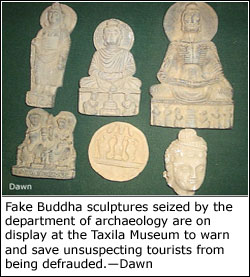 TAXILA, April 26: The mafia selling fake sculptures continues to fleece foreign and local visitors around various ancient sites in Taxila under the very nose of the authorities concerned.
These ‘antiquities’ are made of cement mortar or black stone and very artistically carved like genuine sculptures of the Gandhara art and offered to the tourists at “reasonable” prices around the various ancient sites, especially near Julian and Sir Kap.
It may be noted that director general federal department of archeology and museums Dr Fazal Dad Kakar a few days back paid a surprise visit to Julian monastery and stupa to nab a member of the mafia when he was trying to sell three fake sculptures to a tourist. However, the culprit managed to flee leaving behind the antiquities.
These fake antiquities also included copies of fasting Buddha, Bohistava (future Buddha) and Buddha head. The sculptures were brought to the Taxila museum laboratory for examination and after clinical study, it was revealed that they were fake.
Sources on condition of anonymity said two big names had come to the forefront in the illegal business during preliminary investigations. One of them was a former provincial assembly member and an influential personality of Taxila and the other a Islamabad-based antiquities’ admirer. The sources said the department of archeology officials deputed in Taxila museum knew about this sorry state of affairs but they did not take any action against the illegal treasure hunters.
When contacted, an official of the department said there was no check on illegal excavations due to shortage of staff, adding that it was not possible without the help of the district government. He said efforts were being made to revise, update and enhance the scope of the decades-old antiquity act of 1973 to tight the noose around the mafia.
In July 1997, through a special notification to protect and preserve this heritage, Unesco prohibited mining, excavating, quarrying and blasting in Taxila.
It may be mentioned that official involvement in this illegal business cannot be ruled out as now and then customs authorities in the country as well as aboard seize antiquities smuggled out from Pakistan.
The customs officials usually succeed in detecting those consignments of antiquities about which they get information. Most of the consignments reach their destination with the alleged connivance of the department’s officials. During the last decade, the customs department reportedly detected not more than eight consignments of valuable antiques, which included statues of Buddha, prehistoric human figurines, animal carving, pottery, terra cotta and World War II weapons. Surprisingly, not a single person or gang involved in the smuggling has been rounded up.
It may be recalled that mystery still shrouds the disappearance of the biggest ever theft of 81 precious and invaluable antiquities of Gandhara civilization, which the museum administration claims were “stolen” from the show-cases on December 16, 1999. These pre-BC era antiquities, which were discovered by Sir John Marshall during excavations carried out between 1813 to 1835, suddenly disappeared from the showcases of the museum.