0
0

CAIRO: Parliament head Fathi Sorour set off a furore when he said earlier this month that planned anti-terrorism legislation could be applied to reporters covering news on “terrorist” organisations. The reported comments rattled journalists and rights activists.
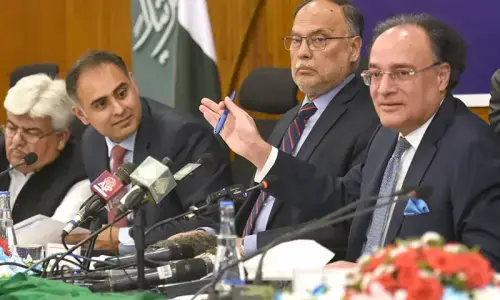
“Sorour’s statements are without precedent,” Gamal Fahmy, board member of the Egyptian Journalists Syndicate told in an interview. “If his suggestion were to be implemented, journalists could be considered criminal accomplices for simply doing their jobs.” After an Apr 4 press conference, Sorour — a veteran of the ruling National Democratic Party of President Hosni Mubarak — was quoted as saying that proposed anti-terror laws “will be applied to reporters or media organisations that publish news about banned groups.”
The term “banned groups” was widely seen as a veiled reference to the Muslim Brotherhood, which, despite its control of roughly a fifth of the national assembly, has been officially banned since the 1950s.
Offending journalists, Sorour was quoted as saying in the Apr 5 edition of independent daily Al-Masri Al-Youm, “will be considered abettors of terrorism.”
The Journalists Syndicate, an outspoken opponent of the country’s stringent press laws, was quick to respond to Sorour’s contentious remarks. “The syndicate completely rejects these suggestions, which represent a blatant attack on journalistic freedoms,” it declared in a statement on Apr 6. “Sorour’s comments equate terrorist acts with simply reporting on them in the press, an idea that runs contrary to rights and freedoms guaranteed in the constitution.” Sorour quickly denied having made the statement, insisting that his words had been misinterpreted. “Terrorism aims to intimidate the people,” he said in a statement the following day. “Terrorists benefit from the publication of news about their crimes in order to achieve their desired ends.”
Nevertheless, he added, there were “absolutely no plans to criminalise the publication of terrorism-related news.”
The story did not end, however, with Sorour’s disavowal.
On Apr 9, Arabic-language satellite channel Al-Mehwar aired footage of the original Apr 4 press conference on a weekly news programme. In the broadcast, Sorour could plainly be seen making the statement attributed to him in the first place. “The programme confirmed our initial reports on Sorour’s comments regarding the possible criminalisation of covering news on banned groups,” Al-Masri Al-Youm said in a statement published on Apr 12.
In an effort to mitigate the damage, Sorour’s media advisor Abdel Raouf Sallah issued a statement on Apr 15, again insisting that the parliamentary head’s statements had been misunderstood.
“Dr Sorour was speaking in scholastic parlance, unlike the misinterpretations employed by some people with certain agendas,” Sallah said. “When he denied these misinterpretations, he wasn’t retreating from his position, but rather confirming the true meaning of his statements.”
The clarification did not do much to clear Sorour.
“Whenever an official statement is met with strong public disapproval, it’s always denied after the fact,” said Fahmy. “Inevitably, however, we find that the original statement is usually implemented in the end.”
“Journalists scarcely have room to breathe under current press laws,” Fahmy added. “If Sorour’s latest proposal — to prosecute those who report on terrorism — is put into effect, even the limited freedoms we have now will be lost.”
Human rights groups have also expressed dismay over the implications of Sorour’s vague remarks. For the last quarter century, the regime has maintained a strict Emergency Law, which critics claim is used by the ruling party to cow political opposition. Constitutional amendments made last month are expected to pave the way for replacement of the current state of emergency with even tougher anti-terrorism legislation.
Spokesmen for the Muslim Brotherhood fear that Sorour’s latest statements represent more than just a slip of the tongue.
“Sorour’s comments were aimed at frightening journalists away from dealing with the Muslim Brotherhood or any other viable opposition groups,” Hamdi Hasan, spokesman for the Islamist group’s parliamentary bloc told reporters.—Dawn/The IPS News Service