0
0

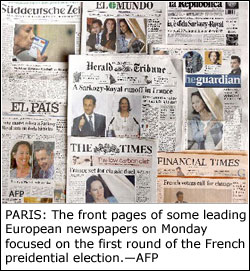 PARIS, April 23: Nicolas Sarkozy, France’s right-wing former interior minister, on Sunday night stormed to one of the most impressive first-round victories in French presidential history, making him favourite to beat the socialist Segolene Royal to the Elysee in a fortnight’s time.
The head of France’s ruling UMP party emerged as the most popular right-wing politician in 30 years after promising to shake France out of its decline with a mixture of free-market reforms, and to restore ‘authority’ with tough law and order measures, clamp down on immigration and instill a sense of ‘national pride’. According to early official counts he scored 30 per cent of the vote.Addressing a rally of around 2,000 supporters in Paris, Mr Sarkozy said: “I wish only to rally people around a new French dream of a fraternal republic.” He said his vision of France valued work, instilled authority and was a France where people did not fear others. He said he would rally the workers, farmers and all those who had suffered and were “exasperated”.
Ms Royal, the first woman with a chance of becoming president, comfortably qualified for the second round run-off on May 6, with an estimated 25.2 per cent of the vote; she has styled herself the defender of social justice who “listens to the people”, challenging Mr Sarkozy indirectly for his “brutal” style, divisiveness and “dangerous” authoritarianism.
France now faces the traditional right-left run-off that it was denied in the last election in 2002, when the far-right leader, Jean-Marie Le Pen, shocked the country by making it through to the final round.
The record 85 per cent turnout in the latest election reflected the huge amount of interest in the race for a new generation of president; 12 years of Jacques Chirac has left the nation struggling with economic stagnation, debt, unemployment and discrimination.
The centrist Francois Bayrou, the dark horse ‘third man’ who had posed a surprise challenge to the frontrunners, took 18.3 per cent of the vote, more than Mr Chirac’s first round vote in 2002.
Mr Le Pen came fourth with 11.5 per cent.—Dawn/The Guardian News Service