0
0

LAHORE, April 19: World Trade Organisation (WTO) Director-General Pascal Lamy is cautiously optimistic of a successful conclusion of the stalled Doha Development Round — which, many assume, will rebalance the global trading system in favour of developing economies — by the end of this year.
“It is doable. But it’s not going to be easy, free-flowing; there are going to be hard nuts to crack. Major political decisions need to be taken, particularly on agriculture,” Mr Lamy, who was in Lahore to attend the 31st Cairns meeting this week, told Dawn in an exclusive interview.
“Political conditions (for arriving at a consensus on contentious issues dividing the WTO members) for the moment are good; I don’t know about tomorrow,” he said. “We have got political determination and engagement; what we need is technical negotiations.”
Asked how the expiry of the US’s Trade Promotion Authority (TPA) this July is going to affect the Doha Round, he said legally speaking the US administration will lose its mandate to negotiate the deal after the expiry of the TPA. But, he said, it would depend more on the political momentum and a will in the US to close the deal.
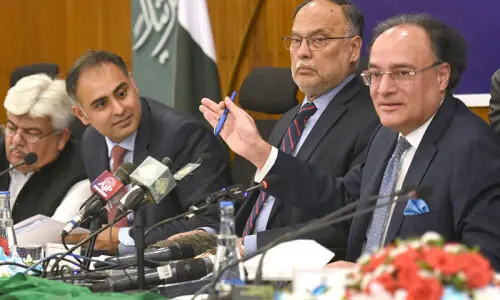
There is a renewed sense of urgency for successful conclusion of the Doha Round of world trade talks as was reflected at the Cairns meeting, which ended on Wednesday. The group resolved to conclude the negotiations by the end of this year by working with other WTO members on agriculture and other issues.
The Doha Round of world trade talks was stalled last year after developed economies — Japan, the US, and the EU — refused to cut heavy agriculture subsidies and bring down tariffs as demanded by agriculture exporting nations, both the developed and developing — unless others opened up their markets for their non-agriculture exports. Economies like India and Brazil want agreements on trade in services before they open up their markets for industrial imports from the developed countries.
The urgency to conclude the Doha Development Round stems from the fear that the US administration will lose its mandate to negotiate the deal after the expiry of the TPA. Besides, the Cairns Group thinks intervention caused by US presidential elections next year will put a long break in the world trade talks if the WTO members fail to finalise the Doha deal earlier.
Although the Cairns Group says it is not very optimistic about the finalisation of the Doha Round by the end of 2007, it wants that WTO members must at least reach agreement on critical issues obstructing successful realisation of a free and fair international trading system.
Mr Lamy agreed there has to be some movement on core issues like agriculture, non-agriculture market access and agreement on (trade in) services. But, he said, there are a number of other issues like anti-dumping rules, trade facilitation, etc where a trade-off has to happen.
“There’s no unimportant topic. All issues have to be together in the final package,” he said. “You can’t add or remove the topics from the bag in which they are bundled. Politically speaking, it is like Animal Farm, where some are more equal than others. Agriculture has taken precedence over other topics because of political considerations.”
Nevertheless, the WTO chief said, there has been a lot of progress in the talks in the last five years. “It is not that we are starting from scratch. Two-thirds of the way has already been covered, and agreements and pre-agreements are on the table.”
According to him, the preparation is at the crucial garnishing stage. “You’ll get it wrong if you add too much salt or pepper.”
But he adds that “still a number of trades-off have to happen and specific sensitivities of some member countries must be addressed”. “Developed countries have different positions on different topics. Same is true for developing nations. The US has to accept cuts on domestic agriculture subsidy and tariffs. The EU, Brazil and India have to be more flexible on tariff cuts in agriculture and industrial products.”
When pointed out that WTO had failed to deliver on its promise of a fair and free trading system, Mr Lamy said the ongoing round of talks was given the name of Doha Development Round because it seeks to change and improve the existing set of rules governing the world trade in favour of developing economies through negotiations and strengthen the dispute settlement system.
He did not agree with the suggestion that the WTO dispute settlement system favoured the richer and bigger economies. “There are many instances where developing countries took developed nations to the WTO dispute settlement system and got decisions in their favour. And the developed countries implemented the findings.
“They (developed economies) have an interest in implementing the findings (of WTO on disputes involving them) because dispute settlement system is the best guarantee that their partners do not cheat them.”
He agreed some countries do not have the legal capacity and funding to hire good lawyers to plead their cases, but added there is a specific organisation outside WTO that provides legal assistance to countries which do not have it or cannot afford it. “Things have changed in the last 10-15 years. Pakistan now has enough capacity on these issues. Same is true for other developing countries.”
Mr Lamy expressed a fear that if the Doha Round didn’t succeed, the danger is that primacy of multilateral trading system will be corroded. “We need to rebalance the 13-year-old rules of world trading system in favour of developing countries, which form two-thirds of WTO membership. Developing countries are pushing a lot for that. They are eager that they get a level playing field. Their development and poverty reduction (programmes) depend partly on their domestic policies and partly on the change in the rules governing the world trade.”
He said the failure of the Doha Round talks will be extremely bad news for the poor and the weaker. “The bigger and richer countries have other avenues to promote trade. (It is) the poor and weaker (countries) who are in need for a level playing field. This is why they had insisted on the resumption of the Doha process.”