0
0

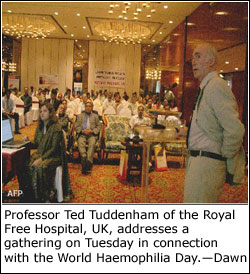 KARACHI, April 17: The Sindh government will establish three haemophilia and thalaessemia centres in Karachi, Hyderabad and Sukkur. It will also request the federal government to abolish import duty on anti-haemophilic factors, and if does not agree to the proposal, the Sindh health department would provide subsidy on their import.
This was announced by Sindh Health Minister Syed Sardar Ahmed at a function held to mark the World Haemophilia Day at a local hotel. The function was organised by Fatimid Foundation.
Addressing the gathering, Syed Sardar Ahmed said that the government is aware of the difficulties being faced by patients suffering from thalaessemia and haemophilia. The government, he announced, would establish three centres for the treatment of such patients at government-run teaching hospitals in Karachi, Hyderabad and Sukkur as soon as possible.
Chairman Fatimid Foundation Lt. General (r) Moinuddin Haider informed the audience that there are 7,000 thalaessemics and 3,000 haemophilics registered with the foundation. He called for proper counseling and pre-marriage screening of couples to prevent further increase in the number of such patients.
About the total number of haemophilics in the country, Dr Rehan Sajid of Fatimid Foundation said that though exact data is not available, it is said that there are 10,000 cases of haemophilia A and 2,000 case of hameophilia B in the country. Punjab is said to have 5,200 men affected by haemophilia A and about 1,000 to 1,300 cases of haemophilia B.
Dr Muniar Shoaib of Bismillah Taqee Institute of Health and Sciences (BTIHS) in his presentation said that haemophilia is an X-linked congenital disorder and the frequency is about one in 100,000 births.
“Haemophilia A is more common than haemophilia B, representing 80 to 85 per cent of the total. The total number of haemophilics in the world is 400,000. However, only 20 per cent of them have access to adequate diagnosis and treatment,” he added.
Another important point which he highlighted was the vulnerability of these patients to various infections. Most of them live in developing countries where there is no ready access to virus inactivation concentrates. In a study conducted in Pakistan, there was a high incidence of hepatitis C among the haemophilics, followed by hepatitis B, he said.
To improve the treatment standard of haemophilics, it was suggested that clotting factors VIII and IX be exempted from import duties and other taxes; government should ensure the availability to these anti-haemophilic factors at all government hospitals free of charge; blood transfusion be made safer at hospitals; blood donation amongst healthy adults be encouraged and well off citizens be motivated to sponsor treatment of such patients.
Professor Ted Tuddenham (Royal Free Hospital, UK), Dr Shahid Noor (Liaquat National Hospital), Dr Tahir Shamsi (BTIHS), Dr S.M. Irfan (BTIHS), Dr Shahid Sultan (LNH) and Dr Zia-ur-Rehman (Medical Director Fatimid Foundation) also spoke.