0
0

ISLAMABAD, April 11: The government on Wednesday accused Wapda of mismanagement that was causing over 1100-mw of unnecessary loadshedding while its units at eight stations remained closed for minor and preventable reasons.
“Generating units at Tarbela, Mangla, Chashma, Malakand, Multan, Guddu, Lahore and Jamshoro were down for various problems and Wapda has not taken timely and diligent steps to bring these units to system in time,” said Minister for Water and Power Liaquat Ali Jatoi in a written statement after holding a meeting on energy crisis.
The statement came after the federal cabinet took serious note of the prevailing power shortage and comments made by the Wapda chairman who tried to shift the onus of crisis to the Indus River System Authority (Irsa).
The federal cabinet had also taken serious note of Wapda’s unilateral decision to reduce electricity supplies to Karachi by 300-mw and decided that KESC’s power needs would be met without any disruption, Information Minister Mohammad Ali Durrani separately told a news conference.
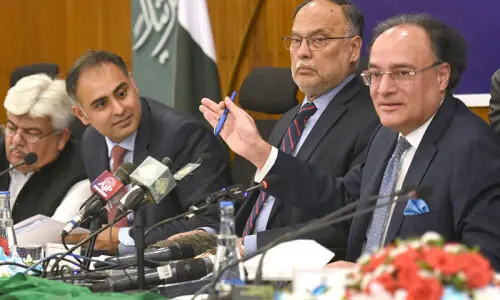
The power minister was directed by the cabinet to take up the issue with Wapda. Accordingly, the minister had convened an emergent meeting of the Wapda chairman and members besides the heads of generation companies on the subject.
The minister, sources said, told the cabinet that Wapda was not in ministry’s control and it did not even inform the government about its independent decision to reduce supplies to the KESC.
Soon after the cabinet meeting, the minister had a briefing from the chairman and members of Irsa.
The minister was informed that Irsa had been releasing water from both reservoirs for power generation much higher than the irrigation requirements and Kotri downstream witnessed continuous flows since March 18, reaching up to 40,000 cusec at present.
The meeting decided that Irsa should release another 10,000 cusec water for power generation that would reduce power shortage by more than 500-mw.
The minister was informed by the secretary and adviser to the Water and Power Ministry that some of the Wapda units were not functioning because of minor defects like clutches and switches and despite the fact that spare parts were also available with the generating companies.
In a written statement, the Ministry of Water and Power said that Irsa had been releasing 20,000 of cusecs of water until April 2 from Tarbela to avoid accentuating the problems of high flood situation in Kabul river and head restrictions at Chashma. After April 2, the discharges were increased to 30,000 cusecs.
The minister was informed by the Irsa authorities that Wapda’ member water, who was a permanent member of the Irsa Advisory Committee, and Wapda chairman, who is ex-officio member of Irsa, had not been attending the meetings, said the statement.
The meeting was also informed that in fact Wapda’s top brass was not aware of the ground situation as to why its units at Tarbela and Mangla were not fully functional.
The minister “directed that in future Wapda chairman or member (water) and member (power) must personally attend the meetings of Irsa Advisory Committee and discuss the water availability situation with the committee”.
He also took notice of the uncalled for and misleading statements by Wapda in the press. He showed his serious concerns on Wapda’s slackness and said that he would hold a meeting on Thursday to address the issues.
Earlier, the Irsa chairman briefed the meeting that on April 3 there was high flood in Kabul river therefore releases from Tarbela could not be increased to avoid synchronisation of flood peaks. Simultaneously, Chashma Barrage water level was at 648 feet and there was no capacity to store the additional water.
He said additional releases might cause dangerous water level for Chashma as well as for Taunsa Barrage where rehabilitation works were in progress.
He informed that Kabul river flows had at present normalised and water releases from Tarbela may increase to overcome Wapda crises.