0
0

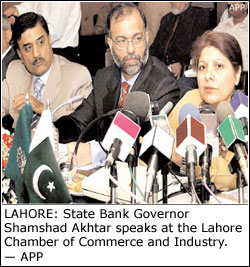 LAHORE, April 4: State Bank Governor Dr Shamshad Akhtar has said monetary tightening is necessary to ensure lowering of inflation without strangulating growth. Addressing businessmen, industrialists and office bearers of trade associations at the Lahore Chamber of Commerce and Industry here on Wednesday, she said monetary tightening was imperative as inflation could not be kept low artificially. It had proved quite effective during the current financial year.
She said prices of credit were a tool used to reduce demand and bring down inflation. The money was invested in unproductive sectors if interest rates were low. The SBP was holding detailed discussion on interest rates every six weeks but these could not be adjusted before inflation came down.
The SBP governor said that interest rate in Pakistan was competitive in the region. Low interest rates had helped achieve growth target and control inflationary pressure in the recent past. Inflation rate had remained low as long as the interest rates were low and had increased with increase in inflation. Average private credit during the past few years was 25 per cent which was not sustainable.
She said that aggressive private sector credit growth decline was temporary because the big corporate sector was taking a breather. Some of the companies had arranged one billion dollar loans from abroad and some were planning new projects.
The country, she said, would again have the credit growth of yester years in the near future. There was no decline in consumer financing, which constituted 50 per cent of credit, due to better returns.
Dr Akhtar said companies could raise capital themselves by issuing term finance certificates but would have to be listed for the purpose. The SBP had also advised the banks not to rely only on banking and issue TFCs.
She said the growth of SME sector was important for economic development but banks were not advancing credit to it because of lack of expertise. The Standard Chartered Bank and NIBS Bank of Singapore had promised to meet financial requirements of the SME sector and promote micro-financing.
The SBP governor said that export growth and diversification was the only way for macro-economic stability and financing the trade deficit of dollar 6.1 billion effectively.
A new export strategy, she said, was under discussion to get required results. Banks had been asked to increase remittances by 23 per cent for bridging it.
Foreign exchange reserves stood at dollar 13.5 billion at present and would increase to dollar 15 billion by the end of current fiscal year. Foreign directed investment was also expected to reach dollar 6 billion.
Emphasizing on promotion of public-private partnership, Dr Akhtar said that it could lessen the burden on government and enabled the entrepreneurs to invest independently.
Foreign remittances witnessed a growth of 23 per cent this year. She said the current fiscal year 2005-06 would end with a modest overall balance of payments. She said the country’s macro-economic stability was judged by supportive monetary policy. Good economic performance had been made possible because the financial sector had met the needs and had grown.
She said the assistance provided to the sick industry in the past was only a one-tome arrangement which could not be repeated. Restructuring of loans was in accordance with bank rules and the SBP did not interfere in it. She said loans could be restructured but not written off.
Chamber president Shahid Hassan Sheikh said that government’s policy of public-private partnership had started yielding results as the GDP growth, for the first time in the national history, had touched the figure of 7 per cent.
He said the CBR had collected 81 per cent more revenue in the last five years and the banking sector development was matchless. However, the existing rate of markup, which was raised to control inflation, was troubling the whole industrial segment. There was a dire need to lower this rate so that the business community could be able to avail the opportunity.
Mr Shahid said a committee, comprising two bankers and as many businessmen, had helped in revival of some 1,400 industrial units and ensured recovery of Rs15 billion loans.
On the same pattern, he said the finance ministry had formed a body for the revival of sick units but it could not give the desired results for the banking sector did not show the required interest.
The SBP should not only activate the committee but also direct the banks to play their role for its success, he said.