0
0

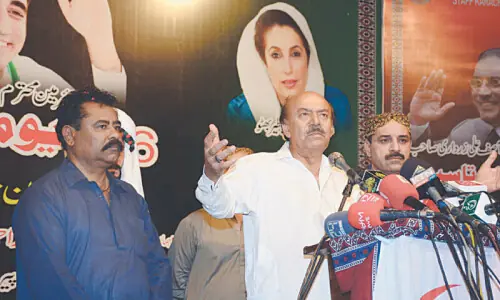
KARACHI, April 3: Speakers at a public hearing on Tuesday rejected the proposed construction of an elevated expressway starting from M.T. Khan Road and continuing along Sharea Faisal before ending at Quaidabad, saying it was an expensive and inefficient response to the city’s traffic problems.
The project will not only cause enormous social and environmental hazards during and after construction, but will also hamper the view of houses, hotels, offices and commercial buildings behind its huge structure. At some sections beneath the expressway it is likely that some tunnel like structure will also emerge.
The public hearing pertaining to environmental impact assessment (EIA) for construction of a 25-km long Karachi Elevated Expressway (KEE) over Sharea Faisal and M.T. Khan Road was conducted by Director General of Sindh Environmental Protection Agency (Sepa). The participants included engineers, architects, conservationists, professionals, community leaders and representatives of entrepreneurs and utilities and other services. However, there was no one from the CDGK to face the reviewers or respond to queries about feasibility, concept, financial and land acquisition issues relevant to the project which is likely to cost around Rs60 billion and, according to EIA documents, be recovered from citizens.
In his conclusive remarks, however, Secretary of the Environment and Energy Department of the Sindh government, Mir Hussain Ali, said SEPA should send the unanswered questions and relevant observations to the CDGK. If needed, Sepa can arrange further meetings of stakeholders and CDGK authorities to address citizens’ concerns. He said Sepa’s NOC for the proposed elevated expressway should be based on merit and in the interest of Karachi.
The KEE consultants on environmental and socio economic issues said the prime
objective was to enhance the road capacity of the corridor in question (Jiinah Bridge-Sharea Faisal-Jinnah terminal-Quaidabad) and facilitate safe, secure, speedy and environmental friendly travel from Karachi Port to the airport, Port Qasim, Steel Mills, National Highways.
At one stage it was said that precise record of the utilities along the corridor was not available with CDGK, but during the reconnaissance surveys along Sharea Faisal, 744 electric poles, 915 light poles, 1,112 manholes, 179 telephone poles, 216 traffic signal poles and six traffic signal control box were observed and some portion of those were likely to be affected, while about 1,000 small to medium trees would have to be removed.
They maintained that KEE project envisaged acquisition of about 60,000 square meters of land from various quarters belonging to public and private sectors and services as well. A practical traffic diversion plan will be developed later to ensure minimum inconvenience to users of Sharea Faisal during construction, an official of the consulting firm told a questioner.
The nature of an elevated carriageway on Shahrea Faisal and operation of KEE system may have impact on aesthetics of the environment, which will be mitigated through careful planning, suitable landscaping and adopting appropriate measures, besides providing a monitoring and contingency plan, the consultants said.
Opponents of the KEE project claimed the proponent had no idea about any meaningful and cost effective solutions of traffic problems and they had decided to go for an elevated expressway at a time when some countries had started razing the same in view of environmental and socio related problems.
They suggested the government go for effective traffic management, try mass transit options, including overhead trains, introduction of CNG buses, reformation of police etc. They suggested to the KEE the proposed alignment over Sharea Faisal should not be undertaken at all as from common man point of view, it was unnecessary and not feasible.
One speaker said the planned elevated road will pass through the heart of Karachi’s thriving commercial, business and tourist districts. The expressway will obscure the facades of almost all the buildings that it will cross. As alternatives to KEE over Sharea Faisal, it was also suggested that a mass friendly elevated corridor be constructed along Mai-Kolachi, Khyaban-e-Saadi, Sunset Boulevard, Korangi Road.
Some other citizens said that the proposed KEE had no concept or vision behind it and was sure to badly hit one of the best roads in the city, while the EIA report was just a rubber stamp to what the CDGK had proposed.
A couple of participants maintained that government should not go for such a commercial venture at the cost of citizens’ peace, health, security, environment, hotel and tourism business, historical buildings and heritages, cemetery and utilities. The CDGK team of consultant responded that the EIA report was not a sort of rubber stamp and it had addressed all the relevant components and aspects and ensured improved environment and development. The KEE will save time and ensure safe movement of heavy vehicles from KPT on Sharea Faisal, without disrupting traffic flow in the city, besides bringing in foreign investment.