0
0

KARACHI, April 2: The proposed construction and commissioning of a 25-kilometre elevated expressway over M.T. Khan Road and Sharea Faisal from Jinnah Bridge to Quaidabad Intersection by the city government may entail a host of socio-economic, environmental and vegetation-depletion problems.
According to a CDGK report submitted to the Sindh Environmental Protection Agency (Sepa), the benefits offered by the rapid transit system, however, would outweigh the problems which are going to be of temporary nature or not so significant.
On the other hand, concerned citizens and professionals question the validity of the proposal, saying that the expressway along business strip Sharea Faisal, having a toll tax of Rs25 to Rs40 per trip for about 20 years, will prove beneficial either to the VIPs or the industrialists and warehouse affiliates moving to or from the Karachi Port Trust or the Port Qasim.
They say that much had been done to ease the operation of vehicular traffic in the shape of projects like Lyari Expressway and Northern Bypass and as such an economic and mass-friendly elevated corridor would be more suggestive along Mai-Kolachi, Khyaban-i-Saadi, Sunset Boulevard, Korangi Road.
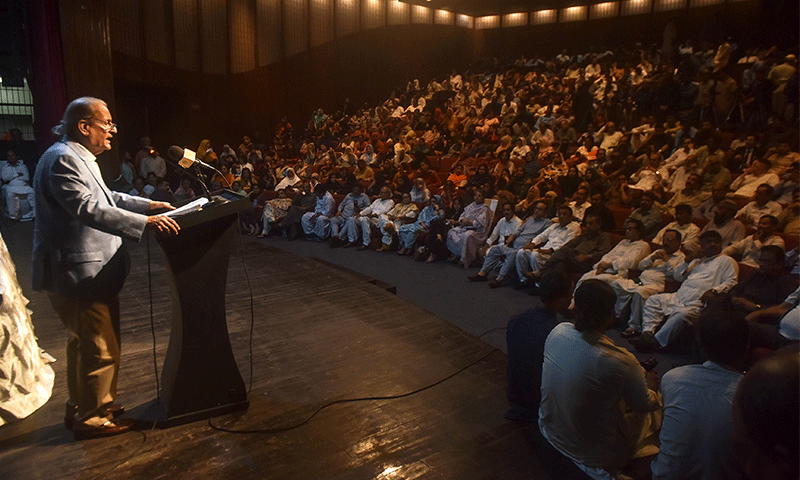
The Sepa is all set to conduct a public hearing of environmental impact assessment pertaining to ‘Karachi Elevated Expressway’ (KEE) on April 3 at it’s headquarters in Korangi, near Chamra Chowrangi, at 10am.
The city government maintains that the project in question is first of its kind in the country and will bring a direct investment of $350 million to it. President Pervez Musharraf performed the ground-breaking of the project, planned to be constructed on annuity basis in three years, on February 9 at a ceremony held at the Sindh Governor’s House.
On its invitation the Sepa has received six to eight sets of comments from NGOs, individuals and utility organisations, which would be considered as part of the EIA proceedings, said a source in the environmental agency.
A summary of the project prepared on behalf of the city government said that the edge of the elevated carriageway would flank at just about the edge of the footpath at each section of the elevated corridor, while landscape would be undertaken at the narrow sections and sensitive areas.
The project at its sitting or initiation stage will have socioeconomic impact at few locations due to disruption of commercial activities. The site preparation activities will include excavation, pilling, earth and fill movement, concrete foundations and columns, transportation of construction machinery, accessories and associated equipment to the site, placement of aerial span structures, construction of elevated bridges and toll plazas, the report mentions.
However, as it was said further, such activities did not cause extensive soil erosion but some fugitive dust emissions which would be controlled through appropriate measures.
Operation of vehicular traffic on the elevated expressway will be under optimized conditions and it will be responsible for small volumes of gases, which will disperse at the heights of the expressway. The diesel and other petroleum products used for the operation of construction machinery and equipment will cause air pollution besides causing soil pollution through oil spill, but impact of those will be of minor significance and will also be controlled by good housekeeping practices.
While admitting that noise emissions from the operation on the KEE will be high in the microenvironments, it was said in the report that noise level would be contained by adopting adequate measures in the form of suitable landscaping with acoustic tiles at sensitive locations such as schools and hospitals would also be taken to minimize the impact.
The report confirms the vegetation depletion, reduction of sunlight, visual impact on historical buildings and cultural heritage, including the Quad-i-Azam House. The project also emphasizes for acquisition of land from Pearl Continental Hotel, Karachi Gymkhana, Metropole Hotel, Qasr-i-Naz and State Guest House, Regent Plaza, Sea Breeze Plaza, Navy Residential Area and Aisha Bawany School, FTC, area near HIR Interchange along CSD Shop from the Karsaz area, Central Store Depot near Drigh Road Station, and strip of land near Nargis Cinema for redefining of the ROW.
The dual two-lane KEE will ramp up and down between Quaidabad Interchange and the EPZ intersection on National Highway (N5). This as well as the other five entry and exist ramps will need land acquisitions as well, the report said.
In the meantime, an NGO Shehri, commented that the identities, qualifications and experiences of the technical consultants in the fields of transportation and traffic planning had not been mentioned in the report.
Air pollution will increase below the expressway deck and adversely affect the health of area residents and visitors, especially in sections where high-rise structures adjoin the KEE on both the sides; Shehri noted and said that noise pollution, especially at night, will affect the residents of buildings at the deck level of the expressway and would exceed internationally approved levels.
The four-lane KEE has no emergency lanes or shoulders for vehicles. The traffic diversion plan during the three years of construction is not clear, while Karachi will exist in madness during this time, especially during VVIP movement, the NGO further stated. It was also said that that the projected costs of project apparently did not include the acquisition payments for 15 acres of lands and as such there was a likelihood that the cost of the project would increase up to $500 million.
The Institute of Architects Pakistan is of the view that the KEE is a project conceived in isolation by the city government, devoid of any practical or technical justification.