0
0

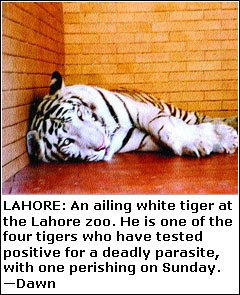 LAHORE, March 18: A tiger cub died at the Lahore Zoo on Sunday due to the “attack of a deadly parasite and tuberculosis.”
Sources in the wildlife department said the parasite, theleria babesia, had also hit three other tigers at the zoo.
With Sunday’s death, the number of tigers perishing at the zoo in less than a year has risen to four. Earlier, in last summer, three tigers had died due to the attack of trypanosome, another deadly parasite.
The body of the one-year-old cub was taken to the Veterinary Research Institute on Ghazi Road on Sunday morning for an autopsy to determine the exact cause of the death.
Sources said the TB attack was so severe that an abscess had developed in cub’s mouth. There was a big hollow hole in his neck.
Though the autopsy findings were yet to come, sources said the initial examination suggested that the TB and parasite were the main causes of the death.
Zoo tigers blood samples were taken on March 8 and four of them (including the one that died on Sunday) had tested positive for theleria Babesia. Among the other affected beasts are a white tiger (seven years old), a brown tigress (eight) and a cub (the brother the cub who died on Sunday). The ailing cub has stopped eating.
Sources said the zoo lions and tigers had become prone to attack of different diseases mainly due to frequent inter-breeding. “The zoo administration is well aware of the fact but it has done nothing so far,” sources said.
Wildlife experts say that to avoid the outbreak of bacterial or viral diseases among the zoo big cats, there is a need to import more pairs of lions, leopards and tigers.
Wildlife officials had announced a few months ago that they would buy a pair of lions, leopards and tigers each to keep them with animals who had become weak due to inter-breeding.
The inter-breeding issue was first raised in a meeting of the Zoo Management Committee in October last where experts had stressed the need to import more lions, leopards and tigers.
Speaking about the lack of veterinary care at the zoo, sources said the Punjab wildlife Department had no vet on its panel. There was one vet in the Lahore Zoo, Dr Saleem Nasir, but he was working as a deputy director and not as a full-fledged vet.
To meet the demand of full-time veterinarians to treat sick animals and deal with occasional outbreaks of bacterial and viral diseases, the department has been planning to create new posts in Punjab as no vet is presently working in the wildlife department. There are five vacancies of vets in Loie Bhair Wildlife Park, Rawalpindi, Jallo Wildlife Park, Lahore, Wildlife Park, Gutwala, Faisalabad and Lahore Zoo.
Sources said the department had received five nominations from the Punjab Public Service Commission but none joined.
Sources meanwhile said that TB affecting tigers was threatening not only for other zoo inmates but for visitors also.
The zoo otherwise has become messy. Digging and incomplete construction work has made it home to mosquitoes, ticks and flies.
Confirming the death of the cub, Lahore Zoo director Yousaf Pal said that other affected tigers were healthy now after treatment.
Deputy director Saleem Nasir, who took the dead cub to the veterinary institute, said the animal had developed an abscess on lungs besides being affected by the blood disease. He said ticks, mosquitoes, flies and insanitation were major sources of the blood parasite.